


The Central Epidemic Command Center (CECC) yesterday said it would release another 10,000 doses of the AstraZeneca COVID-19 vaccine for self-pay vaccinations.
Centers for Disease Control (CDC) Deputy Director-General Chuang Jen-hsiang (莊人祥), who is the CECC’s spokesman, said that 7,165 people had received a self-pay vaccine shot as of Monday.
Self-pay vaccinations were made available on Wednesday last week for people who are planning to travel abroad for business, work, study or medical treatment, and 10,000 doses were initially released.
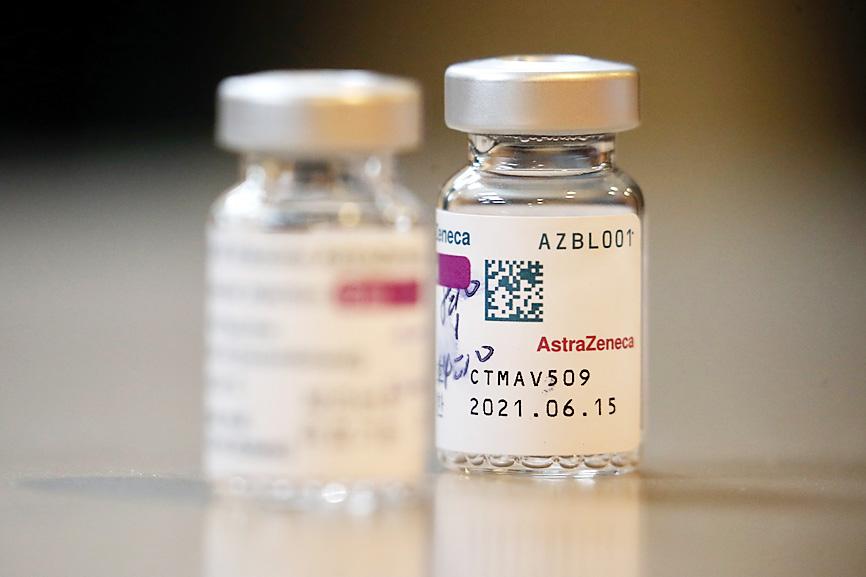
Photo: Ritchie B. Tongo, EPA-EFE
Chuang said those doses are likely to be used up in a couple of days, while another 7,909 people have made appointments with hospitals to get vaccinated between yesterday and Saturday.
Following Chuang’s remarks, Minister of Health and Welfare Chen Shih-chung (陳時中), who heads the CECC, announced that the center would release another 10,000 doses of the vaccine for self-pay vaccinations.
Based on the number of government-funded shots administered on Monday, it appears that a spate of infections among China Airlines pilots has not boosted people’s willingness to get vaccinated, so there are sufficient doses to be released for self-pay shots, Chen said.
The center would also discuss whether to increase the number of locations where self-pay shots are administered.
Chuang said that 2,509 people received a vaccine shot on Monday, adding to a total of 45,387 people who have received the first shot of the AstraZeneca vaccine in Taiwan.
Separately yesterday, Taipei Mayor Ko Wen-je (柯文哲) said that getting vaccinated is still the best solution, given the number of confirmed cases worldwide continue to increase by more than 800,000 per day.
“However, until today, we have no information on when the vaccines will arrive and the related time schedule,” Ko said.
Different vaccines need to be stored at different temperatures, so local governments need time to prepare in advance, because it would be impossible to be ready if the central government suddenly announced a new policy, he added.
More than 1 billion people have been vaccinated globally, but Taiwan is still taking a defensive approach by practicing preventive measures and not implementing a universal vaccination plan, Ko said, adding that he is concerned that an outbreak could still occur in the long term if the nation only uses preventive measures.
Asked about Ko’s remarks, Chen said the center only knows how many doses of vaccines Taiwan has purchased, but it does not know the import schedule.
Giving an example, he said the COVAX global distribution platform had originally informed the CECC that it would start sending vaccines from late February, but later postponed the schedule and sent the first batch this month. The center remains in touch with the platform and is awaiting to find out when the next batch would arrive.

More than half of the bamboo vipers captured in Tainan in the past few years were found in the city’s Sinhua District (新化), while other districts had smaller catches or none at all. Every year, Tainan captures about 6,000 snakes which have made their way into people’s homes. Of the six major venomous snakes in Taiwan, the cobra, the many-banded krait, the brown-spotted pit viper and the bamboo viper are the most frequently captured. The high concentration of bamboo vipers captured in Sinhua District is puzzling. Tainan Agriculture Bureau Forestry and Nature Conservation Division head Chu Chien-ming (朱健明) earlier this week said that the
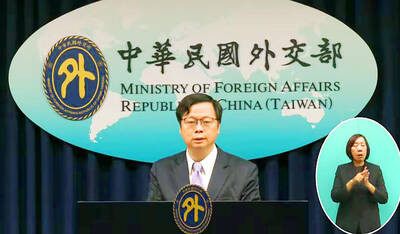
NAMING SPAT: The foreign ministry called on Denmark to propose an acceptable solution to the erroneous nationality used for Taiwanese on residence permits Taiwan has revoked some privileges for Danish diplomatic staff over a Danish permit that lists “Taiwan” as “China,” Eric Huang (黃鈞耀), head of the Ministry of Foreign Affairs’ Department of European Affairs, told a news conference in Taipei yesterday. Reporters asked Huang whether the Danish government had responded to the ministry’s request that it correct the nationality on Danish residence permits of Taiwanese, which has been listed as “China” since 2024. Taiwan’s representative office in Denmark continues to communicate with the Danish government, and the ministry has revoked some privileges previously granted to Danish representatives in Taiwan and would continue to review
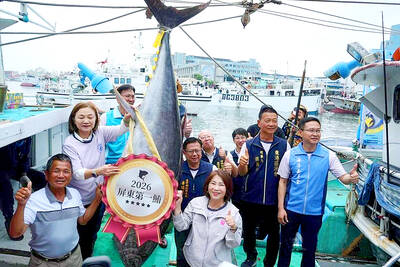
The first bluefin tuna of the season, brought to shore in Pingtung County and weighing 190kg, was yesterday auctioned for NT$10,600 (US$333.5) per kilogram, setting a record high for the local market. The auction was held at the fish market in Donggang Fishing Harbor, where the Siaoliouciou Island-registered fishing vessel Fu Yu Ching No. 2 delivered the “Pingtung First Tuna” it had caught for bidding. Bidding was intense, and the tuna was ultimately jointly purchased by a local restaurant and a local company for NT$10,600 per kilogram — NT$300 ,more than last year — for a total of NT$2.014 million. The 67-year-old skipper
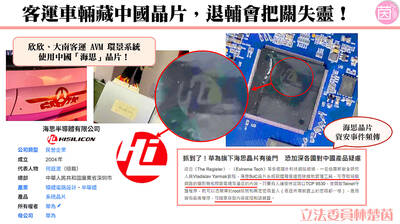
BREACH OF CONTRACT: The bus operators would seek compensation and have demanded that the manufacturer replace the chips with ones that meet regulations Two bus operators found to be using buses with China-made chips are to demand that the original manufacturers replace the systems and provide compensation for breach of contract, the Veterans Affairs Council said yesterday. Democratic Progressive Party Legislator Michelle Lin (林楚茵) yesterday said that Da Nan Bus Co and Shin-Shin Bus Co Ltd have fielded a total of 82 buses that are using Chinese chips. The bus models were made by Tron-E, while the systems provider was CYE Electronics, Lin said. Lin alleged that the buses were using chips manufactured by Huawei subsidiary HiSilicon Co, which presents a national security risk if the


 RSS
RSS