


Paraguayan President Mario Abdo Benitez on Tuesday said that the country would not accept any kind of blackmail or diplomatic conditions in exchange for COVID-19 vaccine purchases.
Abdo Benitez’s remarks followed media reports over the past month that the South American nation might switch diplomatic recognition from Taiwan to China, as it was desperate to obtain vaccines due to surging COVID-19 cases.
Paraguay is one of Taiwan’s 15 diplomatic allies and the only one in South America. Speculation was rife that it could switch sides, especially after Guyana in February backed out of its agreement with Taiwan over the establishment of a Taiwanese representative office.
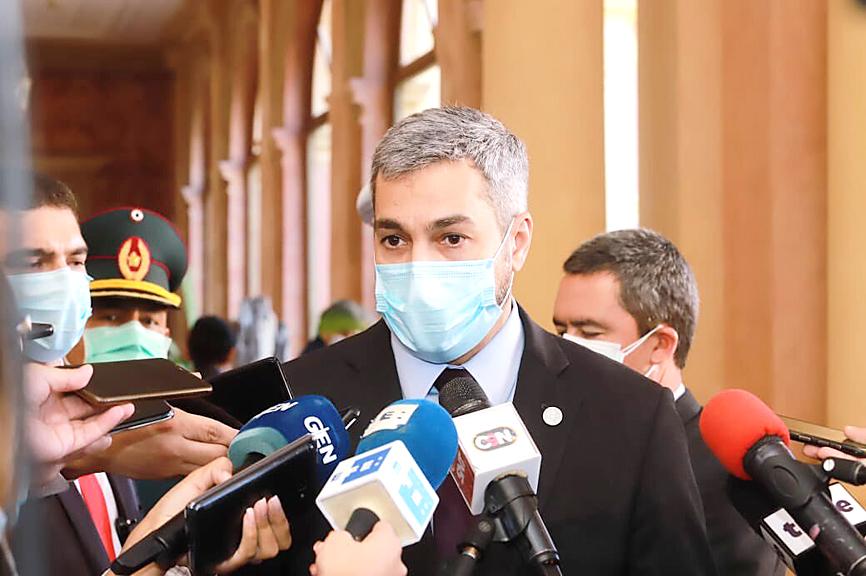
Photo: Screen grab from Twitter
After the Ministry of Foreign Affairs in Taipei reaffirmed ties with Asuncion and pledged to continue helping it obtain vaccines by engaging other friends, Abdo Benitez said in a statement that his government was open to all possibilities to buy more vaccines.
However, “these negotiations must take place within the framework of respect for independence and diplomatic freedom,” he added.
“We have no problem buying from anywhere. Now, we are not going to accept any kind of blackmail for vaccine purchases. We ask and we are open to have direct dealings with factories in China, without any type of conditions regarding diplomatic relations,” he said.
Paraguay has signed a contract with the Indian company Bharat Biotech for the purchase of 2 million doses of vaccines, and expects to receive another 100,000 donated by India next week, he said.
“I am optimistic about the quantities of vaccines that we are going to receive. I believe that by the end of the year or by the middle of the year, Paraguay will have a good volume of vaccines and we will advance with the vaccination process,” he said.
As of Tuesday, the South American nation had 250,165 confirmed cases of COVID-19, with 5,313 deaths, while as of Thursday last week, a total of 74,340 doses of COVID-19 vaccines have been administered, WHO data showed.
The foreign ministry said it was glad to see the Paraguayan government continue to receive COVID-19 vaccines under the joint efforts of various parties.
Access to vaccines is a public health, as well as a humanitarian, issue, which is pertinent to people’s life and should not become a tool for political maneuvering, ministry spokeswoman Joanne Ou (歐江安) said in a statement.
It is not only the Paraguayan government that rejects any type of blackmail to acquire vaccines, the Taiwanese government is also firmly opposed to any vaccine supply that involves certain conditions and is aimed at damaging Taiwan-Paraguay ties, Ou said.
The government will continue to engage like-minded partners to defend democracy and freedom, and help Paraguay combat the COVID-19 pandemic, she said.

SPACE VETERAN: Kjell N. Lindgren, who helps lead NASA’s human spaceflight missions, has been on two expeditions on the ISS and has spent 311 days in space Taiwan-born US astronaut Kjell N. Lindgren is to visit Taiwan to promote technological partnerships through one of the programs organized by the US for its 250th national anniversary. Lindgren would be in Taiwan from Tuesday to Saturday next week as part of the US Bureau of Educational and Cultural Affairs’ US Speaker Program, organized to celebrate the 250th anniversary of the signing of the Declaration of Independence, the American Institute in Taiwan (AIT) said in a statement yesterday. Lindgren plans to engage with key leaders across the nation “to advance cutting-edge technological partnerships and inspire the next generation of scientists and engineers,”

UNREASONABLE SURVEILLANCE: A camera targeted on an road by a neighbor captured a man’s habitual unsignaled turn into home, netting him dozens of tickets The Taichung High Administrative Court has canceled all 45 tickets given to a man for failing to use a turn signal while driving, as it considered long-term surveillance of his privacy more problematic than the traffic violations. The man, surnamed Tseng (曾), lives in Changhua County and was reported 45 times within a month for failing to signal while driving when he turned into the alley where his residence is. The reports were filed by his neighbor, who set up security cameras that constantly monitored not only the alley but also the door and yard of Tseng’s house. The surveillance occurred from July

A Japan Self-Defense Forces vessel entered the Taiwan Strait yesterday, Japanese media reported. After passing through the Taiwan Strait, the Ikazuchi was to proceed to the South China Sea to take part in a joint military exercise with the US and the Philippines, the reports said. Japan Self-Defense Force vessels were first reported to have passed through the strait in September, 2024, with two further transits taking place in February and June last year, the Asahi Shimbun reported. Yesterday’s transit also marked the first time since Japanese Prime Minister Sanae Takaichi took office that a Japanese warship has been sent through the Taiwan
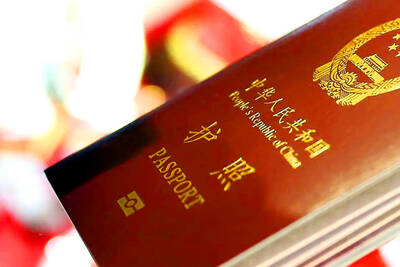
ANOTHER OPTION: The 13-year-old, whose residency status was revoked for holding a Chinese passport, could still apply for residency on humanitarian grounds, the government said The Executive Yuan has rejected an appeal from a 13-year-old Chinese student surnamed Lu (陸), whose permanent residency was revoked after immigration officers discovered he held a Chinese passport. Lu in December 2023 applied to settle in Taiwan to be with his mother, surnamed Lin (林), who is a Taiwan resident, an appeal decision released this month by the Executive Yuan showed. Lin settled in Taiwan after marrying a Taiwanese man in 2003, but the two divorced in 2011, and after marrying a Chinese man, she had Lu, the Executive Yuan’s appeals committee said. Lu’s application was approved in December 2024, and in


 RSS
RSS