


Typhoon Surigae is to bring rain to the nation’s east coast and mountainous areas in central and southern Taiwan from Wednesday to Friday, the Central Weather Bureau (CWB) said yesterday.
As of 2pm yesterday, the typhoon’s center was 1,170km southeast of Oluanpi (鵝鑾鼻), Taiwan’s southernmost tip. The radius of the storm was 280km, and it was moving northwest at 9kph, with a maximum wind speed of 198kph.
The bureau forecasts that the storm would switch to a northerly direction when approaching the east coast of Luzon Island in the Philippines on Wednesday, CWB forecaster Lin Ding-yi (林定宜) said, adding that Surigae would then move northeast along the Bashi Channel.
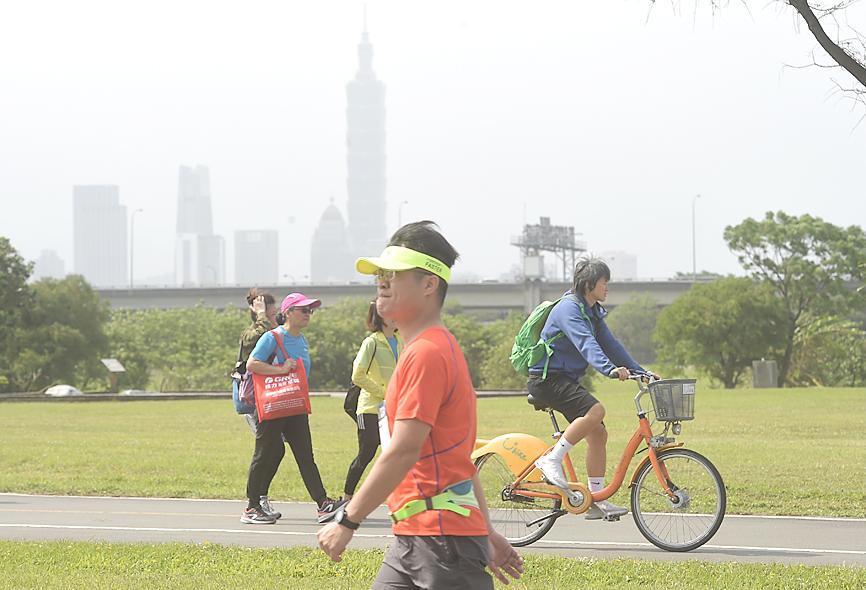
Photo: Chien Jung-fong, Taipei Times
Chances of temporary showers would be high in Yilan, Hualien and Taitung counties, as well as in the mountainous areas of central and southern Taiwan, he said.
Surigae was to maintain its strength yesterday and today, Lin said, adding that similarly strong typhoons in April occurred in 1997, 2003 and 2015.
Typhoons usually occur from July to September, the bureau said.
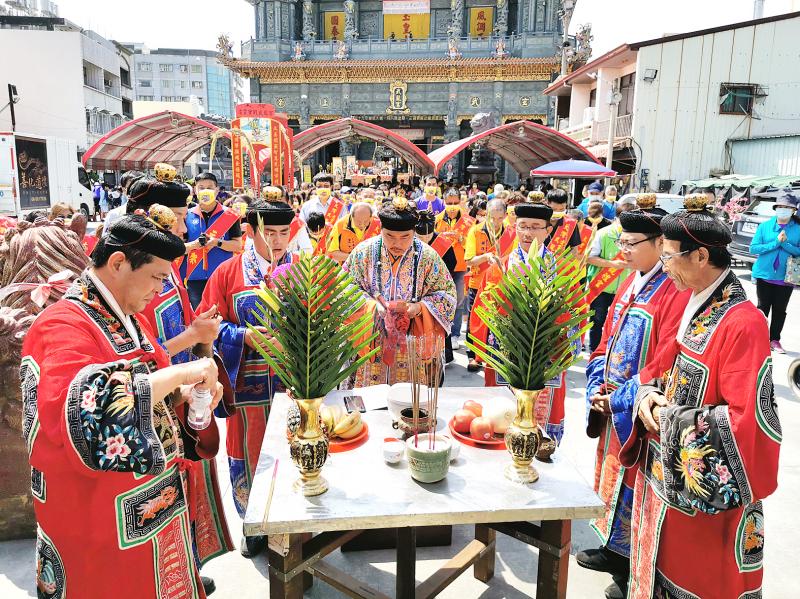
Photo: Wu Chun-feng, Taipei Times
Residents on the northern, eastern and southern coasts as well as those in Penghu and Kinmen counties should be prepared for swells, Lin said.
Peng Chi-ming (彭啟明), chief executive of WeatherRisk Explore Inc, yesterday wrote on Facebook that Surigae was at the peak of its strength, with lightning frequently occurring at its eye and convection at its circumfluence.
If it made landfall at this strength, it might cause a major disaster, he said.
However, it was a good sign that convective heat transfer in mountainous areas began to occur yesterday afternoon, Peng said.
“Convective heat transfer usually occurs on the west coast in April, but this year, it did not occur until yesterday,” he said.
Thermal instability in the mountains of southern Taiwan were influenced by the typhoon, he added.
CWB Director-General Cheng Ming-dean (鄭明典) said that Surigae has a double eyewall, which is generally a feature of strong typhoons, indicating that the storm might grow further before reaching Luzon.
However, Surigae would gradually weaken once it is moving away from Luzon, Cheng said, citing conditions unfavorable for the typhoon.
WeatherRisk analyst Wu Sheng-yu (吳聖宇) wrote on Facebook that Surigae would likely remain east of the Philippines for at least three to four days, and then accelerate its northward motion.
“When the westerly trough abates, Surigae could also bring rain from southeast China. This might be the best opportunity we have for rain since the beginning of this month. If rain does not occur this time, we might have to wait for next month,” Wu said.
Meanwhile, poor air quality was early yesterday recorded in the outlying island counties of Kinmen and Penghu, and parts of western Taiwan due to pollutants from China and stagnant winds, the Environmental Protection Administration said.
At 9am, 20 air monitoring stations in areas north of Hsinchu County and in Penghu and Kinmen detected generally unhealthy air quality at the “red alert” level, the agency said.
Additional reporting by CNA

UPGRADE: The Kang Ding-class frigate is replacing its Chaparall missiles with Tien Chien II and Hua Yang VLS, which would provide it with long-range, 360° air defense Taiwan plans to produce 1,200 to 1,376 Hai Chien II missiles (海劍二, Sea Sword II) — also known as TC-2N — to serve as the standard air defense system of the navy’s surface combatant fleet, a source said yesterday. Last week, the Hai Chien II, the naval version of the Tien Kung II missile (天劍二, Sky Sword II), completed a live-fire test in waters off the National Chungshan Institute of Science and Technology’s Jiupeng facility (九鵬) in Pingtung County’s Manjhou Township (滿州). The MIM72 Chaparral and other dated air defense missiles that currently arm Taiwanese ships have inadequate range to combat Chinese

REASONS FOR TRAVEL: An assistant professor said that proposed amendments to penalize drivers if they used drugs overseas would not deter people from traveling People who operate a motor vehicle under the influence of marijuana would have their driver’s license revoked, even if they used the substance while overseas, the Ministry of Transportation and Communications said yesterday, citing proposed amendments to the Road Traffic Management and Penalty Act (道路交通管理處罰條例). The amendments would also authorize the government to revoke the licenses of people determined to have used Category 1 or Category 2 narcotics, even if they were not operating a vehicle while under the influence of drugs, as well as ban them from taking the license test for three years, the ministry said. People aged 18 or

Shih Hsin University President Chen Ching-he (陳清河) yesterday issued a public apology for comments made in his commencement speech last week, stating that he has asked the school to suspend his duties and halt his wages for two months as a show of contrition. At the commencement ceremony on May 30, Chen said, “If you don’t manage your time well, or your own emotions, or your health, then I am telling every one of you — put a quick end to ‘you,’ because the world has no need for ‘you.’” The comments have sparked significant controversy online, and Chen through an open
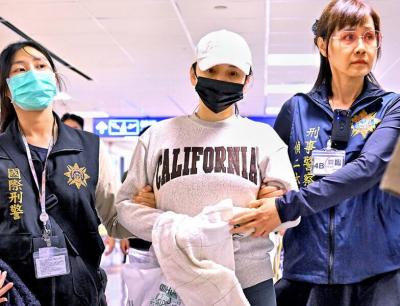
Johanne Liou (劉喬安), a Taiwanese woman who shot to unwanted fame during the Sunflower movement protests in 2014, returned to Taiwan last night after being deported from the US. She is to stand trial in Taiwan for charges involving embezzlement, fraud and drug crimes. The Criminal Investigation Bureau (CIB) said it took her into custody at Taiwan Taoyuan International Airport and would first question her before transferring her to the New Taipei District Prosecutors’ Office. She was arrested upon disembarking a flight from San Francisco that landed shortly before 7pm. Liou absconded to the US in 2019 after jumping bail


 RSS
RSS