


The Central Epidemic Command Center (CECC) is considering relaxing self-health management requirements for Taiwanese tourists returning from Palau after disappointing tour sales threaten the “travel bubble” agreement between the two countries.
The CECC made the remarks yesterday after the six travel agencies designated to arrange tours to Palau reported lackluster sales following the pilot tours on April 1, which were joined by 100 tourists.
Since the launch, the average load factor for flights to and from Palau was about 26 percent, China Airlines (CAL) said.
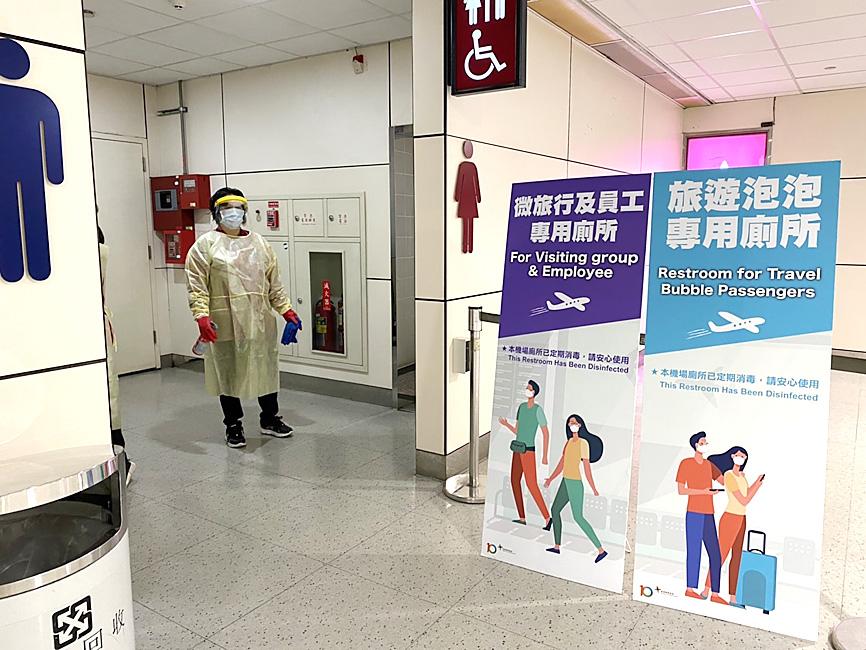
Photo: Hsiao Yu-hsin, Taipei Times
Travel operators have been urging the CECC to loosen the 14-day self-health management requirement for visitors returning from Palau, which they said is a major reason why people are reluctant to visit the country, which has zero COVID-19 cases.
Tourists are subject to a stricter version of self-health management in the first five days after returning to Taiwan, which bans them from going to crowded places and taking public transportation. Afterward, they are required to observe general self-health management guidelines for another nine days.
“We are leaning toward relaxing the self-health management requirement in the first five days following their return to the country by requiring them to abide by general self-health management guidelines during the five-day period,” Centers for Disease Control Deputy Director-General Chuang Jen-hsiang (莊人祥), who is also the CECC’s spokesman, said at a daily briefing, adding that the CECC has yet to approve the proposal.
While the CECC might relax the self-health management requirement, Chuang said that visitors must still take a polymerase chain reaction (PCR) test on the fifth day of their return from Palau.
Three of the six designated travel agencies have said they might pull out of the program, as the tours have failed to attract large numbers of travelers, local Chinese-language media reported.
They only agreed to stay after CAL canceled the rule requiring travel agencies to make a NT$10,000 deposit in advance for each seat assigned to them on the charter flight, the reports added.
CAL said it has voluntarily lowered the fare to Palau to attract visitors, in addition to canceling the deposit requirement.
“We will continue to work with travel agents to promote tours to Palau in the hope of maximizing the benefits brought by the ‘travel bubble’ agreement,” it said.
On Thursday, the Palauan government said it would lift a cap that limits flight and hotel occupancy to 70 percent, and waive the NT$500 service fee for the Traveler Verification Center.
Tourists visiting attractions such as the Jellyfish Lake would receive a US$25 subsidy per person, it said.

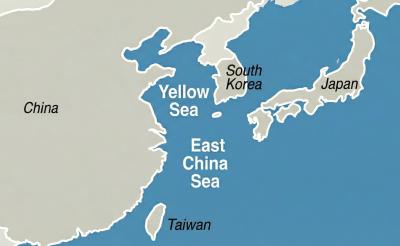
China has reserved offshore airspace in the Yellow Sea and East China Sea from March 27 to May 6, issuing alerts usually used to warn of military exercises, although no such exercises have been announced, the Wall Street Journal (WSJ) reported yesterday. Reserving such a large area for 40 days without explanation is an “unusual step,” as military exercises normally only last a few days, the paper said. These alerts, known as Notice to Air Missions (Notams), “are intended to inform pilots and aviation authorities of temporary airspace hazards or restrictions,” the article said. The airspace reserved in the alert is
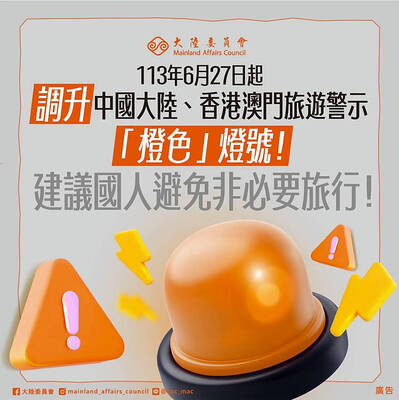
More than 6,000 Taiwanese students have participated in exchange programs in China over the past two years, despite the Mainland Affairs Council’s (MAC) “orange light” travel advisory, government records showed. The MAC’s publicly available registry showed that Taiwanese college and university students who went on exchange programs across the Strait numbered 3,592 and 2,966 people respectively. The National Immigration Agency data revealed that 2,296 and 2,551 Chinese students visited Taiwan for study in the same two years. A review of the Web sites of publicly-run universities and colleges showed that Taiwanese higher education institutions continued to recruit students for Chinese educational programs without
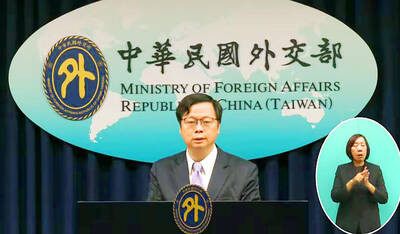
NAMING SPAT: The foreign ministry called on Denmark to propose an acceptable solution to the erroneous nationality used for Taiwanese on residence permits Taiwan has revoked some privileges for Danish diplomatic staff over a Danish permit that lists “Taiwan” as “China,” Eric Huang (黃鈞耀), head of the Ministry of Foreign Affairs’ Department of European Affairs, told a news conference in Taipei yesterday. Reporters asked Huang whether the Danish government had responded to the ministry’s request that it correct the nationality on Danish residence permits of Taiwanese, which has been listed as “China” since 2024. Taiwan’s representative office in Denmark continues to communicate with the Danish government, and the ministry has revoked some privileges previously granted to Danish representatives in Taiwan and would continue to review

A bipartisan group of US senators has introduced a bill to enhance cooperation with Taiwan on drone development and to reduce reliance on supply chains linked to China. The proposed Blue Skies for Taiwan Act of 2026 was introduced by Republican US senators Ted Cruz and John Curtis, and Democratic US senators Jeff Merkley and Andy Kim. The legislation seeks to ease constraints on Taiwan-US cooperation in uncrewed aerial systems (UAS), including dependence on China-sourced components, limited access to capital and regulatory barriers under US export controls, a news release issued by Cruz on Wednesday said. The bill would establish a "Blue UAS


 RSS
RSS