


While the second tropical storm of the year could form to the south of Guam this week, it has little chance of affecting Taiwan and would not alleviate the water shortage in central and southern Taiwan, meteorologists said.
The Central Weather Bureau on Sunday forecast that Tropical Storm Surigae could form as soon as tomorrow.
A tropical storm in the northwest Pacific could ease the water shortage.
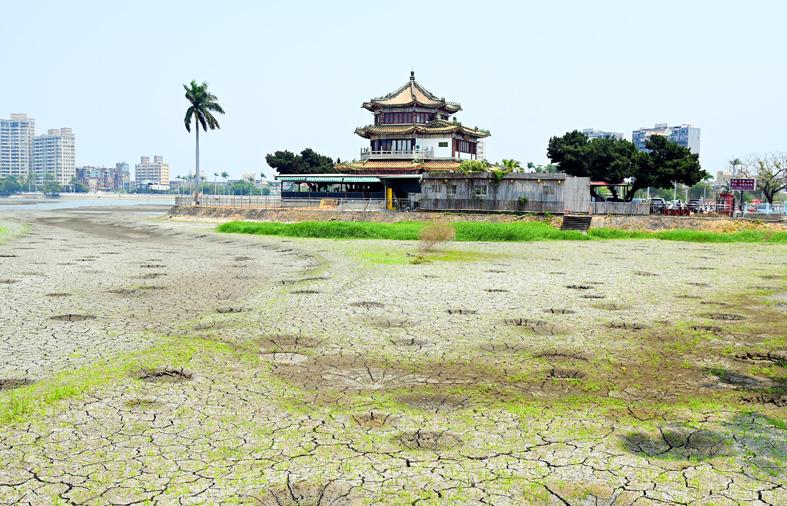
Photo: Chang Chia-yi, Taipei Times
Residents of Taichung as well as Hsinchu, Miaoli and Changhua counties have been under a water rationing system since Tuesday last week.
A simulation run by the US National Weather Service’s Global Forecast System has shown that Surigae would first move to the west of Guam before slowly turning north and northeast, former bureau Weather Forecast Center director Daniel Wu (吳德榮) wrote in his online column yesterday.
Wu is now an adjunct associate professor of atmospheric sciences at National Central University.
However, simulations run by the European Center for Medium-Range Weather Forecasts showed that the storm would probably not form until Thursday and would start turning north as it comes close to the east coast of the Philippines, he said.
Both agencies projected Surigae to follow one of the most typical paths for tropical storms or typhoons that form in April, which is to make a wide turn near the east coast of Taiwan, Wu said.
“The storm would not threaten Taiwan, nor is there the possibility that it would relieve the water shortage facing the country,” he added.
Peng Chi-ming (彭啟明), chief executive of WeatherRisk Explore Inc, said that the storm has a low chance of coming close to Taiwan, as there is a weak Pacific high-pressure system.
“Because of the northeast monsoon and cold high-pressure systems in the north, storms that form this month do not survive by the time they are near Taiwan. However, they strengthen the northeast monsoon, which prevents the arrival of spring rain fronts and formations of afternoon thundershower cells,” Peng said, adding that this would not help relieve the water shortage.
“I am afraid we are looking at a relatively drier atmosphere from now until mid-May. While rain fronts might still come from time to time during this period, they would at best bring isolated showers to the northern and northeastern regions,” he added.

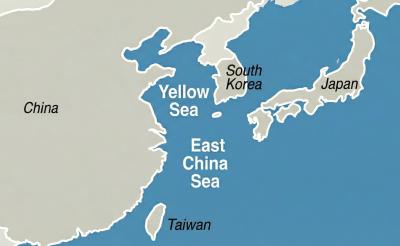
China has reserved offshore airspace in the Yellow Sea and East China Sea from March 27 to May 6, issuing alerts usually used to warn of military exercises, although no such exercises have been announced, the Wall Street Journal (WSJ) reported yesterday. Reserving such a large area for 40 days without explanation is an “unusual step,” as military exercises normally only last a few days, the paper said. These alerts, known as Notice to Air Missions (Notams), “are intended to inform pilots and aviation authorities of temporary airspace hazards or restrictions,” the article said. The airspace reserved in the alert is
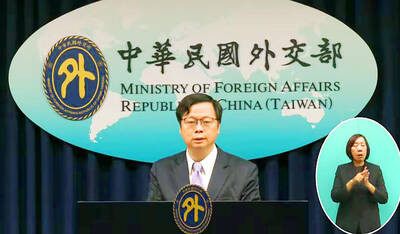
NAMING SPAT: The foreign ministry called on Denmark to propose an acceptable solution to the erroneous nationality used for Taiwanese on residence permits Taiwan has revoked some privileges for Danish diplomatic staff over a Danish permit that lists “Taiwan” as “China,” Eric Huang (黃鈞耀), head of the Ministry of Foreign Affairs’ Department of European Affairs, told a news conference in Taipei yesterday. Reporters asked Huang whether the Danish government had responded to the ministry’s request that it correct the nationality on Danish residence permits of Taiwanese, which has been listed as “China” since 2024. Taiwan’s representative office in Denmark continues to communicate with the Danish government, and the ministry has revoked some privileges previously granted to Danish representatives in Taiwan and would continue to review

More than 6,000 Taiwanese students have participated in exchange programs in China over the past two years, despite the Mainland Affairs Council’s (MAC) “orange light” travel advisory, government records showed. The MAC’s publicly available registry showed that Taiwanese college and university students who went on exchange programs across the Strait numbered 3,592 and 2,966 people respectively. The National Immigration Agency data revealed that 2,296 and 2,551 Chinese students visited Taiwan for study in the same two years. A review of the Web sites of publicly-run universities and colleges showed that Taiwanese higher education institutions continued to recruit students for Chinese educational programs without

A bipartisan group of US senators has introduced a bill to enhance cooperation with Taiwan on drone development and to reduce reliance on supply chains linked to China. The proposed Blue Skies for Taiwan Act of 2026 was introduced by Republican US senators Ted Cruz and John Curtis, and Democratic US senators Jeff Merkley and Andy Kim. The legislation seeks to ease constraints on Taiwan-US cooperation in uncrewed aerial systems (UAS), including dependence on China-sourced components, limited access to capital and regulatory barriers under US export controls, a news release issued by Cruz on Wednesday said. The bill would establish a "Blue UAS


 RSS
RSS