


The Taipei District Prosecutors’ Office on Wednesday charged media personality Dennis Peng (彭文正) with aggravated libel for accusing President Tsai Ing-wen (蔡英文) of having forged her academic credentials.
Prosecutors said that documents and other evidence prove that Tsai completed her doctoral dissertation, passed an oral examination and obtained her doctoral degree in law from the London School of Economics and Political Science (LSE) in 1984.
They charged Peng, formerly a journalism professor at National Taiwan University (NTU), for alleging in 2019 that Tsai’s academic credentials were fake.
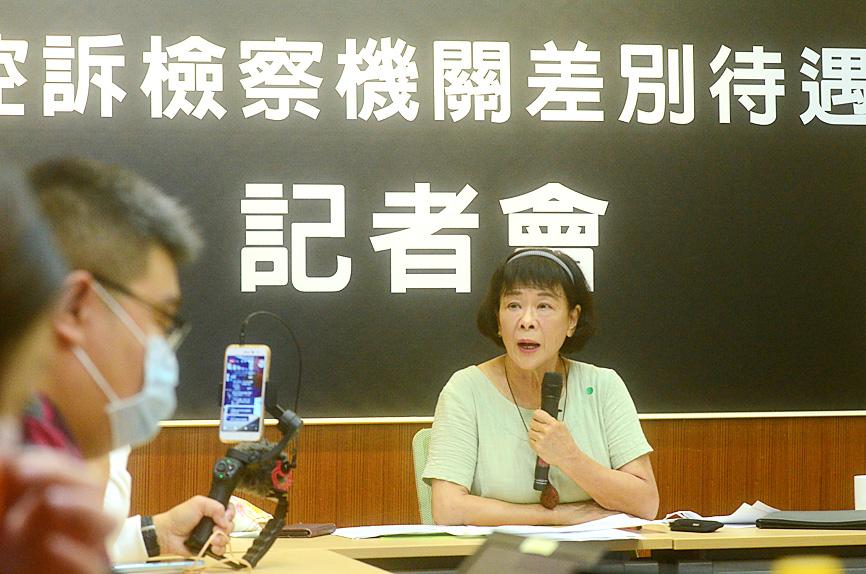
Photo: Wang Yi-sung, Taipei Times
Peng spread the rumors without researching the facts to increase the viewership of his online talk show “True Voice of Taiwan,” they said.
The indictment came after Tsai in September 2019 filed a lawsuit against Ho De-fen (賀德芬), a law professor emeritus at NTU; Hwan C. Lin (林環牆), an associate professor of economics at the University of North Carolina at Charlotte; and Peng after they said that her academic credentials were fake.
Ho and Lin had not been indicted because the two had double-checked their claims as best as they could before making the accusations, prosecutors said.
The office also did not find sufficient evidence indicating that the two academics had malicious intent, and wanted to denigrate Tsai and damage her reputation, it said.
Ho yesterday called a news conference in Taipei, urging prosecutors not to treat defendants differently.
“I am 100 percent — totally, absolutely, unreservedly — certain that Tsai did not write a doctoral dissertation, nor had an oral defense, or obtained a doctoral degree. Prosecutors, there is no need to go light on me,” she said.
Tsai’s academic credentials have been the subject of discussion in local media since Peng raised the issue in a Facebook post in June 2019, when Tsai was seeking re-election.
Following months of speculation about Tsai’s academic credentials, the LSE issued a formal statement in October confirming that Tsai “was correctly awarded a Ph.D. in Law in 1984.”

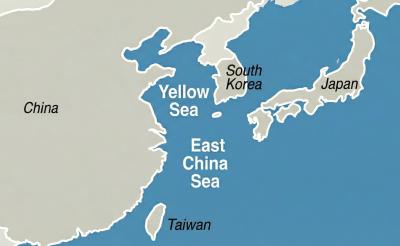
China has reserved offshore airspace in the Yellow Sea and East China Sea from March 27 to May 6, issuing alerts usually used to warn of military exercises, although no such exercises have been announced, the Wall Street Journal (WSJ) reported yesterday. Reserving such a large area for 40 days without explanation is an “unusual step,” as military exercises normally only last a few days, the paper said. These alerts, known as Notice to Air Missions (Notams), “are intended to inform pilots and aviation authorities of temporary airspace hazards or restrictions,” the article said. The airspace reserved in the alert is
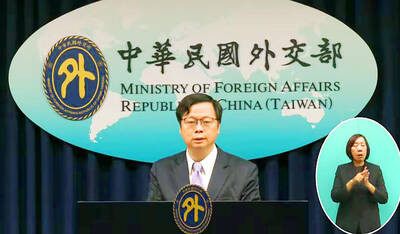
NAMING SPAT: The foreign ministry called on Denmark to propose an acceptable solution to the erroneous nationality used for Taiwanese on residence permits Taiwan has revoked some privileges for Danish diplomatic staff over a Danish permit that lists “Taiwan” as “China,” Eric Huang (黃鈞耀), head of the Ministry of Foreign Affairs’ Department of European Affairs, told a news conference in Taipei yesterday. Reporters asked Huang whether the Danish government had responded to the ministry’s request that it correct the nationality on Danish residence permits of Taiwanese, which has been listed as “China” since 2024. Taiwan’s representative office in Denmark continues to communicate with the Danish government, and the ministry has revoked some privileges previously granted to Danish representatives in Taiwan and would continue to review

More than 6,000 Taiwanese students have participated in exchange programs in China over the past two years, despite the Mainland Affairs Council’s (MAC) “orange light” travel advisory, government records showed. The MAC’s publicly available registry showed that Taiwanese college and university students who went on exchange programs across the Strait numbered 3,592 and 2,966 people respectively. The National Immigration Agency data revealed that 2,296 and 2,551 Chinese students visited Taiwan for study in the same two years. A review of the Web sites of publicly-run universities and colleges showed that Taiwanese higher education institutions continued to recruit students for Chinese educational programs without

A bipartisan group of US senators has introduced a bill to enhance cooperation with Taiwan on drone development and to reduce reliance on supply chains linked to China. The proposed Blue Skies for Taiwan Act of 2026 was introduced by Republican US senators Ted Cruz and John Curtis, and Democratic US senators Jeff Merkley and Andy Kim. The legislation seeks to ease constraints on Taiwan-US cooperation in uncrewed aerial systems (UAS), including dependence on China-sourced components, limited access to capital and regulatory barriers under US export controls, a news release issued by Cruz on Wednesday said. The bill would establish a "Blue UAS


 RSS
RSS