


Taiwan People’s Party (TPP) lawmakers yesterday blasted a plan by the Executive Yuan to spend NT$12.8 billion (US$448.6 million) on a children’s plaza, saying the money could be put to better use on education, social and labor reforms to improve children’s quality of life.
TPP caucus convener Chiu Chen-yuan (邱臣遠) and TPP deputy caucus convener Ann Kao (高虹安) made the call at a news conference in Taipei ahead of Children’s Day on Sunday.
Premier Su Tseng-chang (蘇貞昌) on Saturday last week unveiled a plan to build a children’s plaza in New Taipei City’s Banciao District (板橋), where he said children could learn about technology and culture through play.

Photo: Peter Lo, Taipei Times
Citing a study by the Child Welfare League Foundation, Chiu said that Taiwanese children are less happy now than they were in 2017, and 20 percent of children said they do not feel happy in their daily lives.
The three main causes of unhappiness were classwork, fears about the COVID-19 pandemic, and not having time for leisure and recreation, he cited the study as saying.
Most Taiwanese children do not have time to play before 7pm and about 10 percent of the children said they did not have any time for themselves, Chiu said.
The foundation concluded that an unfriendly school environment and emotionally distant family members are to blame for the nation’s lack of progress in making children happy, he said.
The ministries of education, labor and the interior have to tackle these issues with coordinated policy initiatives, he said, adding: “Building a children’s plaza is not a solution.”
Kao said that the country needs to commit to the policy changes and resources that would improve children’s quality of life.
Playgrounds in parks and schools either do not have jungle gym equipment or have cookie-cutter pieces that are monotonous, unimaginative, and contain unsafe wood splinters and lead residues, she said.
The Ministry of Education has allocated NT$2.7 billion to build inclusive and individualized playgrounds in 2,813 schools, Kao said, adding that the ministry could have helped build 10,000 school playgrounds with NT$13 billion.
For example, the planned funding for the plaza could be used to improve special education with more teachers, smaller class sizes and cheaper textbooks, she said.
The TPP caucus also issued a news release urging the government to make more efficient use of the budget by focusing on welfare priorities that are more urgent, more inclusive and would benefit more children.

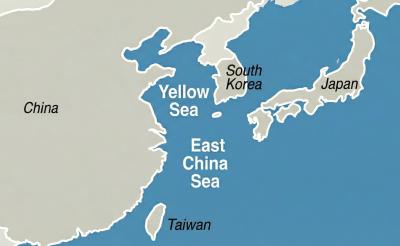
China has reserved offshore airspace in the Yellow Sea and East China Sea from March 27 to May 6, issuing alerts usually used to warn of military exercises, although no such exercises have been announced, the Wall Street Journal (WSJ) reported yesterday. Reserving such a large area for 40 days without explanation is an “unusual step,” as military exercises normally only last a few days, the paper said. These alerts, known as Notice to Air Missions (Notams), “are intended to inform pilots and aviation authorities of temporary airspace hazards or restrictions,” the article said. The airspace reserved in the alert is
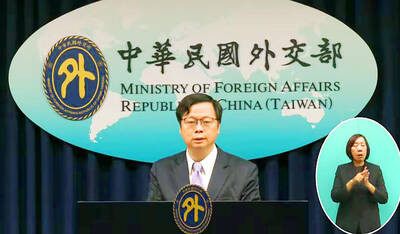
NAMING SPAT: The foreign ministry called on Denmark to propose an acceptable solution to the erroneous nationality used for Taiwanese on residence permits Taiwan has revoked some privileges for Danish diplomatic staff over a Danish permit that lists “Taiwan” as “China,” Eric Huang (黃鈞耀), head of the Ministry of Foreign Affairs’ Department of European Affairs, told a news conference in Taipei yesterday. Reporters asked Huang whether the Danish government had responded to the ministry’s request that it correct the nationality on Danish residence permits of Taiwanese, which has been listed as “China” since 2024. Taiwan’s representative office in Denmark continues to communicate with the Danish government, and the ministry has revoked some privileges previously granted to Danish representatives in Taiwan and would continue to review
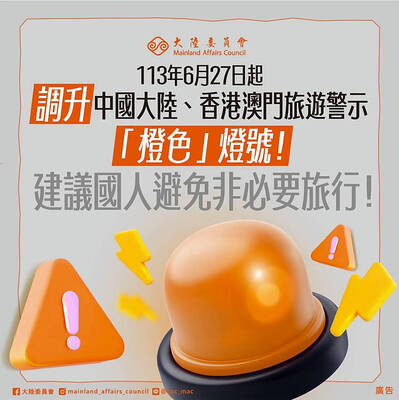
More than 6,000 Taiwanese students have participated in exchange programs in China over the past two years, despite the Mainland Affairs Council’s (MAC) “orange light” travel advisory, government records showed. The MAC’s publicly available registry showed that Taiwanese college and university students who went on exchange programs across the Strait numbered 3,592 and 2,966 people respectively. The National Immigration Agency data revealed that 2,296 and 2,551 Chinese students visited Taiwan for study in the same two years. A review of the Web sites of publicly-run universities and colleges showed that Taiwanese higher education institutions continued to recruit students for Chinese educational programs without

A bipartisan group of US senators has introduced a bill to enhance cooperation with Taiwan on drone development and to reduce reliance on supply chains linked to China. The proposed Blue Skies for Taiwan Act of 2026 was introduced by Republican US senators Ted Cruz and John Curtis, and Democratic US senators Jeff Merkley and Andy Kim. The legislation seeks to ease constraints on Taiwan-US cooperation in uncrewed aerial systems (UAS), including dependence on China-sourced components, limited access to capital and regulatory barriers under US export controls, a news release issued by Cruz on Wednesday said. The bill would establish a "Blue UAS


 RSS
RSS