


While retro shops selling nostalgic trinkets and snacks are a familiar sight in historic districts, the owner of one such store in Pingtung County has discovered an unexpected use for his collection — as a salve for dementia.
After retiring from a career at a foreign company, Liu Hsiao-tien (劉效典) returned to his native Chaojhou Township (潮州) to be with his elderly mother and open a store with his collection of more than 1,000 retro items.
As a child, Liu lived with his family in a Japanese-style house, where his father renovated old furniture and household items.
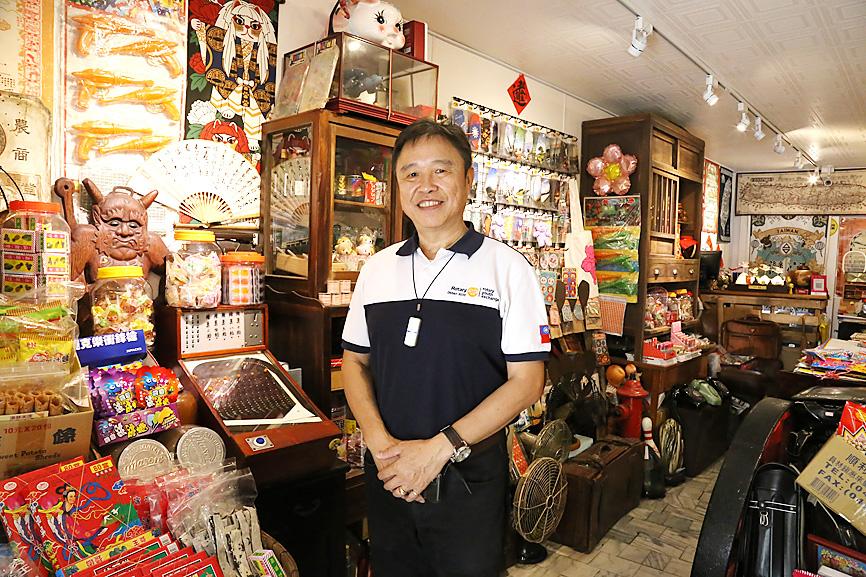
Photo: Chiu Chih-jou, Taipei Times
However, when the house was torn down, everything his father had collected went missing, including the toys he had saved from his school days.
Mourning the disappearance, Liu took it upon himself to remedy the loss.
For years, he used his free time to peruse flea markets for old snacks, toys, payphones, phonographs and whatever else he could find.
He even acquired a bicycle ridden by the owner of a popular ice dessert shop in Chaojhou, a piece of local history.
“I never thought my collection would become a remedy for my mother’s dementia,” Liu said.
His mother used to sell furniture at a shop on the central traffic circle in Chaojhou, but after she developed mild dementia, Liu returned to look after her.
Before long, he realized that she had particularly strong memories associated with childhood games, especially playing pachinko to win candy and “marble” soda drinks.
When in such an environment, Liu said that his mother felt especially at ease.
In his retirement, Liu is operating the antiques store from his mother’s old furniture shop and drawing upon his experience working abroad to help exchange students.
It was through conversations with students that he discovered the draw his collection has among foreigners, and he was even interviewed on a YouTube channel run by “Aiong,” an American who speaks Hoklo (commonly known as Taiwanese).
“Retro things not only arouse nostalgia among Taiwanese, but foreigners also like this kind of strong ‘Taiwanese flavor,’” Liu said, adding that through his collection, he hopes to share these recollections with even more people.

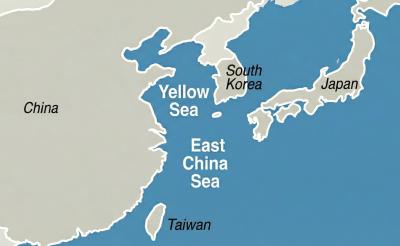
China has reserved offshore airspace in the Yellow Sea and East China Sea from March 27 to May 6, issuing alerts usually used to warn of military exercises, although no such exercises have been announced, the Wall Street Journal (WSJ) reported yesterday. Reserving such a large area for 40 days without explanation is an “unusual step,” as military exercises normally only last a few days, the paper said. These alerts, known as Notice to Air Missions (Notams), “are intended to inform pilots and aviation authorities of temporary airspace hazards or restrictions,” the article said. The airspace reserved in the alert is
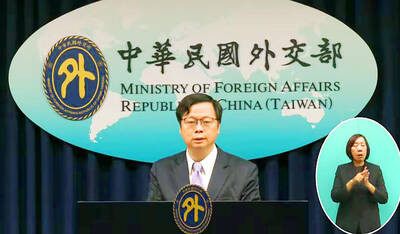
NAMING SPAT: The foreign ministry called on Denmark to propose an acceptable solution to the erroneous nationality used for Taiwanese on residence permits Taiwan has revoked some privileges for Danish diplomatic staff over a Danish permit that lists “Taiwan” as “China,” Eric Huang (黃鈞耀), head of the Ministry of Foreign Affairs’ Department of European Affairs, told a news conference in Taipei yesterday. Reporters asked Huang whether the Danish government had responded to the ministry’s request that it correct the nationality on Danish residence permits of Taiwanese, which has been listed as “China” since 2024. Taiwan’s representative office in Denmark continues to communicate with the Danish government, and the ministry has revoked some privileges previously granted to Danish representatives in Taiwan and would continue to review
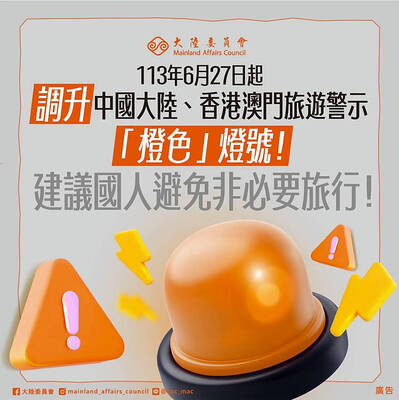
More than 6,000 Taiwanese students have participated in exchange programs in China over the past two years, despite the Mainland Affairs Council’s (MAC) “orange light” travel advisory, government records showed. The MAC’s publicly available registry showed that Taiwanese college and university students who went on exchange programs across the Strait numbered 3,592 and 2,966 people respectively. The National Immigration Agency data revealed that 2,296 and 2,551 Chinese students visited Taiwan for study in the same two years. A review of the Web sites of publicly-run universities and colleges showed that Taiwanese higher education institutions continued to recruit students for Chinese educational programs without

China has reserved offshore airspace over the Yellow Sea and East China Sea from March 27 to May 6, issuing alerts that are usually used to warn of military exercises, although no such exercises have been announced, the Wall Street Journal (WSJ) reported on Sunday. Reserving such a large area for 40 days without explanation is an “unusual step,” as military exercises normally only last a few days, the paper said. The alerts, known as notice to air missions (NOTAMs), “are intended to inform pilots and aviation authorities of temporary airspace hazards or restrictions,” the article said. The airspace reserved in the alert


 RSS
RSS