


After being shunned for decades because of a local superstition, the Great Buddha in Changhua County has begun attracting couples with the beautiful scenery atop the newly reinvigorated Baguashan (八卦山).
According to legend, couples who visit the massive Buddha sculpture are destined to separate, as the Taoist immortal and infamous playboy Lu Tung-pin (呂洞賓), who is known for dismantling romantic relationships, is also enshrined in the temple.
The superstition is strengthened by another legend that a couple died after hanging themselves from the statue, leading residents to either warn couples against visiting it or suggesting taking a partner there if they wish to break up.
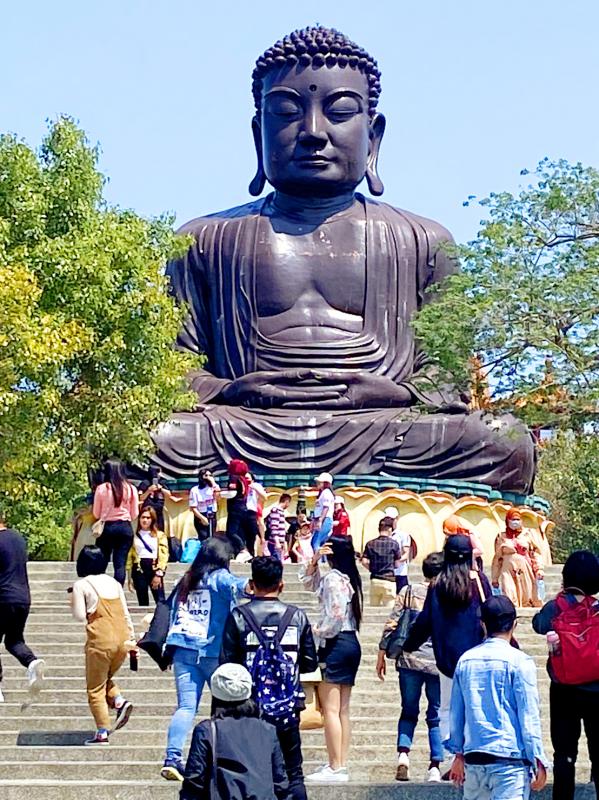
Photo: Chang Tsung-chiu, Taipei Times
However, over the past few years, the Changhua County Government has worked to reinvigorate its most famous tourist destination.
In collaboration with the Changhua City Government, it has organized Valentine’s Day and singles events at the plaza in front of the Buddha and enlivened its often-ridiculed market.
At the forefront of its newfound popularity is the new Guashan Village (卦山), which houses 20 shops featuring local artists, and hosts a variety of arts and crafts activities.
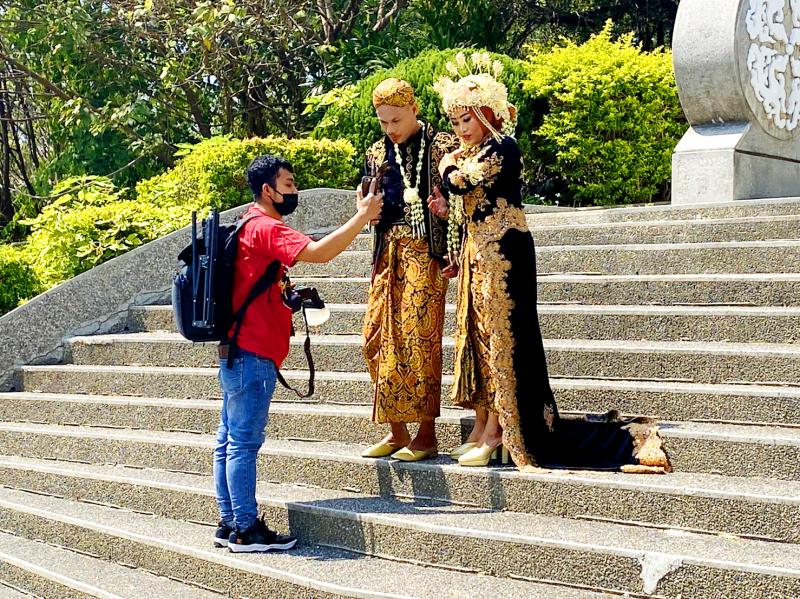
Photo: Chang Tsung-chiu, Taipei Times
The city government’s efforts have paid off with rising visitor numbers, transforming the staid attraction into a hot spot for young travelers — especially couples.
On White Day on Sunday, the mountain was packed with visitors enjoying the nice weather.
Among them was a couple wearing traditional Indonesian wedding attire, accompanied by friends and a photographer.
The newlyweds made their way from the archway near the visitors’ center to Nine Dragon Pond, stopping to take photos and receive good wishes from passersby, the Great Buddha omnipresent behind them.
A friend of the couple said that the two would often come with friends both before and after getting married.
To them, the Great Buddha represents Changhua, so they decided it would be the perfect spot to take wedding photos, they added.
The newlyweds said they had never heard of the legend, but would not believe it even if they had, as superstitions have no place in a rapidly advancing society.
“So many people come to take wedding photos,” Baguashan Great Buddha Scenic Association chairman Chang Shih-liang (張世良) said.
People are conflating the Taoist immortal Lu with the legends about him that flourished during the Song Dynasty, he said.
Lu was just a pleasure seeker, not a relationship destroyer, Chang said, adding: “Legends are not facts.”
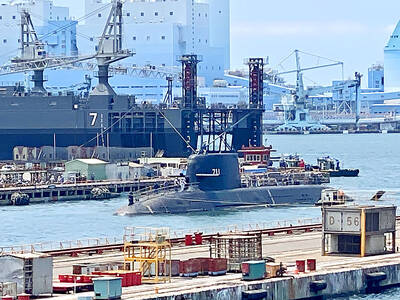
AGING: While Japan has 22 submarines, Taiwan only operates four, two of which were commissioned by the US in 1945 and 1946, and transferred to Taiwan in 1973 Taiwan would need at least 12 submarines to reach modern fleet capabilities, CSBC Corp, Taiwan chairman Chen Cheng-hung (陳政宏) said in an interview broadcast on Friday, citing a US assessment. CSBC is testing the nation’s first indigenous defense submarine, the Hai Kun (海鯤, Narwhal), which is scheduled to be delivered to the navy next month or in July. The Hai Kun has completed torpedo-firing tests and is scheduled to undergo overnight sea trials, Chen said on an SET TV military affairs program. Taiwan would require at least 12 submarines to establish a modern submarine force after assessing the nation’s operational environment and defense

Yangmingshan National Park authorities yesterday urged visitors to respect public spaces and obey the law after a couple was caught on a camera livestream having sex at the park’s Qingtiangang (擎天崗) earlier in the day. The Shilin Police Precinct in Taipei said it has identified a suspect and his vehicle registration number, and would summon him for questioning. The case would be handled in accordance with public indecency charges, it added. The couple entered the park at about 11pm on Thursday and began fooling around by 1am yesterday, the police said, adding that the two were unaware of the park’s all-day live
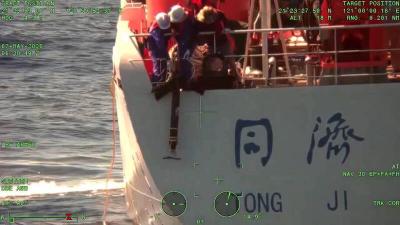
The coast guard today said that it had disrupted "illegal" operations by a Chinese research ship in waters close to the nation and driven it away, part of what Taipei sees a provocative pattern of China's stepped up maritime activities. The coast guard said that it on Thursday last week detected the Chinese ship Tongji (同濟號), which was commissioned only last year, 29 nautical miles (54km) southeast of the southern tip of Taiwan, although just outside restricted waters. The ship was observed lowering ropes into the water, suspected to be the deployment of scientific instruments for "illegal" survey operations, and the coast

A former soldier and an active-duty army officer were yesterday indicted for allegedly selling classified military training materials to a Chinese intelligence operative for a total of NT$79,440. The Taipei District Prosecutors’ Office indicted Chen Tai-yin (陳泰尹) and Lee Chun-ta (李俊達) for contravening the National Security Act (國家安全法) and the Anti-Corruption Act (貪污治罪條例). Chen left the military in September 2013 after serving alongside then-staff sergeant Lee, now an army lieutenant, at the 21st Artillery Command of the army’s Sixth Corps from 2011 to 2013, according to the indictment. Chen met a Chinese intelligence operative identified as “Wang” (王) through a friend in November


 RSS
RSS