


The government is giving people running online sports-betting commercials “a break from the law” rather than regulating them, Democratic Progressive Party Legislator Lin Chun-hsien (林俊憲) said yesterday, calling on the National Communications Commission (NCC) to push for passage of a draft digital communications act to hold online platform operators accountable for the content they air.
Lin made the remarks at a meeting of the legislature’s Transportation Committee, as he asked NCC Chairman Chen Yaw-shyang (陳耀祥) about the commission’s progress in drafting the act.
Although gambling is forbidden in Taiwan, online platforms such as YouTube are allowed to air commercials that encourage people to bet on sports games, Lin said.
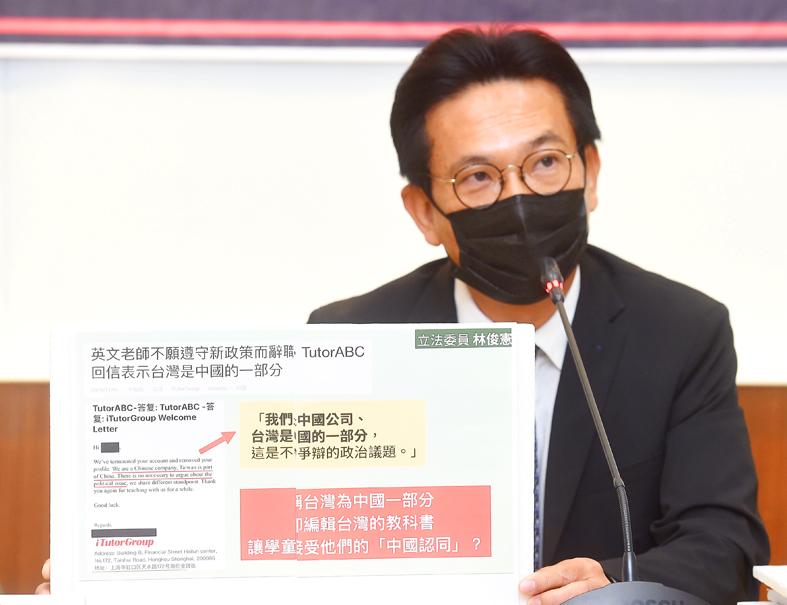
Photo: Chien Jung-fong, Taipei Times
“These commercials are designed to attract people to join sports-betting clubs. With actors driving a sports car or dumping a whole wad of cash on the table, the commercials are trying to convey the message that people who follow the club’s suggestion on betting targets would reap huge profits. This is like seducing people to gamble,” he said.
Such commercials have become a major source of consumer complaints, but the government has not done anything about it, he said.
Lin said he was told by the National Police Agency at the legislature on Tuesday that police can only intervene if the commercials clearly state that they are encouraging people to gamble or have caused them financial losses; otherwise, they are considered freedom of speech, not abetting a person to commit a crime.
The commission had drafted a digital communications act, which could have been used to deal with problematic content on online platforms, Lin said.
However, after securing preliminary approval at the committee in 2018, the draft act has been put on the back burner, as lawmakers said that the act should adhere to the principles of Internet governance and protect freedom of speech, he said.
Online platforms have a responsibility that comes with the freedom to air diverse content, Lin said.
While part of the commission’s work might be incorporated into a proposed Ministry of Digital Development, which the Executive Yuan is expected to establish soon, the commission should not use it as an excuse to delay drafting the digital communications act, he said.
Chen said that the commission aims to send the draft act to the Executive Yuan in June for deliberation at the Legislative Yuan in the next legislative session.
In other news, the commission confirmed that it had received two viewer complaints accusing SET News (三立新聞) of trying to downplay allegations of an extramarital affair involving Democratic Progressive Party Legislator Wang Ting-yu (王定宇) by not covering the news at all.
“We have sent an official letter to the news station and asked its ethics committee to review this matter,” Chen told the committee, adding that the news station is required to submit a report on the incident following its committee meeting.
Chinese Nationalist Party (KMT) Hung Mong-kai (洪孟楷) asked Chen if SET News chose not to cover Wang’s “affair” because he has good relations with the station’s senior management.
Chen said he had not heard of such an allegation.
The commission respects the freedom of the press, and the Satellite Broadcasting Act (衛星廣播電視法) does not stipulate penalties if news stations choose not to cover particular events, NCC Vice Chairman Wong Po-tsung (翁柏宗) said.
“However, a television news station has to undergo a performance evaluation every three years and apply for license renewal every six years. Its performance would come under scrutiny then,” Wong said.

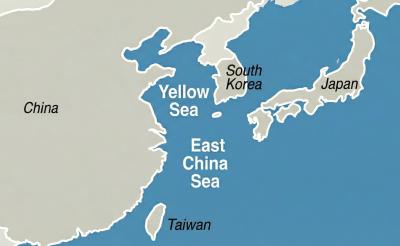
China has reserved offshore airspace in the Yellow Sea and East China Sea from March 27 to May 6, issuing alerts usually used to warn of military exercises, although no such exercises have been announced, the Wall Street Journal (WSJ) reported yesterday. Reserving such a large area for 40 days without explanation is an “unusual step,” as military exercises normally only last a few days, the paper said. These alerts, known as Notice to Air Missions (Notams), “are intended to inform pilots and aviation authorities of temporary airspace hazards or restrictions,” the article said. The airspace reserved in the alert is
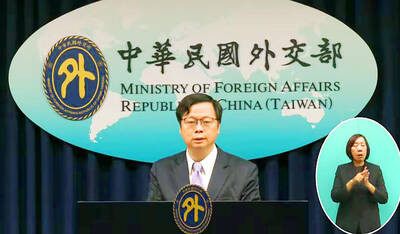
NAMING SPAT: The foreign ministry called on Denmark to propose an acceptable solution to the erroneous nationality used for Taiwanese on residence permits Taiwan has revoked some privileges for Danish diplomatic staff over a Danish permit that lists “Taiwan” as “China,” Eric Huang (黃鈞耀), head of the Ministry of Foreign Affairs’ Department of European Affairs, told a news conference in Taipei yesterday. Reporters asked Huang whether the Danish government had responded to the ministry’s request that it correct the nationality on Danish residence permits of Taiwanese, which has been listed as “China” since 2024. Taiwan’s representative office in Denmark continues to communicate with the Danish government, and the ministry has revoked some privileges previously granted to Danish representatives in Taiwan and would continue to review

More than 6,000 Taiwanese students have participated in exchange programs in China over the past two years, despite the Mainland Affairs Council’s (MAC) “orange light” travel advisory, government records showed. The MAC’s publicly available registry showed that Taiwanese college and university students who went on exchange programs across the Strait numbered 3,592 and 2,966 people respectively. The National Immigration Agency data revealed that 2,296 and 2,551 Chinese students visited Taiwan for study in the same two years. A review of the Web sites of publicly-run universities and colleges showed that Taiwanese higher education institutions continued to recruit students for Chinese educational programs without

China has reserved offshore airspace over the Yellow Sea and East China Sea from March 27 to May 6, issuing alerts that are usually used to warn of military exercises, although no such exercises have been announced, the Wall Street Journal (WSJ) reported on Sunday. Reserving such a large area for 40 days without explanation is an “unusual step,” as military exercises normally only last a few days, the paper said. The alerts, known as notice to air missions (NOTAMs), “are intended to inform pilots and aviation authorities of temporary airspace hazards or restrictions,” the article said. The airspace reserved in the alert


 RSS
RSS