


The Chinese Nationalist Party (KMT) yesterday accused Premier Su Tseng-chang (蘇貞昌) and Minister of the Interior Hsu Kuo-yung (徐國勇) of having double standards in their reactions to crime in Kaohsiung under the administrations of Kaohsiung Mayor Chen Chi-mai (陳其邁) and former Kaohsiung mayor Han Kuo-yu (韓國瑜).
Chen, of the Democratic Progressive Party, was elected mayor in a by-election on Aug. 15 last year after Han, of the KMT, was removed from office following a recall vote on June 6.
From January to last month, 17 major crimes occurred in the city, KMT Culture and Communications Committee director-general Alicia Wang (王育敏) told a news conference in Taipei.
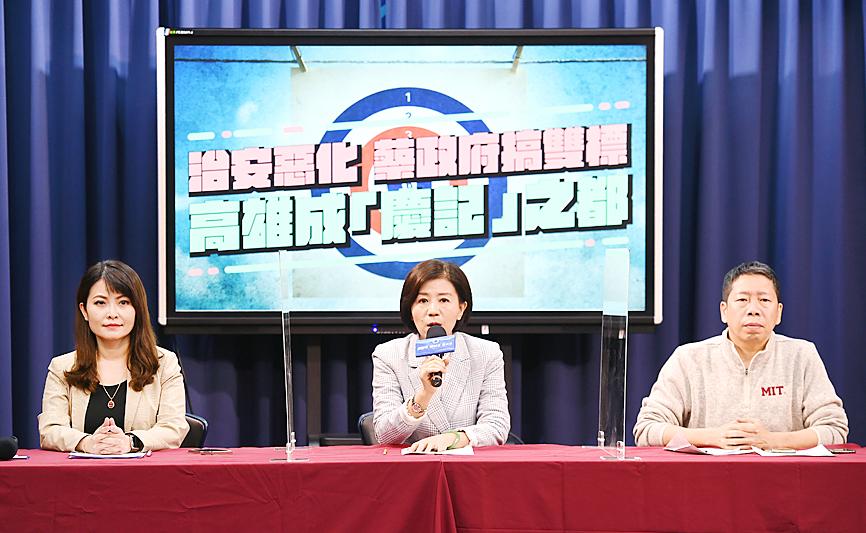
Photo: Liao Chen-huei, Taipei Times
In 2019, when Han was in office, Hsu and National Police Agency Director-General Chen Ja-chin (陳家欽) went to Kaohsiung out of concern about the crime rate in the city, she said.
Su told reporters at the time that it was “not inappropriate” for central government officials to visit local jurisdictions to offer assistance, Wang said.
With Chen Chi-mai now in office, there has been a huge change in Hsu’s and Su’s attitude, she said.
Hsu said he was in contact with local authorities by telephone, while Su said public satisfaction with public security and their confidence in the police had grown, and that “sudden public safety incidents, crimes of passion and revengeful killings are hard to avoid,” the KMT said in a statement.
The premier’s comments are designed to “protect Chen Chi-mai,” Wang said, calling his remarks “irresponsible” and “unfair to Kaohsiung residents.”
“Many residents are asking: ‘What happened to Kaohsiung?’” KMT Kaohsiung City Councilor Chen Mei-ya (陳美雅) said.
The mayor has not come up with a solution to the city’s deteriorating public security, she said, adding that the recent incidents have been “very damaging” to Kaohsiung’s image.
As long as illegal guns exist in Kaohsiung, its residents live in insecurity, KMT Kaohsiung City Councilor Huang Shao-ting (黃紹庭) said, urging the mayor and Kaohsiung Police Department Commissioner Huang Ming-chao (黃明昭) to formulate a strategy to improve public security immediately.
Asked when he would visit the south, Hsu yesterday told reporters that he often does without informing the press.
“We regret every public security incident,” Hsu said, adding that police would aim to do better.
Chen Chi-mai wrote on Facebook yesterday that “there is only one standard for public security, and that is to let residents [feel] at ease.”
The Kaohsiung City Government and Police Department are working together to “demonstrate their determination to combat violence and prevent major public security incidents,” he added.
Additional reporting by Chien Hui-ju and CNA

Considering that most countries issue more than five denominations of banknotes, the central bank has decided to redesign all five denominations, the bank said as it prepares for the first major overhaul of the banknotes in more than 24 years. Central bank Governor Yang Chin-lung (楊金龍) is expected to report to the Legislative Yuan today on the bank’s operations and the redesign’s progress. The bank in a report sent to the legislature ahead of today’s meeting said it had commissioned a survey on the public’s preferences. Survey results showed that NT$100 and NT$1,000 banknotes are the most commonly used, while NT$200 and NT$2,000

The Centers for Disease Control (CDC) yesterday reported the first case of a new COVID-19 subvariant — BA.3.2 — in a 10-year-old Singaporean girl who had a fever upon arrival in Taiwan and tested positive for the disease. The girl left Taiwan on March 20 and the case did not have a direct impact on the local community, it said. The WHO added the BA.3.2 strain to its list of Variants Under Monitoring in December last year, but this was the first imported case of the COVID-19 variant in Taiwan, CDC Deputy Director-General Lin Ming-cheng (林明誠) said. The girl arrived in Taiwan on

South Korea is planning to revise its controversial electronic arrival card, a step Taiwanese officials said prompted them to hold off on planned retaliatory measures, a South Korean media report said yesterday. A Yonhap News Agency report said that the South Korean Ministry of Foreign Affairs is planning to remove the “previous departure place” and “next destination” fields from its e-arrival card system. The plan, reached after interagency consultations, is under review and aims to simplify entry procedures and align the electronic form with the paper version, a South Korean ministry official said. The fields — which appeared only on the electronic form

The Ministry of Foreign Affairs (MOFA) is suspending retaliation measures against South Korea that were set to take effect tomorrow, after Seoul said it is updating its e-arrival system, MOFA said today. The measures were to be a new round of retaliation after Taiwan on March 1 changed South Korea's designation on government-issued alien resident certificates held by South Korean nationals to "South Korea” from the "Republic of Korea," the country’s official name. The move came after months of protests to Seoul over its listing of Taiwan as "China (Taiwan)" in dropdown menus on its new online immigration entry system. MOFA last week


 RSS
RSS