


The Ministry of Culture yesterday vowed to continue public dialogue as work on transforming the Chiang Kai-shek Memorial Hall in Taipei progresses.
Since 2017, the ministry has been engaged in discussions over the transformation of the site in Zhongzheng District (中正), it said in a statement.
That process has involved forming an expert advisory panel, building a Web site, curating exhibits and conducting a series of 12 “vision workshops” in the spirit of deliberative democracy, it said.
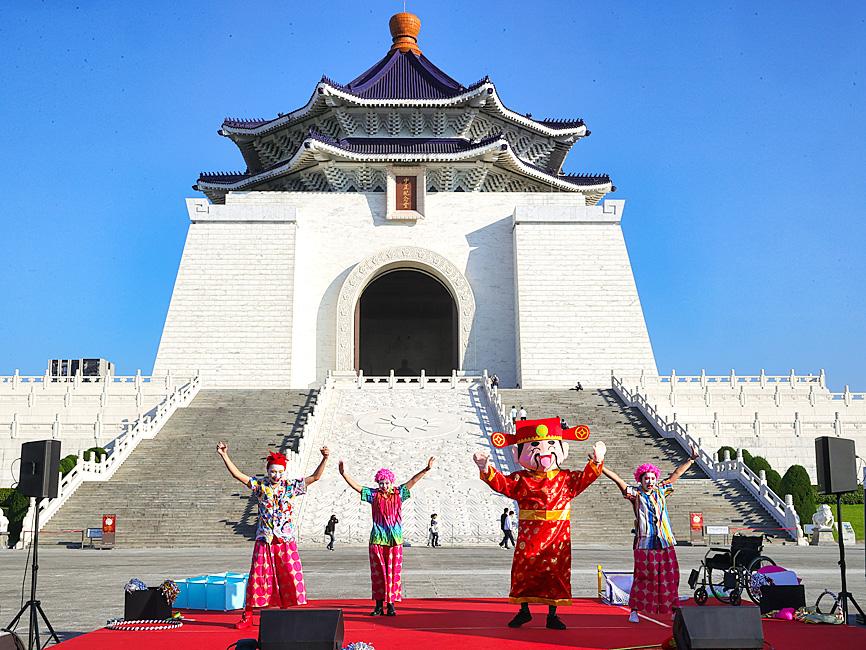
Photo: CNA
In that time, members of the public have made several recommendations on how the transformation should take place, the ministry said.
With those suggestions, the first phase of the transformation began last year, it said.
The ministry organized a permanent exhibition on human rights, titled Awakening Tide — The Call for Freedom on the Long Road to Democracy (覺醒浪潮 — 迢迢民主路上的自由呼聲), which opened on Nov. 14 last year, as well as other activities, including workshops, lectures and guided tours, it said.
This year, it is to revise the memorial’s leaflet, include perspectives on transitional justice and human rights in guided tours, and work with the Transitional Justice Commission to hold research activities on transitional justice, the ministry said.
It is to partner with New Taipei City’s National Human Rights Museum and the 228 Memorial Foundation to organize an exhibition of artwork created by political victims, and plan an exhibition of archives and historical materials, it said, adding that it hopes “to present the historical truth from an objective and diverse perspective.”
Regarding the honor guard stationed at the memorial, the ministry said that it and the commission would continue to communicate with the Ministry of National Defense and the public to determine what changes to their role would be made.
As the first phase progresses, it would continue to communicate with the public to build a consensus on plans for the second phase, it said.
Earlier yesterday, several groups, including the Northern Taiwan Society, held a news conference in Taipei urging the government to remove statues of Chiang Kai-shek (蔣介石) across the nation.
Additional reporting by Peng Wan-hsin

Considering that most countries issue more than five denominations of banknotes, the central bank has decided to redesign all five denominations, the bank said as it prepares for the first major overhaul of the banknotes in more than 24 years. Central bank Governor Yang Chin-lung (楊金龍) is expected to report to the Legislative Yuan today on the bank’s operations and the redesign’s progress. The bank in a report sent to the legislature ahead of today’s meeting said it had commissioned a survey on the public’s preferences. Survey results showed that NT$100 and NT$1,000 banknotes are the most commonly used, while NT$200 and NT$2,000

The Centers for Disease Control (CDC) yesterday reported the first case of a new COVID-19 subvariant — BA.3.2 — in a 10-year-old Singaporean girl who had a fever upon arrival in Taiwan and tested positive for the disease. The girl left Taiwan on March 20 and the case did not have a direct impact on the local community, it said. The WHO added the BA.3.2 strain to its list of Variants Under Monitoring in December last year, but this was the first imported case of the COVID-19 variant in Taiwan, CDC Deputy Director-General Lin Ming-cheng (林明誠) said. The girl arrived in Taiwan on

South Korea is planning to revise its controversial electronic arrival card, a step Taiwanese officials said prompted them to hold off on planned retaliatory measures, a South Korean media report said yesterday. A Yonhap News Agency report said that the South Korean Ministry of Foreign Affairs is planning to remove the “previous departure place” and “next destination” fields from its e-arrival card system. The plan, reached after interagency consultations, is under review and aims to simplify entry procedures and align the electronic form with the paper version, a South Korean ministry official said. The fields — which appeared only on the electronic form

The Ministry of Foreign Affairs (MOFA) is suspending retaliation measures against South Korea that were set to take effect tomorrow, after Seoul said it is updating its e-arrival system, MOFA said today. The measures were to be a new round of retaliation after Taiwan on March 1 changed South Korea's designation on government-issued alien resident certificates held by South Korean nationals to "South Korea” from the "Republic of Korea," the country’s official name. The move came after months of protests to Seoul over its listing of Taiwan as "China (Taiwan)" in dropdown menus on its new online immigration entry system. MOFA last week


 RSS
RSS