


National Central University (NCU) on Monday released a book telling the stories behind the naming of 40 asteroids discovered by its Lulin Observatory.
The book, titled The Story of Asteroids (小行星的故事), aims to draw attention to the nation’s spirit and values, the university said.
Built in 1992, the observatory in Nantou County is the highest in Taiwan. It has made hundreds of thousands of observations on more than 800 asteroids since discovering its first in 2002.
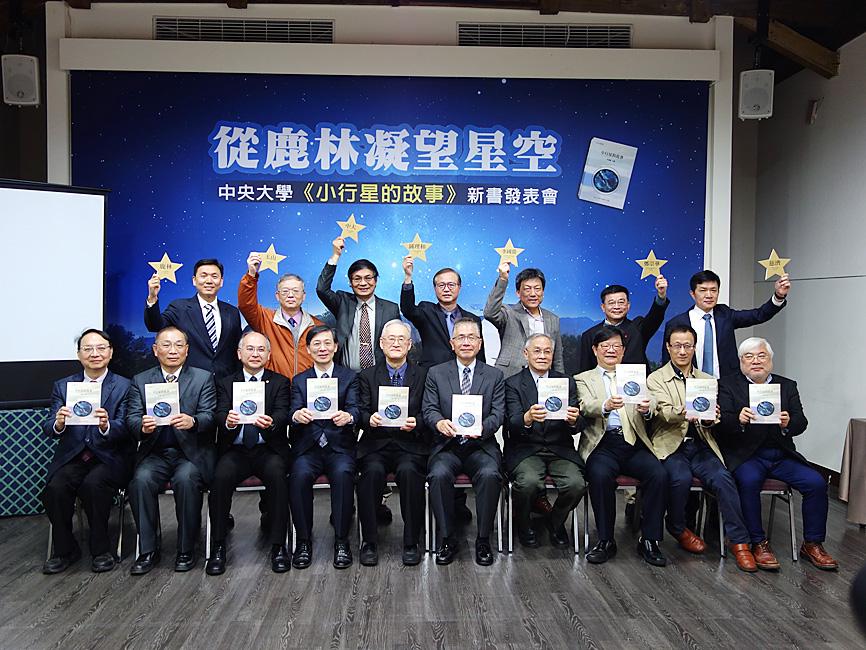
Photo: Wu Po-hsuan, Taipei Times
Researchers have officially named more than 100 of the objects after notable people and locations in Taiwan.
The university owes its international acclaim to more than 40 years of investment into the observatory, Academia Sinica academician Ip Wing-huen (葉永烜) said.
As there are no observatories in the Pacific Ocean from western Hawaii to Taiwan, many astronomers from around the world seek input from Lulin, he said.
The asteroids discovered by the observatory are valuable assets for Taiwan, as according to International Astronomical Union rules, asteroids may be named by those who discover them, Ip added.
Aside from using naming rights to commemorate Taiwanese figures and locations, Ip said that the observatory also plans to begin naming asteroids after important figures in Asia.
Lulin Observatory director Lin Hung-chin (林宏欽) said that the facility benefits from its favorable location.
From 2006 to 2009, numerous discoveries were made every day and sent for official recognition, Lin said.
NCU president Jou Jing-yang (周景揚) said that during the period, astronomers focused on the area between Saturn and Jupiter, where asteroids have an orbit of three to five years.
Of the more than 800 asteroids discovered at the observatory, more than 400 have been granted permanent identification after determining their precise orbits, he added.
The naming process can take from one to 10 years, Lin said, adding that all literature mentioning the celestial bodies would use those names.
While discovering asteroids is the purview of scientists, naming them has cultural implications, said Lee Jui-teng (李瑞騰), director of the Humanities Center at NCU.
The names highlight the value of Taiwan through locations such as Hehuanshan or Nantou, or people such as Delta Electronics founder Bruce Cheng (鄭崇華) or philanthropist Chen Shu-chu (陳樹菊), Lee said.
They also honor the literary talents of people such as lyricist Teng Yu-hsien (鄧雨賢) and Hakka novelist Chung Li-ho (鍾理和), as well as NCU academics Lo Chia-lun (羅家倫) and Tsai Wen-hsiang (蔡文祥), he added.
The university has even named an asteroid after South African activist and former Constitutional Court of South Africa judge Albie Sachs to honor the human rights champion, Lee added.
Before beginning the naming process, applicants must first prove an asteroid’s existence and plot its precise orbital path, Jou said.
The names cannot be related to business or politics, so they tend to reference the humanities, he said, adding that this shows the contributions the field has to offer.

FUKUOKA SITUATION: Japanese media reported that the pathogen is expected to be identified by the summer, while the CDC downplayed the idea that it was hMPV A “mysterious cold-like illness” reported in Japan’s Fukuoka Prefecture does not seem to be a new disease, but Japanese authorities have been asked about the situation, the Centers for Disease Control (CDC) said yesterday. The Fukuoka Prefectural Medical Association on Wednesday told a news conference that a “mystery cold” that has become a hot topic on social media is “highly likely to be caused by some kind of viral infection,” Japan’s KBC News reported. “Many people are experiencing symptoms starting with a sore throat, followed by a runny nose, phlegm and a severe cough,” KBC News reported, citing association officials. Health authorities are

Nvidia Corp CEO Jensen Huang (黃仁勳) arrived in Taiwan yesterday ahead of upcoming AI and technology events, saying he plans to meet with clients and Taiwan Semiconductor Manufacturing Co Chairman C.C. Wei (魏哲家) during his visit. After landing at Taipei Songshan Airport, Huang posed for photos with fans and handed out Yakult drinks to reporters and supporters waiting at the scene, saying he has “a lot to do” during the trip. Asked about reports that Nvidia’s planned headquarters site in Taipei’s Beitou Shilin Technology Park could break ground on May 27, Huang said that if the company holds an event, he would

The Ministry of Finance this afternoon announced the winning numbers for the March-April uniform invoice lottery. The winning number for the NT$10 million (US$318,060) special prize is 19531471, and the winning number for the NT$2 million grand prize is 85941329. Three numbers were drawn for the NT$200,000 first prize: 07225810, 20231230 and 83518781. Those with receipts matching the last seven digits of any of the first-prize numbers will win the NT$40,000 second prize, while those matching the last six digits will win the NT$10,000 third prize. Those whose receipts match the last five digits of the first-prize numbers can claim the NT$4,000 fourth prize,
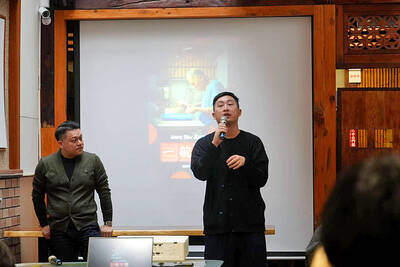
Taiwan Travelogue (臺灣漫遊錄), which earlier this week became the first Taiwanese novel to win the International Booker Prize, is to be adapted into a television series through a Taiwan-Japan coproduction, producer Chang Chen-yu (張辰漁) said yesterday. Chang, a producer at World Softest Production Film Co, wrote on Facebook that the company had been searching for projects with international appeal that retain a strong Taiwanese identity after colleagues and Japanese partners strongly recommended the novel. After reading the book, Chang said he immediately decided to pursue the screen rights. “A great story has the power to transcend time and borders, and connect countless people,”


 RSS
RSS