


The majority of Taiwanese, or 76.1 percent, are unwilling to receive COVID-19 vaccines developed by Chinese firms, while 61.6 percent said the government should not import Chinese vaccines, a survey released yesterday by the Association of Chinese Elite Leadership showed as the nation reported one new imported case of COVID-19.
According to the survey, 19 percent of respondents were willing to receive a Chinese vaccine and 24.9 percent were open to the idea of importing Chinese vaccines.
Of the respondents, 28.5 percent identified themselves as Democratic Progressive Party (DPP) supporters and 18.6 percent as Chinese Nationalist Party (KMT) supporters.
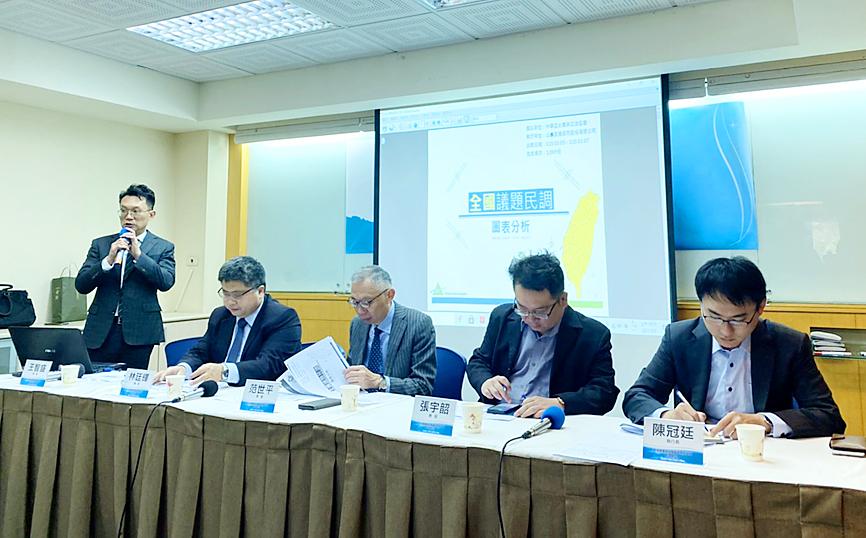
Photo: Chen Yu-fu, Taipei Times
Among those who identified themselves as KMT supporters, 42 percent were willing to receive Chinese-made vaccines.
However, the percentage fell to about 6 percent among the respondents who identified themselves as DPP supporters.
Minister of Health and Welfare Chen Shih-chung (陳時中) has said that Taiwan will not import COVID-19 vaccines from China, citing a lack of data on their efficacy and safety, as well as legal restrictions.
However, some KMT members, including former president Ma Ying-jeou (馬英九), have called on the DPP government to accept Chinese vaccinations.
The survey revealed that 76.1 percent of the respondents supported President Tsai Ing-wen’s (蔡英文) remark that Taiwan is willing to push for meaningful cross-strait dialogue on the basis of equal footing “as long as Beijing is willing to resolve antagonism.”
“Taiwan also hopes that once the COVID-19 pandemic is properly contained, people on both sides of the [Taiwan] Strait can resume normal exchanges,” Tsai said at a national security meeting last month.
Speaking at a news conference to reveal the survey results, Taiwan Society of International Law deputy secretary-general Lin Ting-hui (林廷輝) said the poll shows that a majority of Taiwanese support resuming cross-strait dialogue, despite Beijing’s hostility toward Taipei.
“Beijing should take this opportunity to engage in meaningful dialogue with Taipei,” Lin said.
The survey was conducted on Friday and Saturday by telephone interviews among Taiwanese aged 20 or older, collecting 1,069 valid responses, the association said.
It has a confidence level of 95 percent and a margin of error of 3 percentage points.
Separately yesterday, Centers for Disease Control Deputy Director-General Chuang Jen-hsiang (莊人祥), who is the Central Epidemic Command Center’s spokesman, said an imported case of COVID-19 has been confirmed — a Taiwanese woman in her 30s who had been working in Honduras since May 2019.
She developed nasal congestion in January and tested positive for COVID-19 on Jan. 6.
She was isolated at home until Feb. 19 and tested negative four times during the period, he said.
She returned to Taiwan with a friend on Feb. 21 and stayed at a quarantine hotel after arrival. She tested positive in a paid test at a hospital on Monday, after completing quarantine, Chuang said.
Additional reporting by Lee I-chia

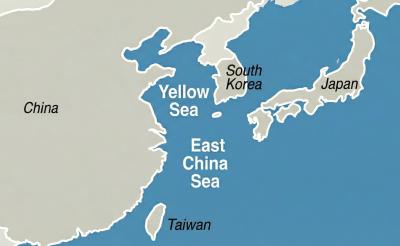
China has reserved offshore airspace in the Yellow Sea and East China Sea from March 27 to May 6, issuing alerts usually used to warn of military exercises, although no such exercises have been announced, the Wall Street Journal (WSJ) reported yesterday. Reserving such a large area for 40 days without explanation is an “unusual step,” as military exercises normally only last a few days, the paper said. These alerts, known as Notice to Air Missions (Notams), “are intended to inform pilots and aviation authorities of temporary airspace hazards or restrictions,” the article said. The airspace reserved in the alert is
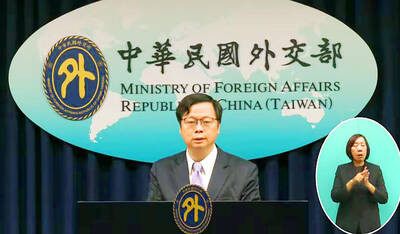
NAMING SPAT: The foreign ministry called on Denmark to propose an acceptable solution to the erroneous nationality used for Taiwanese on residence permits Taiwan has revoked some privileges for Danish diplomatic staff over a Danish permit that lists “Taiwan” as “China,” Eric Huang (黃鈞耀), head of the Ministry of Foreign Affairs’ Department of European Affairs, told a news conference in Taipei yesterday. Reporters asked Huang whether the Danish government had responded to the ministry’s request that it correct the nationality on Danish residence permits of Taiwanese, which has been listed as “China” since 2024. Taiwan’s representative office in Denmark continues to communicate with the Danish government, and the ministry has revoked some privileges previously granted to Danish representatives in Taiwan and would continue to review
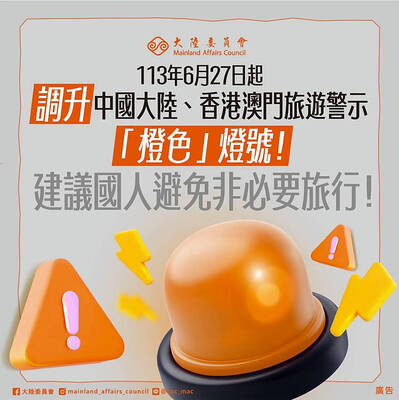
More than 6,000 Taiwanese students have participated in exchange programs in China over the past two years, despite the Mainland Affairs Council’s (MAC) “orange light” travel advisory, government records showed. The MAC’s publicly available registry showed that Taiwanese college and university students who went on exchange programs across the Strait numbered 3,592 and 2,966 people respectively. The National Immigration Agency data revealed that 2,296 and 2,551 Chinese students visited Taiwan for study in the same two years. A review of the Web sites of publicly-run universities and colleges showed that Taiwanese higher education institutions continued to recruit students for Chinese educational programs without
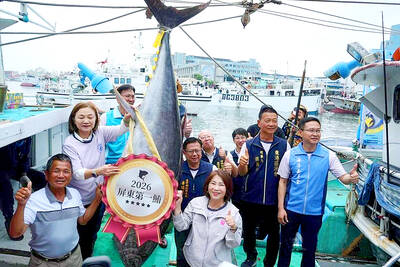
The first bluefin tuna of the season, brought to shore in Pingtung County and weighing 190kg, was yesterday auctioned for NT$10,600 (US$333.5) per kilogram, setting a record high for the local market. The auction was held at the fish market in Donggang Fishing Harbor, where the Siaoliouciou Island-registered fishing vessel Fu Yu Ching No. 2 delivered the “Pingtung First Tuna” it had caught for bidding. Bidding was intense, and the tuna was ultimately jointly purchased by a local restaurant and a local company for NT$10,600 per kilogram — NT$300 ,more than last year — for a total of NT$2.014 million. The 67-year-old skipper


 RSS
RSS