


Most people associate the Legislative Yuan with its debating chamber — a room synonymous with political power, interparty strife and Taiwanese democracy.
Pictures of lawmakers engaged in violent brawls or sending pig intestines flying on the chamber’s carpeted floor have been splattered across newspapers and screens at home and abroad. There have also been defining moments like Czech Senate President Milos Vystrcil’s “I am Taiwanese” speech, which he delivered on Sept. 1 last year during a six-day visit.
Yet for all the hullabaloo and excitement that the main chamber projects, it is just one of the many pieces that make up the sprawling complex serving as the workplace of hundreds of staffers, lobbyists, reporters and police officers.
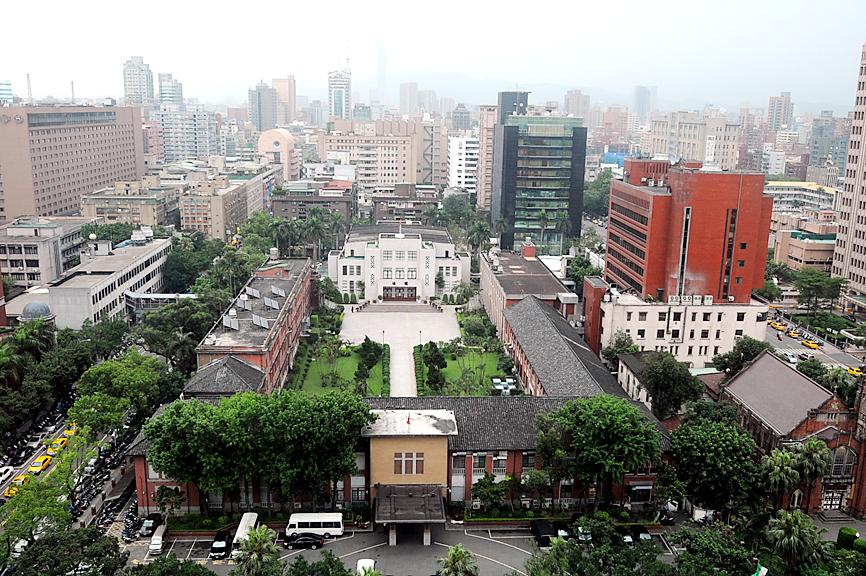
Photo: Wang Yi-sung, Taipei Times
One of the lesser-known parts of the Legislative Yuan is a bustling, makeshift market just a few steps from the debating chamber.
It is a shabby, enclosed hallway lined on one side with the security chief’s office and drivers’ lounge, and on the other with a beauty salon, florist, juice stand, barbershop, laundry and shoe repair services.
The barbershop counts among its past clients former legislative speaker Wang Jin-pyng (王金平), who told reporters before ending his 44-year tenure as a lawmaker in January last year that it was one of the places he would miss the most after leaving office.
Along the various storefronts, folding tables are set up for a rotation of vendors to sell fruits, vegetables, pastries, plants and other merchandise.
In the back of the hall, there is a mini-mart stocked with items such as umbrellas, snacks and bottled drinks.
While the household products it carries — including toothbrushes, shampoos and canned fish — seem out of place in an office-based establishment, they might be justified by the overnight occupations that lawmakers and protesters have in the past organized when the legislature was in session.
Around the corner from the indoor bazaar is Kang Yuan (康園), a Cantonese-inspired restaurant that serves as the legislature’s canteen and provides an events room where lawmakers host guests.
It is known for its affordable prices — the buffet on the first floor costs NT$65 per person — and traditional banquet favorites like Dongpo-style braised pork belly and deep-fried duck with taro paste.
Positioned around the restaurant are large posters of the chamber building’s facade for tourists to photograph and pose in front of.
Although the two police officers standing guard outside its street-facing side might suggest otherwise, the restaurant’s general manager, Tsai Tsung-lung (蔡宗龍), said Kang Yuan is accessible to anyone with a reservation.
The restaurant attracts many of its customers through word of mouth, he said, adding that the popularity of its pickled cabbage has helped spread the word.
People often wonder if they would meet lawmakers at Kang Yuan and his answer would be: “Of course,” said Tsai, who described the Legislative Yuan as “the people’s palace.”
While he has grown accustomed to seeing lawmakers around the place, it is a unique experience for first-time visitors, he said.
Another rarely discussed part of the Legislative Yuan is the Parliamentary Library, which is housed inside a dingy basement in the Chun-hsien Building (群賢樓).
Smaller than the average municipal public library branch and producing a distracting hum, its physical presence appears less functional than symbolic.
Parliamentary Library data show that in December last year it recorded just 894 visits, but about 1.03 million online searches of its digital database.
Nevertheless, the saving grace of the brick-and-mortar library is a limited, but curated collection of books and periodicals on subjects ranging from politics, economics and law to gender issues, healthcare and the environment.
It is tailored to the needs of the people who have access: lawmakers, staffers, journalists, government employees, academics with special permission and members of the Interlibrary Cooperation Association.
It also includes surprising and delightful finds such as a 37-volume set of William Shakespeare’s works in Mandarin published in September 1967 by the Far East Book Company, and a manga series titled The Chef of the Ambassador by Mitsuru Nishimura and Hiroshi Kawasumi.
The Legislative Yuan has seen it all in the past 60 years since it moved to its current location in the capital’s Zhongzheng District (中正).
During that time, much attention has been paid to its main chamber, a place presented to the outside world in all its theatricality.
However, beyond the chamber is a whole other ecosystem with a life of its own.

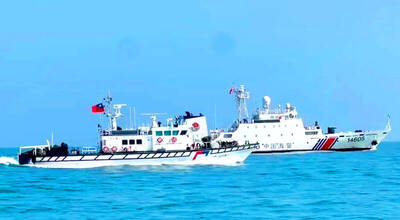
The military has spotted two Chinese warships operating in waters near Penghu County in the Taiwan Strait and sent its own naval and air forces to monitor the vessels, the Ministry of National Defense (MND) said. Beijing sends warships and warplanes into the waters and skies around Taiwan on an almost daily basis, drawing condemnation from Taipei. While the ministry offers daily updates on the locations of Chinese military aircraft, it only rarely gives details of where Chinese warships are operating, generally only when it detects aircraft carriers, as happened last week. A Chinese destroyer and a frigate entered waters to the southwest
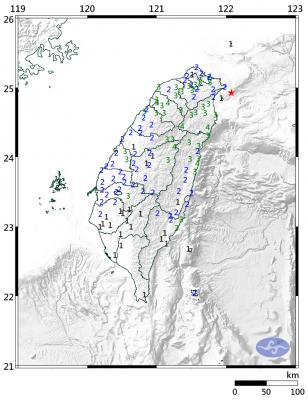
A magnitude 6.1 earthquake struck off the coast of Yilan County at 8:39pm tonight, the Central Weather Administration (CWA) said, with no immediate reports of damage or injuries. The epicenter was 38.7km east-northeast of Yilan County Hall at a focal depth of 98.3km, the CWA’s Seismological Center said. The quake’s maximum intensity, which gauges the actual physical effect of a seismic event, was a level 4 on Taiwan’s 7-tier intensity scale, the center said. That intensity level was recorded in Yilan County’s Nanao Township (南澳), Hsinchu County’s Guansi Township (關西), Nantou County’s Hehuanshan (合歡山) and Hualien County’s Yanliao (鹽寮). An intensity of 3 was
Instead of focusing solely on the threat of a full-scale military invasion, the US and its allies must prepare for a potential Chinese “quarantine” of Taiwan enforced through customs inspections, Stanford University Hoover fellow Eyck Freymann said in a Foreign Affairs article published on Wednesday. China could use various “gray zone” tactics in “reconfiguring the regional and ultimately the global economic order without a war,” said Freymann, who is also a nonresident research fellow at the US Naval War College. China might seize control of Taiwan’s links to the outside world by requiring all flights and ships entering or leaving Taiwan
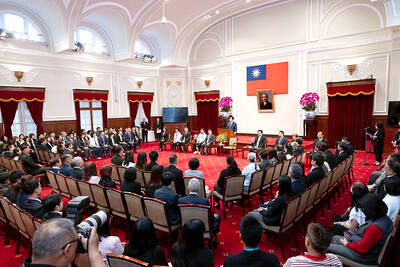
The next minimum wage hike is expected to exceed NT$30,000, President William Lai (賴清德) said yesterday during an award ceremony honoring “model workers,” including migrant workers, at the Presidential Office ahead of Workers’ Day today. Lai said he wished to thank the awardees on behalf of the nation and extend his most sincere respect for their hard work, on which Taiwan’s prosperity has been built. Lai specifically thanked 10 migrant workers selected for the award, saying that although they left their home countries to further their own goals, their efforts have benefited Taiwan as well. The nation’s industrial sector and small businesses lay


 RSS
RSS