


Shoppers bought out the entire stock of 1,000 towels bearing a Taoist peace talisman from Tainan’s Puji Temple (普濟殿) three days after they went on sale, temple staff said on Saturday.
The towels, 103cm by 36cm, bear a blown-up replica of the temple’s famous talisman known as the Puji Temple Hundred-Year-Old Charm of Peace and Tranquility (百年平安符).
A spiritual medium for the temple was said to have written the charm in 1911 while under the possession of Chih Fu Wang Yeh (池府王爺), the main deity worshiped at the shrine.
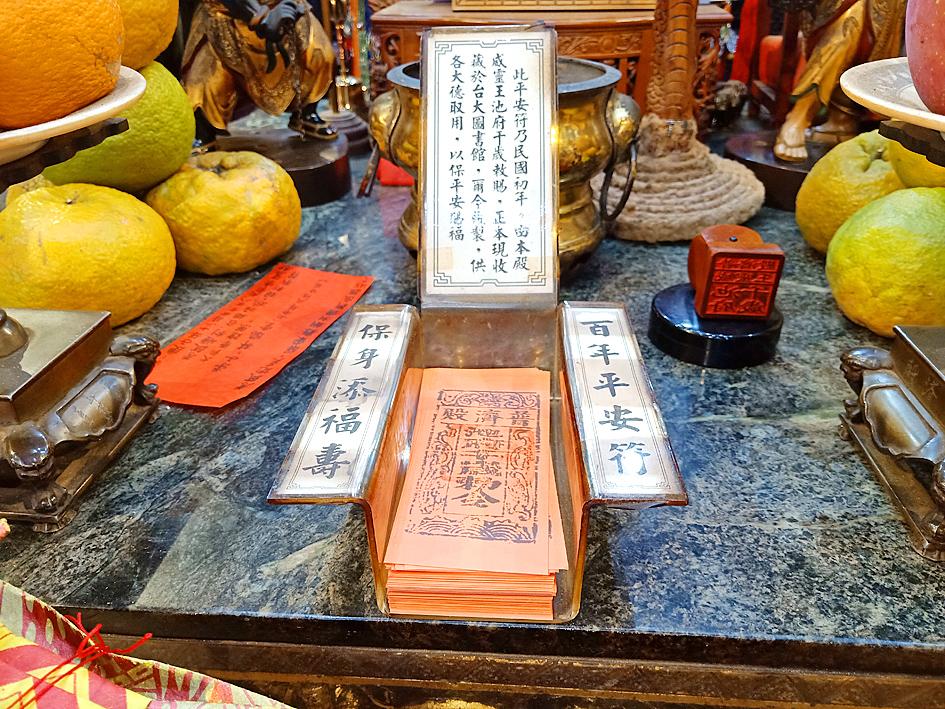
Photo: Wang Shu-hsiu, Taipei Times
The towels were originally made for the Lantern Festival, but after the event was canceled due to the COVID-19 pandemic, the temple put them up for sale on its Web site, Puji Temple Historical Association executive director Chiang Wen-cheng (蔣文正) said.
The popularity of the towels was a pleasant surprise to the temple and the association that helped make them, Chiang said.
The design, an accurate reproduction of the original talisman, down to the color of the paper on which it was written, has been printed on other temple merchandise, including document holders and mask bags, but the towel is by far the best-selling item, he said.
The association is working with manufacturers to produce a second run of the towels after the Lunar New Year holiday, he added.
The temple wrote on its Facebook page that several parents bought the towels to swaddle their babies and said the towels had a calming effect on the toddlers.
Although replicas of the peace talisman have been a perennial favorite at the temple’s gift shop, the charm has a broader academic significance, and colonial-era religious studies academic Masuda Fukutaro deemed it a notable artifact of Taiwan’s folk religion culture.
The talisman is in the collection of the National Taiwan University Library and a digital copy is at the National Repository of Cultural Heritage.

Considering that most countries issue more than five denominations of banknotes, the central bank has decided to redesign all five denominations, the bank said as it prepares for the first major overhaul of the banknotes in more than 24 years. Central bank Governor Yang Chin-lung (楊金龍) is expected to report to the Legislative Yuan today on the bank’s operations and the redesign’s progress. The bank in a report sent to the legislature ahead of today’s meeting said it had commissioned a survey on the public’s preferences. Survey results showed that NT$100 and NT$1,000 banknotes are the most commonly used, while NT$200 and NT$2,000

The Centers for Disease Control (CDC) yesterday reported the first case of a new COVID-19 subvariant — BA.3.2 — in a 10-year-old Singaporean girl who had a fever upon arrival in Taiwan and tested positive for the disease. The girl left Taiwan on March 20 and the case did not have a direct impact on the local community, it said. The WHO added the BA.3.2 strain to its list of Variants Under Monitoring in December last year, but this was the first imported case of the COVID-19 variant in Taiwan, CDC Deputy Director-General Lin Ming-cheng (林明誠) said. The girl arrived in Taiwan on

South Korea is planning to revise its controversial electronic arrival card, a step Taiwanese officials said prompted them to hold off on planned retaliatory measures, a South Korean media report said yesterday. A Yonhap News Agency report said that the South Korean Ministry of Foreign Affairs is planning to remove the “previous departure place” and “next destination” fields from its e-arrival card system. The plan, reached after interagency consultations, is under review and aims to simplify entry procedures and align the electronic form with the paper version, a South Korean ministry official said. The fields — which appeared only on the electronic form

The Ministry of Foreign Affairs (MOFA) is suspending retaliation measures against South Korea that were set to take effect tomorrow, after Seoul said it is updating its e-arrival system, MOFA said today. The measures were to be a new round of retaliation after Taiwan on March 1 changed South Korea's designation on government-issued alien resident certificates held by South Korean nationals to "South Korea” from the "Republic of Korea," the country’s official name. The move came after months of protests to Seoul over its listing of Taiwan as "China (Taiwan)" in dropdown menus on its new online immigration entry system. MOFA last week


 RSS
RSS