

The Mainland Affairs Council (MAC) is exploring legal options to allow Taiwanese to marry their Chinese same-sex partners.
The comments on Thursday came after the Judicial Yuan last week said that it aims to amend regulations on same-sex marriages, opening them for Taiwanese and their spouses from countries that do not recognize same-sex marriage.
This would also apply to spouses from Hong Kong and Macau, but not China, the Executive Yuan said.
MAC Deputy Minister Chiu Chui-cheng (邱垂正) said that the Council of Grand Justices’ Interpretation No. 748, the basis for same-sex marriage in Taiwan, does not allow for the exclusion of Chinese spouses.
However, a “slew of legal issues” would arise from opening same-sex marriage for Taiwanese-Chinese couples, and government agencies are mulling responses to those issues, he said.
They include border and resident visa regulations, and the verification of certificates, Chiu said.
The council has closely followed the developments at the Judicial Yuan and participates in the amendment process, for which it has provided information on expected effects on exchanges across the Taiwan Strait, he said.
The council is collecting further information on legal and practical problems that might arise from opening same-sex marriage for Taiwanese-Chinese couples, and working on solutions with other government agencies involved, he said.
Democratic Progressive Party Legislator Lai Jui-lung (賴瑞隆) said that the council and national security agencies should approach the issue with a focus on Taiwan’s national security.
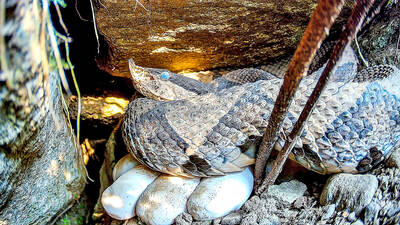
NATURE TAKES ITS COURSE: The agency’s head said he felt a sense of loss watching red-banded snakes eat the babies, as they had decided on non-intervention The Forestry and Nature Conservation Agency yesterday released a documentary on a hundred-pace viper that had incubated 16 eggs, all of which hatched, but only a baby viper escaped after they were attacked by red-banded snakes. The agency’s Taichung branch last year launched the viper reproduction monitoring project soon after forest rangers Lin Chun-yu (林俊佑) and Chou Chia-cheng (周家成) spotted a pregnant hundred-pace viper in a grass-covered burrow near a parking lot in Tbulan Village (松鶴部落). The Atayal village, in Taichung’s Heping District (和平), is headed by Ecyang Yapu, who was positive about the project and assisted in access control and power
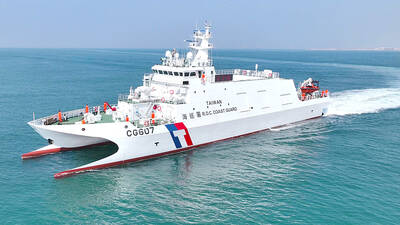
The Coast Guard Administration (CGA) yesterday said that it had deployed vessels to “monitor” Chinese ships operating in waters off the east coast. The CGA said it dispatched vessels in response to a China Coast Guard announcement that it had carried out another “routine law-enforcement patrol” in waters off the east coast. “The CGA firmly rejects China’s cognitive warfare campaign of ‘law enforcement in name, jurisdictional expansion in practice,’” it said on X. As of 11am yesterday, two China Coast Guard ships were “loitering and drifting” about 105 nautical miles (195km) and 74 nautical miles east of Green Island (綠島) respectively, it said. It
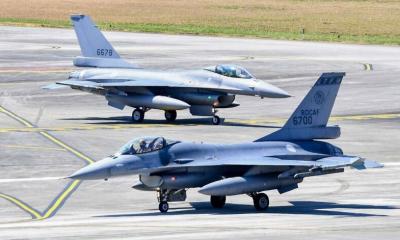
The first two F-16V Block 70 jets Taiwan purchased from the US were spotted unexpectedly turning back after departing from Hawaii yesterday, potentially further delaying delivery of the aircraft. Taiwan has purchased 66 of the F-16 C/D Block 70 jets to be deployed at Chihhang Air Base (志航基地) in Taitung County and operated by the air force's 7th Tactical Fighter Wing to defend Taiwan’s eastern region. Two single-seat jets, bearing serial No. 6727 and 6728, were spotted taking off from Hickam Field in Hawaii yesterday, observers said. Based on the precedent set during the delivery of Taiwan's older F-16 Block 20s, the new

Taiwan’s growing defense preparations might be sending a stronger signal to the US than to Beijing, highlighting the need for Taipei to tailor its deterrence efforts to different audiences, a US security academic said yesterday. Stanford University Freeman Spogli Institute for International Studies fellow Oriana Skylar Mastro made the comment during a Taipei Security Dialogue panel examining lessons Taiwan could draw from the wars in Ukraine and the Middle East. Mastro said she was impressed by Taiwan’s increased defense spending, emphasis on asymmetric capabilities and efforts to prepare society for conflict, but questioned whom those initiatives were influencing. She said when she asked


 RSS
RSS