


A student at Changhua County’s Dayeh University has created a mask that allows the wearer to use an asthma inhaler without removing the mask.
Although masks have become a necessity amid the COVID-19 pandemic, people with asthma must remove them while taking medication, exposing them to risk, Department of Industrial Design student Chiu Chen-ting (邱振莛) said on Monday.
Chiu designed a mask that incorporates a contoured inhaler, which releases medication when the wearer lightly touches the front of the mask.
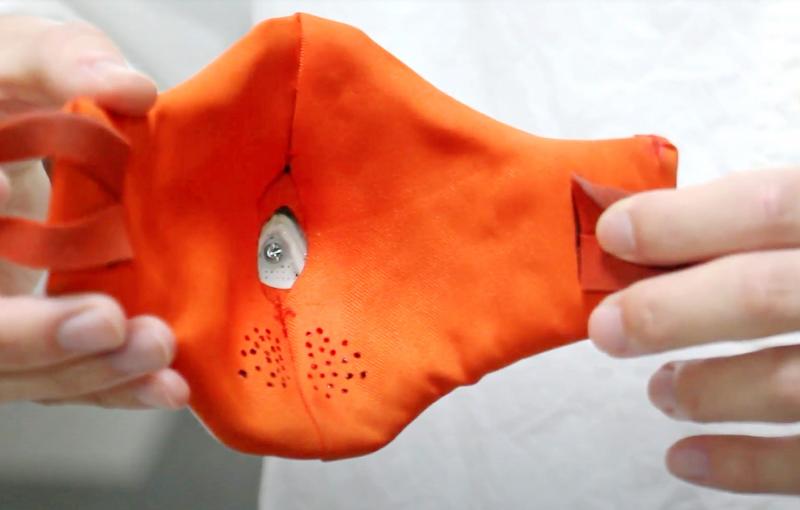
Photo courtesy of Dayeh University
The design won an award for the home products category of last year’s Green Lifestyle Design Awards, which included a cash prize of NT$5,000.
Knowing that the pandemic remained a serious concern, the fourth-year student said he hoped to reduce the risk of infection for people with asthma, who sometimes have attacks while in public places.
He came up with the design with classmates Wang Liang-hsun (王亮勛) and Hsiao Hao-cheng (蕭浩澄), he said.
The mask uses a removable inhaler capsule that can house asthma medicine or allergy medicine, depending on the needs of the wearer, he said.
The amount of medicine dispensed could be adjusted using a mobile phone app, he added.
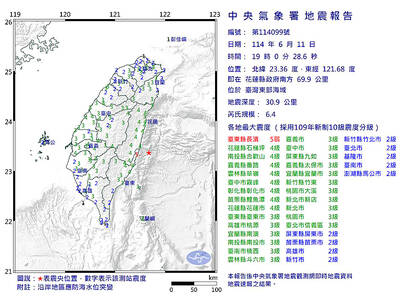
A magnitude 6.4 earthquake struck off the coast of Hualien County in eastern Taiwan at 7pm yesterday, the Central Weather Administration (CWA) said. The epicenter of the temblor was at sea, about 69.9km south of Hualien County Hall, at a depth of 30.9km, it said. There were no immediate reports of damage resulting from the quake. The earthquake’s intensity, which gauges the actual effect of a temblor, was highest in Taitung County’s Changbin Township (長濱), where it measured 5 on Taiwan’s seven-tier intensity scale. The quake also measured an intensity of 4 in Hualien, Nantou, Chiayi, Yunlin, Changhua and Miaoli counties, as well as
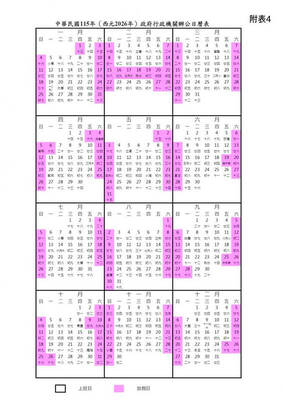
Taiwan is to have nine extended holidays next year, led by a nine-day Lunar New Year break, the Cabinet announced yesterday. The nine-day Lunar New Year holiday next year matches the length of this year’s holiday, which featured six extended holidays. The increase in extended holidays is due to the Act on the Implementation of Commemorative and Festival Holidays (紀念日及節日實施條例), which was passed early last month with support from the opposition Chinese Nationalist Party (KMT) and Taiwan People’s Party. Under the new act, the day before Lunar New Year’s Eve is also a national holiday, and Labor Day would no longer be limited

COMMITMENTS: The company had a relatively low renewable ratio at 56 percent and did not have any goal to achieve 100 percent renewable energy, the report said Pegatron Corp ranked the lowest among five major final assembly suppliers in progressing toward Apple Inc’s commitment to be 100 percent carbon neutral by 2030, a Greenpeace East Asia report said yesterday. While Apple has set the goal of using 100 percent renewable energy across its entire business, supply chain and product lifecycle by 2030, carbon emissions from electronics manufacturing are rising globally due to increased energy consumption, it said. Given that carbon emissions from its supply chain accounted for more than half of its total emissions last year, Greenpeace East Asia evaluated the green transition performance of Apple’s five largest final
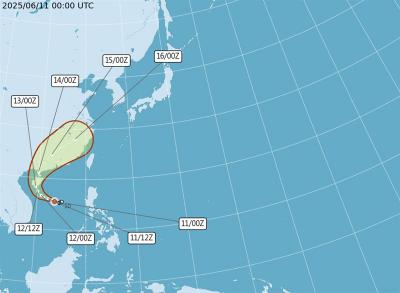
The first tropical storm of the year in the western North Pacific, Wutip (蝴蝶), has formed over the South China Sea and is expected to move toward Hainan Island off southern China, the Central Weather Administration (CWA) said today. The agency said a tropical depression over waters near the Paracel and Zhongsha islands strengthened into a tropical storm this morning. The storm had maximum sustained winds near its center of 64.8kph, with peak gusts reaching 90kph, it said. Winds at Beaufort scale level 7 — ranging from 50kph to 61.5kph — extended up to 80km from the center, it added. Forecaster Kuan Hsin-ping


 RSS
RSS