


Twenty Supreme Court and High Court judges and senior officials, along with 20 prosecutors and judicial investigators, were found to have engaged in illegal activities such as bribe-taking, abuse of authority and conflict of interest, according to a Judicial Yuan report released yesterday.
The report confirmed earlier Control Yuan’s findings that embroiled more than 200 judicial personnel in a corruption scandal involving former Supreme Court judge Shih Mu-chin (石木欽) and Chia Her Industrial Co president Weng Mao-chung (翁茂鍾).
The report recommended disciplinary measures and punishment against the 40 officials, including for judges presiding over nine cases involving Weng starting in the late 1990s, for which he received favorable rulings.
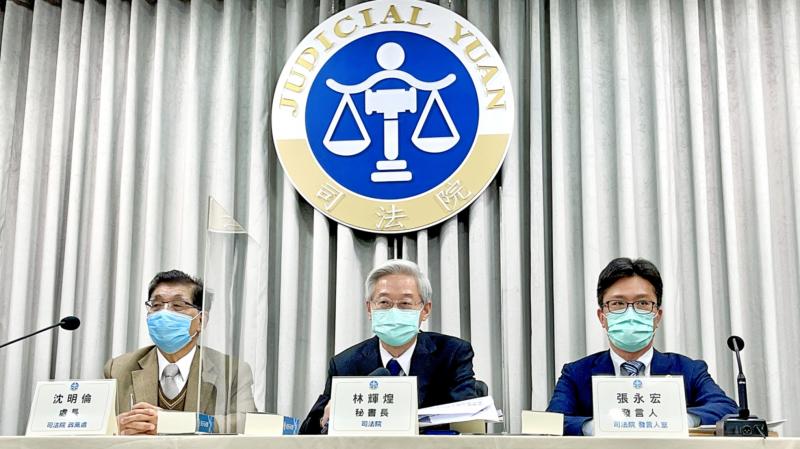
Photo: George Tsorng, Taipei Times
According to the report, Shih, who was president of the High Court, became a close friend of Weng when litigation involving him began in 1997.
Through Shih, Weng was introduced to more than 200 judges, prosecutors and police officials through banquets and personal visits, the report said.
The officials were alleged to have received bribes and lavish gifts, including company stock, in exchange for using their influence to aid Weng.
The Control Yuan in August last year began impeachment proceedings against Shih over alleged contraventions of the Judges Act (法官法) and suspicion of failing to avoid conflicts of interest.
In presenting the findings at a news conference in Taipei, Judicial Yuan Secretary-General Lin Hui-huang (林輝煌) said that the 20 judges involved had committed serious misconduct, and would face punishment to be determined by its disciplinary committee.
Seven of the judges found to have been most involved in abusing their authority face further investigation from the Control Yuan for possible impeachment, he said.
These include former Supreme Court judge Yen Nan-chuan (顏南全), former Supreme Administrative Court president Lin Chi-fu (林奇福), former Supreme Court chief judge Wu Hsiung-ming (吳雄銘), and former Tainan District Court judge Su Yi-chou (蘇義洲).
Some officials would be dismissed or transferred from their offices, with the possibility of losing their pension, as would retired officials implicated in the report, Lin said.
Some could evade punishment, as the allegations involving some officials are older than 10 years, past the statute of limitations on certain breaches under the Judges Act (法官法), he added.
Minister of Justice Tsai Ching-hsiang (蔡清祥) told a separate news conference in Taipei yesterday that 11 former head prosecutors, and nine officials and investigators at the Ministry of Justice Investigation Bureau were involved in the case, some of whom allegedly attended Weng’s banquets more than five times, while others allegedly purchased stocks based on insider information from Weng.
They would be punished as part of internal administrative procedures, Tsai said.
Judicial Reform Foundation chairman Lin Yung-sung (林永頌) said the case had severely eroded faith in the nation’s justice system.
The foundation called on lawmakers to amend the act to include a mechanism for evaluating judges and scrutinizing judicial officials.
“This scandal has shown that our justice system is rotten to the core,” Lin said. “Any further talks about the need for reform are useless, because people do not believe that judicial reform has made any progress.”
Lin also demanded that Judicial Yuan President Hsu Tzong-li (許宗力) and Tsai publicly apologize over the scandal.
Lin and other judicial reform proponents said that the report was only halfway finished.
They urged the Control Yuan to conduct a more thorough probe, by requisitioning all materials pertaining to the case, along with Weng’s 27 notebooks allegedly recording details of meetings, banquets, gifts and insider trading activities.
“This is necessary to find out if these judges have interfered in other court cases where they had a conflict of interest or received other undue financial benefits,” Lin said.
He said that Premier Su Tseng-chang (蘇貞昌) should oversee the investigation, since high-ranking police officials were allegedly involved and had refused to cooperate with the Control Yuan’s probe.


UPGRADE: The Kang Ding-class frigate is replacing its Chaparall missiles with Tien Chien II and Hua Yang VLS, which would provide it with long-range, 360° air defense Taiwan plans to produce 1,200 to 1,376 Hai Chien II missiles (海劍二, Sea Sword II) — also known as TC-2N — to serve as the standard air defense system of the navy’s surface combatant fleet, a source said yesterday. Last week, the Hai Chien II, the naval version of the Tien Kung II missile (天劍二, Sky Sword II), completed a live-fire test in waters off the National Chungshan Institute of Science and Technology’s Jiupeng facility (九鵬) in Pingtung County’s Manjhou Township (滿州). The MIM72 Chaparral and other dated air defense missiles that currently arm Taiwanese ships have inadequate range to combat Chinese

REASONS FOR TRAVEL: An assistant professor said that proposed amendments to penalize drivers if they used drugs overseas would not deter people from traveling People who operate a motor vehicle under the influence of marijuana would have their driver’s license revoked, even if they used the substance while overseas, the Ministry of Transportation and Communications said yesterday, citing proposed amendments to the Road Traffic Management and Penalty Act (道路交通管理處罰條例). The amendments would also authorize the government to revoke the licenses of people determined to have used Category 1 or Category 2 narcotics, even if they were not operating a vehicle while under the influence of drugs, as well as ban them from taking the license test for three years, the ministry said. People aged 18 or
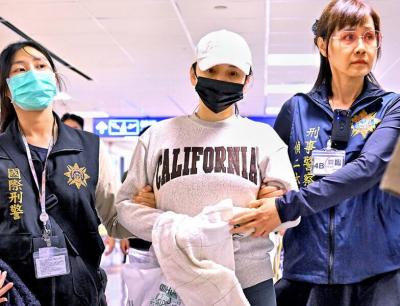
Johanne Liou (劉喬安), a Taiwanese woman who shot to unwanted fame during the Sunflower movement protests in 2014, returned to Taiwan last night after being deported from the US. She is to stand trial in Taiwan for charges involving embezzlement, fraud and drug crimes. The Criminal Investigation Bureau (CIB) said it took her into custody at Taiwan Taoyuan International Airport and would first question her before transferring her to the New Taipei District Prosecutors’ Office. She was arrested upon disembarking a flight from San Francisco that landed shortly before 7pm. Liou absconded to the US in 2019 after jumping bail
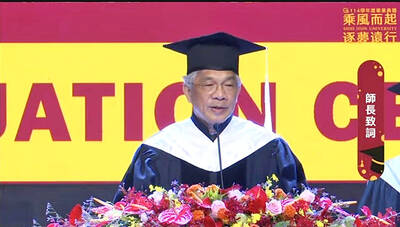
Shih Hsin University President Chen Ching-he (陳清河) yesterday issued a public apology for comments made in his commencement speech last week, stating that he has asked the school to suspend his duties and halt his wages for two months as a show of contrition. At the commencement ceremony on May 30, Chen said, “If you don’t manage your time well, or your own emotions, or your health, then I am telling every one of you — put a quick end to ‘you,’ because the world has no need for ‘you.’” The comments have sparked significant controversy online, and Chen through an open


 RSS
RSS