


Animal rights advocates and veterinarians yesterday called for the Taoyuan City Government to draft ordinances to prevent the ownership of animal traps unless an individual has a permit, following the deaths of 14 animals in the city last year, including a crab-eating mongoose, which is a protected species.
An amendment to the Animal Protection Act (動物保護法) passed 10 years ago stated that no animal traps may be manufactured, sold, displayed, imported or exported without explicit permission from the central government, the group told a news conference in the city.
However, the amendment does not say that one cannot “own” such a trap, which has led to a number of incidents involving traps.
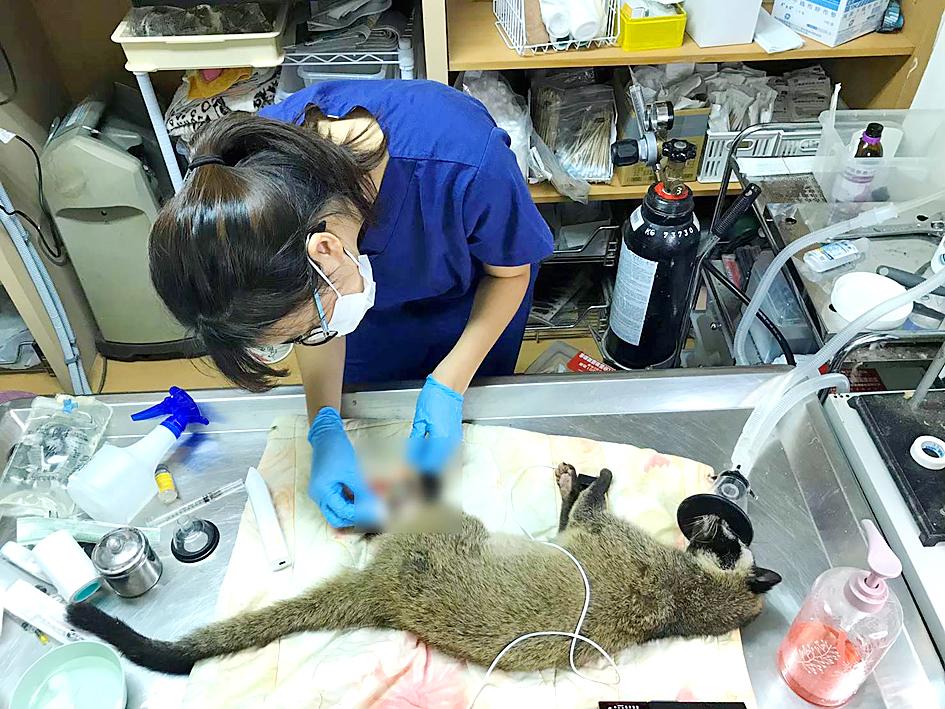
Photo: Hsu Cho-hsun, Taipei Times
There were five incidents of animals being hurt by traps between October last year and last month in Taoyuan’s Jhongli (中壢), Sinwu (新屋), Longtan (龍潭), Houxiang (後巷) and Fusing (復興) districts, said Wu Chia-ying (吳珈瑩), a veterinarian who works with the Wild Bird Society of Taiwan.
Most of the traps were set up by farmers to prevent animals from ruining their crops, or to catch rats, but wildlife usually migrate to lower altitudes during the winter, Wu said.
The jaws of the traps are strong enough to fracture animals’ limbs, and if an injured animal is not discovered soon enough, its wounds could become infected, she said.
The survival rate of animals caught in such traps is extremely low, Wu said, adding that she had been forced to euthanize 90 percent of animals injured by foot-hold traps that she saw.
Taoyuan City Councilor Chen Jui-sheng (陳睿生) said the lack of legal restrictions against owning traps, and the absence of any punitive measures, makes it difficult for the government to enforce the law.
Chen said he is mulling proposing an ordinance to ban ownership of animal traps in the municipality.
Taoyuan Animal Protection Office Commissioner Wang Te-chi (王得吉) said he would support such a measure, as “a civilized society should not condone the use of animal traps.”
The office has set up signs warning against the use of traps and has stepped up inspection of hardware stores, Wang said.
The illegal sale of animal traps is punishable a fine of up to NT$75,000, he said.
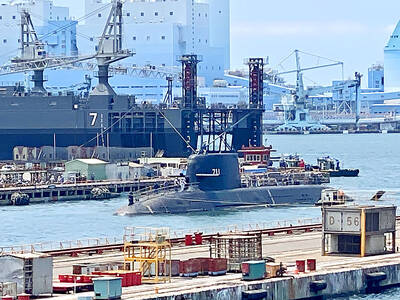
AGING: While Japan has 22 submarines, Taiwan only operates four, two of which were commissioned by the US in 1945 and 1946, and transferred to Taiwan in 1973 Taiwan would need at least 12 submarines to reach modern fleet capabilities, CSBC Corp, Taiwan chairman Chen Cheng-hung (陳政宏) said in an interview broadcast on Friday, citing a US assessment. CSBC is testing the nation’s first indigenous defense submarine, the Hai Kun (海鯤, Narwhal), which is scheduled to be delivered to the navy next month or in July. The Hai Kun has completed torpedo-firing tests and is scheduled to undergo overnight sea trials, Chen said on an SET TV military affairs program. Taiwan would require at least 12 submarines to establish a modern submarine force after assessing the nation’s operational environment and defense

Yangmingshan National Park authorities yesterday urged visitors to respect public spaces and obey the law after a couple was caught on a camera livestream having sex at the park’s Qingtiangang (擎天崗) earlier in the day. The Shilin Police Precinct in Taipei said it has identified a suspect and his vehicle registration number, and would summon him for questioning. The case would be handled in accordance with public indecency charges, it added. The couple entered the park at about 11pm on Thursday and began fooling around by 1am yesterday, the police said, adding that the two were unaware of the park’s all-day live
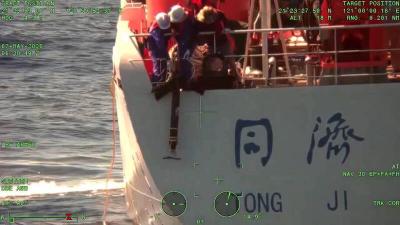
The coast guard today said that it had disrupted "illegal" operations by a Chinese research ship in waters close to the nation and driven it away, part of what Taipei sees a provocative pattern of China's stepped up maritime activities. The coast guard said that it on Thursday last week detected the Chinese ship Tongji (同濟號), which was commissioned only last year, 29 nautical miles (54km) southeast of the southern tip of Taiwan, although just outside restricted waters. The ship was observed lowering ropes into the water, suspected to be the deployment of scientific instruments for "illegal" survey operations, and the coast

A former soldier and an active-duty army officer were yesterday indicted for allegedly selling classified military training materials to a Chinese intelligence operative for a total of NT$79,440. The Taipei District Prosecutors’ Office indicted Chen Tai-yin (陳泰尹) and Lee Chun-ta (李俊達) for contravening the National Security Act (國家安全法) and the Anti-Corruption Act (貪污治罪條例). Chen left the military in September 2013 after serving alongside then-staff sergeant Lee, now an army lieutenant, at the 21st Artillery Command of the army’s Sixth Corps from 2011 to 2013, according to the indictment. Chen met a Chinese intelligence operative identified as “Wang” (王) through a friend in November


 RSS
RSS