


A lawyer and a prosecutor yesterday castigated what they called a lenient ruling by the High Court on Luo Wen-shan (羅文山), whose prison sentence was reduced to two years, which he does not need to serve, after he was convicted for receiving illegal political donations from China to meddle in Taiwan’s elections.
Investigators found that Luo, who retired from the army with the rank of lieutenant general, had accepted NT$8.38 million (US$294,604 at the current exchange rate) under the guise of political contributions from Chinese People’s Political Consultative Conference member Xu Zhiming (許智明) and people in Hong Kong from 2008 to 2012. He was also the head of the pro-Chinese Nationalist Party (KMT) Whampoa Military Academy Alumni Association.
Luo was sentenced to two years and six months in prison in the first ruling.
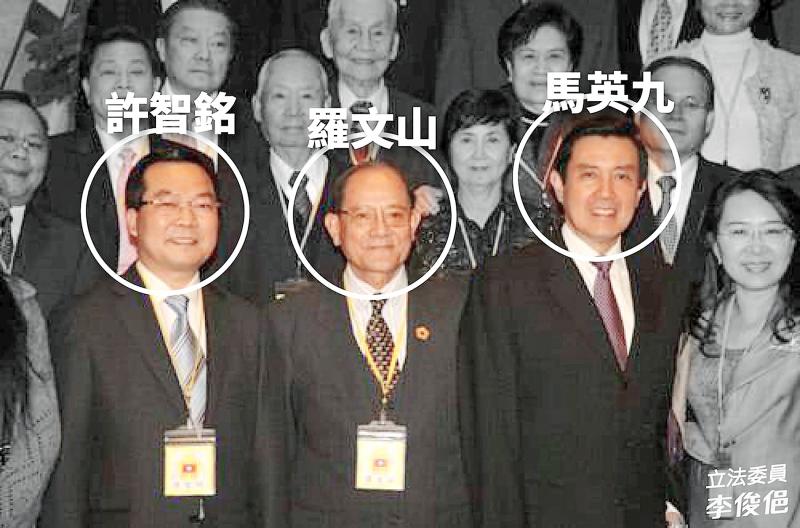
However, the High Court on Tuesday reduced his sentence to two years, which can be commuted to a fine of NT$720,000.
The High Court also ordered the return of the NT$8.38 million Luo had received, as it was found that he was instructed to use the money to take out advertisements and purchase other promotional materials to support then-president Ma Ying-jeou’s (馬英九) election campaign.
Attorney Huang Di-ying (黃帝穎) and chairman of the Taiwan Forever Association decried the sentence as being too lenient.
“It was a ridiculous court decision... The judges seemed wanting to encourage retired military officials to accept money from China to meddle in Taiwan’s democratic election,” Huang said.
“The High Court cited Luo’s advanced age of 85, him having no previous criminal conviction and his long years serving in the military. These are the reasons for reducing his sentence to a two-year term, which can be commuted to a fine. I see the judges had applied the wrong law for this case,” Huang added.
“Precisely because Luo had a long career in our nation’s military, he should understand much better the regulations governing political donations from foreign sources. Instead of abiding by Taiwanese law, he took money from figures in Hong Kong, and also from Chinese People’s Political Consultative Conference member Xu Zhiming [許智明] to do China’s work in Taiwan’s election,” he added.
“Luo is a retired general, and his pension is paid by Taiwanese taxpayers. Luo has clearly violated his duty and obligation of loyalty to the country, therefore his punishment should be more severe... We see the High Court had contradicted itself on the cited reasons,” Huang said.
In cases when convicts receive a reduced sentence due to advanced age, the defendants usually make admissions of guilt and of their wrongdoing, “but Luo denied doing anything wrong through the trials, insisting that the money was not for political purposes. Despite this, Luo still received a lenient sentence,” he added.
Meanwhile, a public prosecutor, who spoke on condition of anonymity, also called for an appeal, saying the sentence was too lenient.
“Most court cases involving national security and espionage activities require sensitive handling and cannot reveal the classified materials, and are difficult for the investigation work,” the prosecutor said.

Considering that most countries issue more than five denominations of banknotes, the central bank has decided to redesign all five denominations, the bank said as it prepares for the first major overhaul of the banknotes in more than 24 years. Central bank Governor Yang Chin-lung (楊金龍) is expected to report to the Legislative Yuan today on the bank’s operations and the redesign’s progress. The bank in a report sent to the legislature ahead of today’s meeting said it had commissioned a survey on the public’s preferences. Survey results showed that NT$100 and NT$1,000 banknotes are the most commonly used, while NT$200 and NT$2,000

The Centers for Disease Control (CDC) yesterday reported the first case of a new COVID-19 subvariant — BA.3.2 — in a 10-year-old Singaporean girl who had a fever upon arrival in Taiwan and tested positive for the disease. The girl left Taiwan on March 20 and the case did not have a direct impact on the local community, it said. The WHO added the BA.3.2 strain to its list of Variants Under Monitoring in December last year, but this was the first imported case of the COVID-19 variant in Taiwan, CDC Deputy Director-General Lin Ming-cheng (林明誠) said. The girl arrived in Taiwan on

South Korea is planning to revise its controversial electronic arrival card, a step Taiwanese officials said prompted them to hold off on planned retaliatory measures, a South Korean media report said yesterday. A Yonhap News Agency report said that the South Korean Ministry of Foreign Affairs is planning to remove the “previous departure place” and “next destination” fields from its e-arrival card system. The plan, reached after interagency consultations, is under review and aims to simplify entry procedures and align the electronic form with the paper version, a South Korean ministry official said. The fields — which appeared only on the electronic form

The Ministry of Foreign Affairs (MOFA) is suspending retaliation measures against South Korea that were set to take effect tomorrow, after Seoul said it is updating its e-arrival system, MOFA said today. The measures were to be a new round of retaliation after Taiwan on March 1 changed South Korea's designation on government-issued alien resident certificates held by South Korean nationals to "South Korea” from the "Republic of Korea," the country’s official name. The move came after months of protests to Seoul over its listing of Taiwan as "China (Taiwan)" in dropdown menus on its new online immigration entry system. MOFA last week


 RSS
RSS