


Chinese Nationalist Party (KMT) Legislator Chiang Wan-an (蔣萬安) yesterday said that his proposal to amend the Act Governing the Recovery of Damage of Individual Rights During the Period of Martial Law (戒嚴時期人民受損權利回復條例) aims to expand the legal basis for victims of the White Terror era and Martial Law period to claim compensation from the state.
Many of the cases were not limited to the Criminal Code and should the amendment be passed, people prosecuted for contravening of the now-defunct punishment of rebellion act and the espionage laws of the period of the communist rebellion would also be eligible to file for state compensation, Chiang said.
People who has received a presidential reinstatement of integrity certificate, or those whose guilty verdict was overturned through the Act on Promoting Transitional Justice (促進轉型正義條例) would also be eligible, Chiang said.
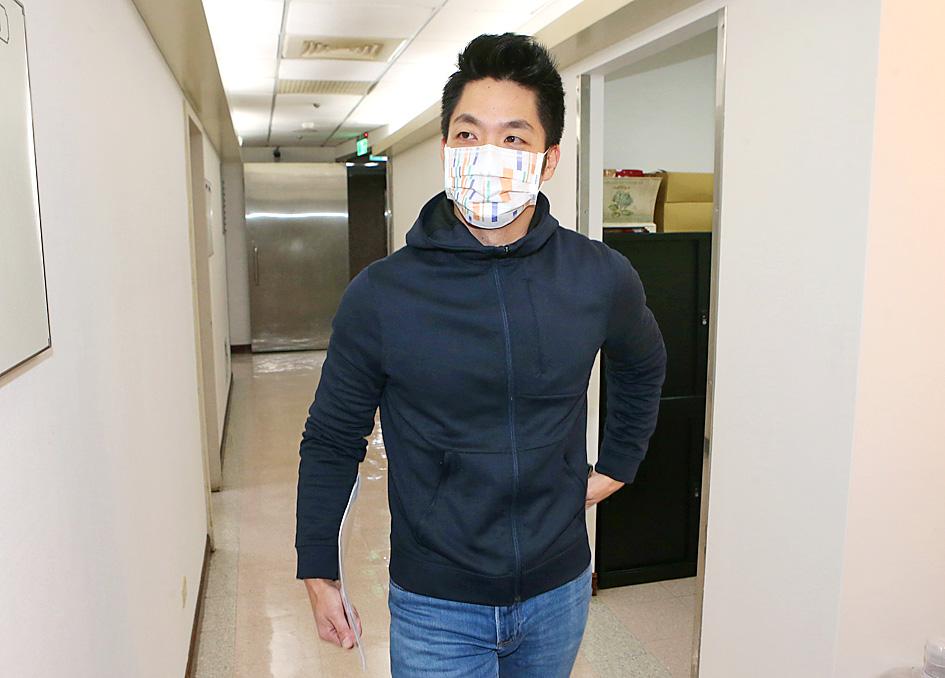
Photo: CNA
According to the draft, if the person has passed away, their descendants or legally designated inheritor in Taiwan may also ask for their assets to be returned, he said.
If the assets are unable to be returned, or cannot be returned in their original state, the claimant may request that the government pay an appropriate sum instead, he said.
If the draft is passed, the official name of the act would be changed to the restoration of individual rights under the autocratic rule period act, Chiang said.
Chiang said he has always supported openly discussing the events of the White Terror era and Martial Law period, and that he expressed such sentiments when Formosan Political Prisoners’ Association honorary director-general Tsai Kuan-yu (蔡寬裕) visited the KMT’s Legislative Yuan caucus in 2017.
When the Legislative Yuan passed the Act on Promoting Transitional Justice on Dec. 5, 2017, Chiang said that he supported Article 6, which was proposed by the Democratic Progressive Party to redress judicial wrongs.
The article is aimed at facing history and restoring the truth, which is the first step Taiwanese must take to putting their past behind them, he said.
Chiang denied accusations that he was making the proposal to gain support for his bid to run as the party’s candidate for Taipei mayor next year.
Many of the victims are old and he wishes to expedite government compensation efforts, he said.
The great-grandson of former president Chiang Kai-shek (蔣介石), Chiang Wan-an said that he had not spoken with his father, former KMT vice chairman John Chiang (蔣孝嚴), about the amendment.

Considering that most countries issue more than five denominations of banknotes, the central bank has decided to redesign all five denominations, the bank said as it prepares for the first major overhaul of the banknotes in more than 24 years. Central bank Governor Yang Chin-lung (楊金龍) is expected to report to the Legislative Yuan today on the bank’s operations and the redesign’s progress. The bank in a report sent to the legislature ahead of today’s meeting said it had commissioned a survey on the public’s preferences. Survey results showed that NT$100 and NT$1,000 banknotes are the most commonly used, while NT$200 and NT$2,000

The Centers for Disease Control (CDC) yesterday reported the first case of a new COVID-19 subvariant — BA.3.2 — in a 10-year-old Singaporean girl who had a fever upon arrival in Taiwan and tested positive for the disease. The girl left Taiwan on March 20 and the case did not have a direct impact on the local community, it said. The WHO added the BA.3.2 strain to its list of Variants Under Monitoring in December last year, but this was the first imported case of the COVID-19 variant in Taiwan, CDC Deputy Director-General Lin Ming-cheng (林明誠) said. The girl arrived in Taiwan on

ANNUAL EVENT: Two massive Pokemon balloons are to be set up in Daan Park, with an event zone operating from 10am to 6pm This year’s Taipei Floral Picnic is to be held at Daan Park today and tomorrow, featuring an exclusive Pokemon Go event, a themed food market, a coffee rave picnic area and stage performances, the Taipei Department of Information and Tourism said yesterday. Two massive Pokemon balloons are to be set up in the park as attractions, with an exclusive event zone operating from 10am to 6pm, it said. Participants who complete designated tasks on-site would have a chance to receive limited-edition souvenirs, it added. People could also try the newly launched game Pokemon Pokopia in the trial area, the department said. Three PokeStops are

South Korea is planning to revise its controversial electronic arrival card, a step Taiwanese officials said prompted them to hold off on planned retaliatory measures, a South Korean media report said yesterday. A Yonhap News Agency report said that the South Korean Ministry of Foreign Affairs is planning to remove the “previous departure place” and “next destination” fields from its e-arrival card system. The plan, reached after interagency consultations, is under review and aims to simplify entry procedures and align the electronic form with the paper version, a South Korean ministry official said. The fields — which appeared only on the electronic form


 RSS
RSS