


People who have cases of lung cancer in their family should ask their doctor for regular screenings, as the survival rate for lung cancer that is detected early is nearly 100 percent, a researcher at National Taiwan University said.
The remarks came after Taipei City Councilor Chung Pei-chun (鍾沛君) on Monday underwent surgery to remove tissue from her lungs believed to be cancerous. She was discharged on Friday.
Before her surgery, Chung wrote on Facebook that her mother and one of her aunts had died from lung cancer.
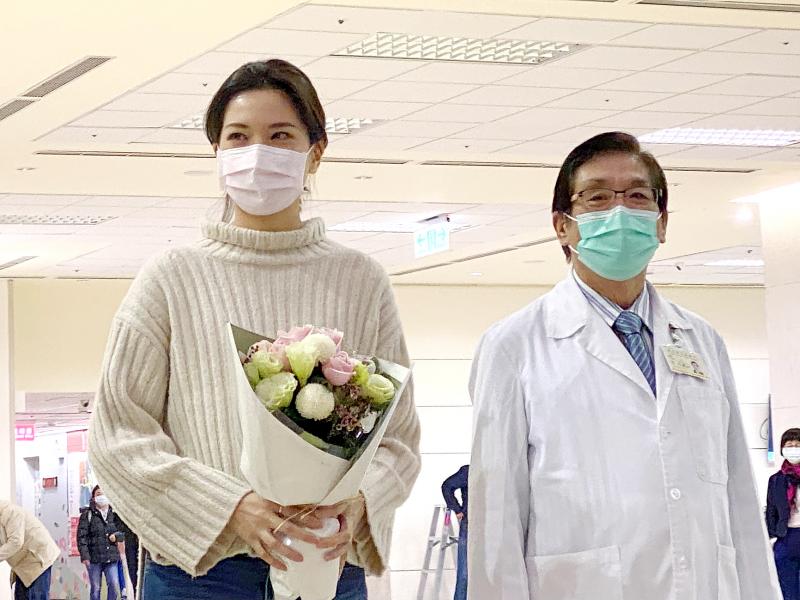
Photo: Cheng Ming-hsiang, Taipei Times
University Cancer Center Chen Chin-hsing (陳晉興) said that people with similar family histories should ask their doctor for screenings for lung nodules — which in most cases are benign, but can be malignant — or signs of other kinds of cancer spreading to the lungs.
“This could be determined through a biopsy,” Chen said.
Especially non-solid nodules, of which 80 percent are malignant, are an indicator of lung cancer, as they often precede cancerous growth, he said.
Nodules less than 5mm in diameter usually do not require surgery, but should be monitored regularly, he said.
Surgery is usually required if nodules grow to more than 8mm, he added.
“When lung nodules are detected early, usually within five years of their appearance, the survival rate is close to 100 percent,” Chen said. “The survival rate for those with nodules of less than 30mm, which have not spread through the lymphatic system, is about 90 percent.”
“If nodules in the lungs grow to 40mm, the rate falls to 60 to 70 percent,” Chen added.
However, if lung cancer spreads to the lymph nodes on both sides of the chest, both lungs and the other organs, the survival rate drops to 15 percent to 20 percent, he added.
The National Health Insurance since June last year subsidizes lung screenings for high-risk groups, including long-term smokers and people with cases of lung cancer in their family.
Health Promotion Administration officials have said that the subsidized low-dose computed tomography is the best tool to detect early-stage lung cancer, allowing physicians to start treatment at a stage with a high likelihood of recovery.

Considering that most countries issue more than five denominations of banknotes, the central bank has decided to redesign all five denominations, the bank said as it prepares for the first major overhaul of the banknotes in more than 24 years. Central bank Governor Yang Chin-lung (楊金龍) is expected to report to the Legislative Yuan today on the bank’s operations and the redesign’s progress. The bank in a report sent to the legislature ahead of today’s meeting said it had commissioned a survey on the public’s preferences. Survey results showed that NT$100 and NT$1,000 banknotes are the most commonly used, while NT$200 and NT$2,000

The Centers for Disease Control (CDC) yesterday reported the first case of a new COVID-19 subvariant — BA.3.2 — in a 10-year-old Singaporean girl who had a fever upon arrival in Taiwan and tested positive for the disease. The girl left Taiwan on March 20 and the case did not have a direct impact on the local community, it said. The WHO added the BA.3.2 strain to its list of Variants Under Monitoring in December last year, but this was the first imported case of the COVID-19 variant in Taiwan, CDC Deputy Director-General Lin Ming-cheng (林明誠) said. The girl arrived in Taiwan on

South Korea is planning to revise its controversial electronic arrival card, a step Taiwanese officials said prompted them to hold off on planned retaliatory measures, a South Korean media report said yesterday. A Yonhap News Agency report said that the South Korean Ministry of Foreign Affairs is planning to remove the “previous departure place” and “next destination” fields from its e-arrival card system. The plan, reached after interagency consultations, is under review and aims to simplify entry procedures and align the electronic form with the paper version, a South Korean ministry official said. The fields — which appeared only on the electronic form

The Ministry of Foreign Affairs (MOFA) is suspending retaliation measures against South Korea that were set to take effect tomorrow, after Seoul said it is updating its e-arrival system, MOFA said today. The measures were to be a new round of retaliation after Taiwan on March 1 changed South Korea's designation on government-issued alien resident certificates held by South Korean nationals to "South Korea” from the "Republic of Korea," the country’s official name. The move came after months of protests to Seoul over its listing of Taiwan as "China (Taiwan)" in dropdown menus on its new online immigration entry system. MOFA last week


 RSS
RSS