


The National Museum of Taiwan History in Tainan is on Friday to reopen following a year-long renovation with four special exhibitions.
The museum, which is in the city’s Annan District (安南), first opened to the public in 2011, but in November 2019, it began a 14-month project to completely transform its children’s hall, update some of the displays in its permanent gallery and upgrade other facilities, it said in a statement on Monday.
The permanent exhibition, titled “Our Land, Our People: The Story of Taiwan,” aims to tell the histories of the land and people in different periods, it said.
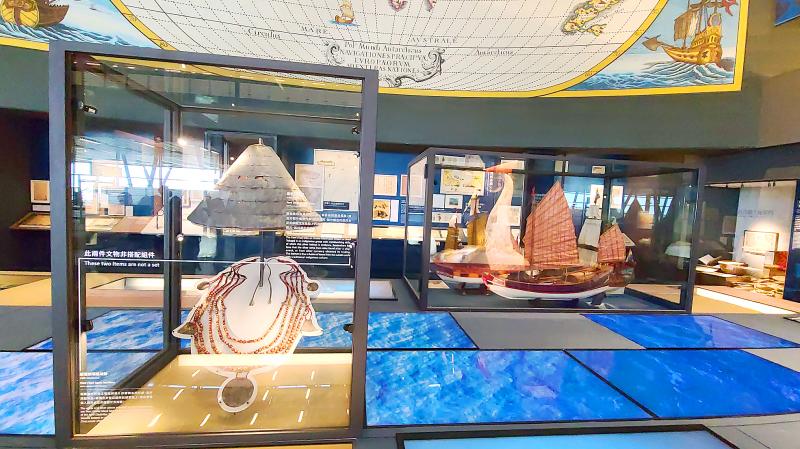
Photo: Liu Wan-chun, Taipei Times
The museum said that it is devoted to showcasing the diverse ethnic groups and cultures of Taiwan, and promoting cultural equity.
The updated permanent exhibition presents a dialogue of diverse values, enhances its depiction of ethnic groups and shows the perspectives of regular local people, museum acting director Yang Hsien-fei (楊仙妃) said.
The museum commissioned contemporary artist Ruby Swana, an Amis, to complete an installation of an Aboriginal legend at the entrance of the permanent exhibition, Yang said.
Discussions of Taiwan’s history should not only be about the past, but should also confront changes in society and reality, she said, adding that in recent years, the museum has added art work on social issues, such as gender equality, new immigrants and social movements.
These works, along with interview data it has collected, are to be on display at the museum following its reopening, she said.
The museum seeks to present contemporary trends in the society and local communities of Taiwan, she added.
The renovation project included creating a space where visitors could use virtual reality to take in stories about history, the museum said.
New facilities with interactive multimedia technology have also been installed to offer visitors a new sensory experience, the museum added.
“Islands in Between: Thousand Faces of Taiwan,” one of the special exhibitions to open on Friday and run through June 6, broaches the question of how Taiwan should be imagined and defined, a description on the museum’s Web site said.
“Contemporary Housing and Society in Taiwan,” a special exhibition to open on Friday and run through April 6, focuses on local housing issues.
General admission to the museum is NT$100. More information about the museum can be found at www.nmth.gov.tw.

FUKUOKA SITUATION: Japanese media reported that the pathogen is expected to be identified by the summer, while the CDC downplayed the idea that it was hMPV A “mysterious cold-like illness” reported in Japan’s Fukuoka Prefecture does not seem to be a new disease, but Japanese authorities have been asked about the situation, the Centers for Disease Control (CDC) said yesterday. The Fukuoka Prefectural Medical Association on Wednesday told a news conference that a “mystery cold” that has become a hot topic on social media is “highly likely to be caused by some kind of viral infection,” Japan’s KBC News reported. “Many people are experiencing symptoms starting with a sore throat, followed by a runny nose, phlegm and a severe cough,” KBC News reported, citing association officials. Health authorities are

Nvidia Corp CEO Jensen Huang (黃仁勳) arrived in Taiwan yesterday ahead of upcoming AI and technology events, saying he plans to meet with clients and Taiwan Semiconductor Manufacturing Co Chairman C.C. Wei (魏哲家) during his visit. After landing at Taipei Songshan Airport, Huang posed for photos with fans and handed out Yakult drinks to reporters and supporters waiting at the scene, saying he has “a lot to do” during the trip. Asked about reports that Nvidia’s planned headquarters site in Taipei’s Beitou Shilin Technology Park could break ground on May 27, Huang said that if the company holds an event, he would

Carrefour Taiwan is to begin using a new name from the start of July, but it cannot divulge the name until then, the chairman of the supermarket chain's parent company said today. President Chain Store Co chairman Lo Chih-hsien (羅智先) was asked by reporters after a shareholders' meeting to confirm whether the company has settled on a new name for the supermarket brand. In March, the government-registered name of two Carrefour Taiwan branches was quietly changed to "Le Chia Kang" (樂家康) in Chinese, raising speculation that has been selected as the name. Lo said that because of local regulations and contractual obligations, the
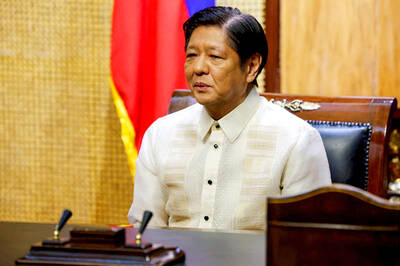
The Philippines would likely be involved in any conflict over Taiwan due to its proximity to the democracy claimed by China, President Ferdinand Marcos Jr said, reiterating a stance that risks angering Beijing. “In the Philippines, we do not have a choice because Taiwan is so close to the Philippines and we have almost 200,000 Filipino nationals living and working in Taiwan,” Marcos said in an interview with Japanese media in Manila on Monday. The Philippine leader’s comments come ahead of a state visit to Japan next week, where he is to meet with Japanese Prime Minister Sanae Takaichi to discuss security


 RSS
RSS