


Borough wardens and a Chinese Nationalist Party (KMT) lawmaker yesterday criticized the government for asking for wardens’ help in implementing ractopamine labeling rules weeks before lawmakers approved the importation of pork containing the substance.
The Ministry of the Interior in a memo on Dec. 3 informed wardens that they would be responsible for distributing ractopamine content label stickers to non-unionized pork vendors and retailers, KMT Legislator Wan Mei-ling (萬美玲) told a news conference in Taipei.
“The memo must have come from the future, because the legislature did not approve the importation of pork containing ractopamine until Dec. 24,” Wan said.
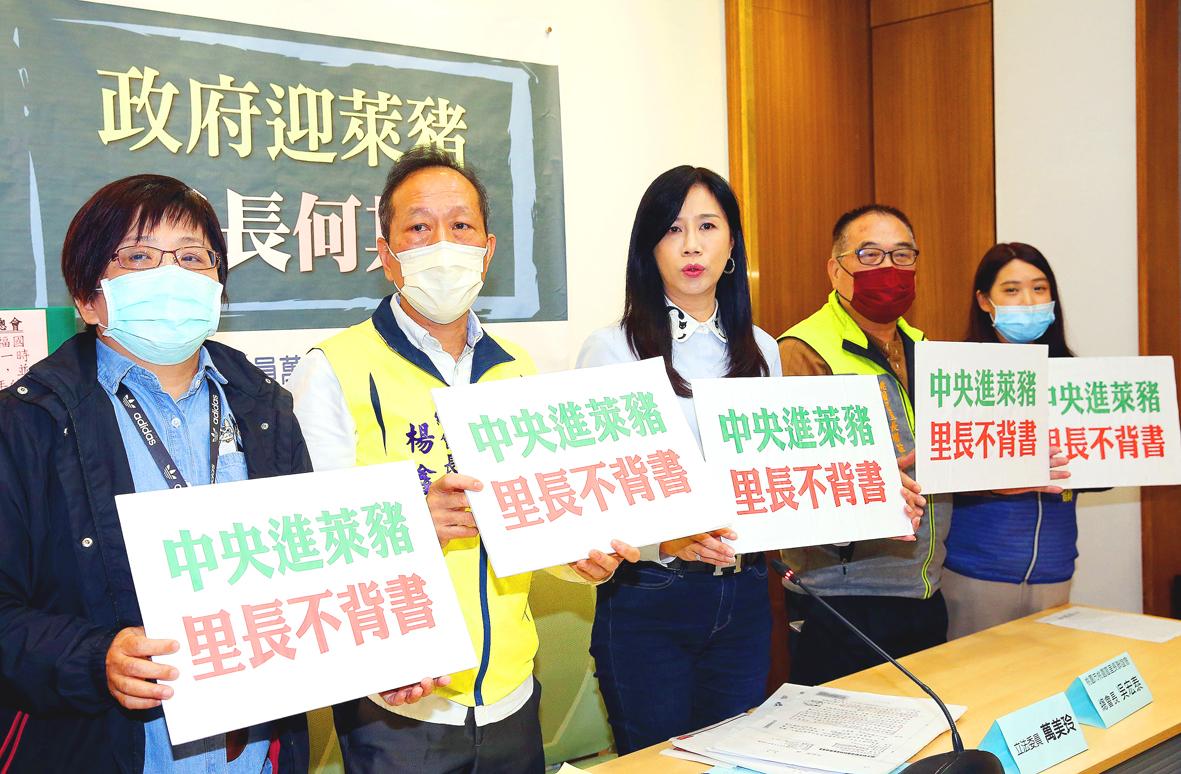
Photo: CNA
The ministry has inappropriately asked wardens, who lack authority over health and welfare matters, to do the government’s work in connection with a policy that is unpopular, she said.
Furthermore, the document was ambiguously phrased and wardens had to call district offices to learn that non-unionized pork vendors and retailers refer to all food stalls, breakfast places and snack shops that sell pork, she said.
“The government is passing the buck to wardens in an issue that could make the public unhappy, yet it could not be bothered to tell the wardens exactly who it is they should be working with,” she said.
The memo did not explain a course of action for dealing with uncooperative vendors, or “who is in charge of monitoring compliance and who would be responsible if the labeling does not match the content,” she said. “It is asking a lot of wardens and is very unfair.”
The ministry has not clarified the roles of sanitation inspectors and wardens in policing food labeling, an omission that has lead to confusion over jurisdiction, Taoyuan’s Rueicing Borough (瑞慶) warden Huang Hsin-yun (黃欣韻) told the news conference.
“The memo they sent us had no explanatory notes and I am sure I am not the only warden confused by it,” she said. “We are willing to comply with government policies, but orders must be clear, precise and inside the bounds of our duties.”
Taiwan Borough Wardens’ Friendship Association president Yang Hsin-kun (楊鑫坤) told the news conference that marking food products is the Ministry of Health and Welfare’s business, in which wardens have no say.
“I kindly thank the government for finding us wardens work, but it is not as if we did not have enough on our plates,” he said. “We are already involved with pandemic control this year.”
“Wardens are willing to serve the public and support government policies, but how come pork containing ractopamine does not have to be clearly marked? Why do wardens have to put their faces on a policy that harms public health?” Yang asked.

Yangmingshan National Park authorities yesterday urged visitors to respect public spaces and obey the law after a couple was caught on a camera livestream having sex at the park’s Qingtiangang (擎天崗) earlier in the day. The Shilin Police Precinct in Taipei said it has identified a suspect and his vehicle registration number, and would summon him for questioning. The case would be handled in accordance with public indecency charges, it added. The couple entered the park at about 11pm on Thursday and began fooling around by 1am yesterday, the police said, adding that the two were unaware of the park’s all-day live

Fast food chain McDonald's is to raise prices by up to NT$5 on some products at its restaurants across Taiwan, starting on Wednesday next week, the company announced today. The prices of all extra value meals and sharing boxes are to increase by NT$5, while breakfast combos and creamy corn soup would go up by NT$3, the company said in a statement. The price of the main items of those meals, if ordered individually, would remain the same. Meanwhile, the price of a medium-sized lemon iced tea and hot cappuccino would rise by NT$3, extra dipping sauces for chicken nuggets would go up

Yangmingshan National Park’s Qingtiangang (擎天崗) nature area has gone viral after a park livestream camera observed a couple in the throes of intimate congress, which was broadcast live on YouTube, drawing large late-night crowds and sparking a backlash over noise, bright lights and disruption to wildlife habitat. The area’s livestream footage appeared to show a couple engaging in sexual activity on a picnic table in the park on Friday last week, with the uncensored footage streamed publicly online. The footage quickly spread across social media, prompting a tide of visitors to travel to the site to “check in” and recreate the

Minister of Digital Affairs Lin Yi-ching (林宜敬) yesterday cited regulatory issues and national security concerns as an expert said that Taiwan is among the few Asian regions without Starlink. Lin made the remarks on Facebook after funP Innovation Group chief executive officer Nathan Chiu (邱繼弘) on Friday said Taiwan and four other countries in Asia — China, North Korea, Afghanistan and Syria — have no access to Starlink. Starlink has become available in 166 countries worldwide, including Ukraine, Malaysia, the Philippines and Vietnam, in the six years since it became commercial, he said. While China and North Korea block Starlink, Syria is not


 RSS
RSS