


Taiwan’s “cancer death clock” in 2018 worsened by 11 seconds to an average of one person diagnosed with cancer every four minutes and 31 seconds, the Health Promotion Administration (HPA) said yesterday, as it announced the nation’s top 10 cancers.
Citing Taiwan Cancer Registry data from 2018, the HPA said that the “cancer death clock” sped up by 11 seconds from 2016.
A total of 116,131 new cancer cases were diagnosed in 2018, an increase of 4,447 from 2017 and a record for Taiwan, it said.
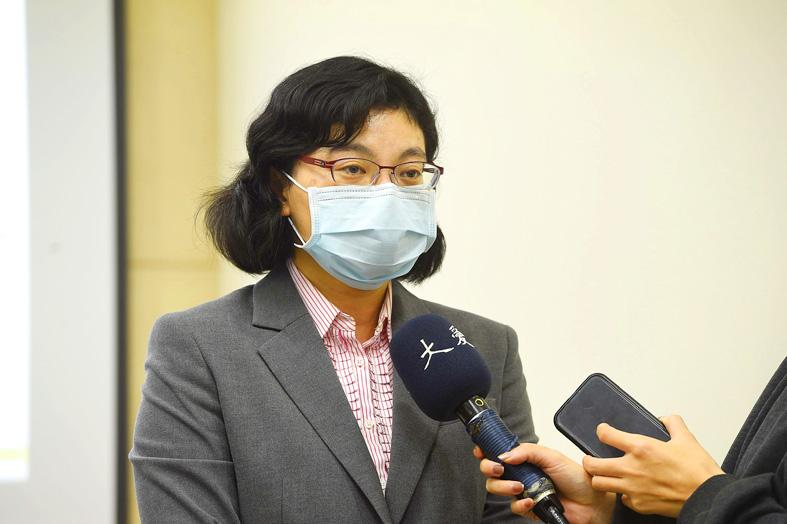
Photo: George Tsorng, Taipei Times
The most common cancers of 2018 were colorectal cancer, followed by lung cancer, female breast cancer, liver cancer, oral cancer, prostate cancer, thyroid cancer, skin cancer, gastric cancer and cancer of the uterine corpus.
The top 10 cancers remained the same as in 2017, except that uterine corpus cancer rose to 10th, while esophageal cancer fell to 11th, HPA Cancer Prevention and Control Division Director Lin Li-ju (林莉茹) said.
A total of 61,779 men were diagnosed with cancer in 2018, an age-standardized incidence rate of 341.3 cases per 100,000 people.
The top five cancers among men were colorectal cancer, lung cancer, liver cancer, oral cancer and prostate cancer.
A total of 54,352 women were diagnosed with cancer in 2018, an age-standardized incidence rate of 284.7 cases per 100,000 people.
The top five cancers among women were breast cancer, lung cancer, colorectal cancer, thyroid cancer and liver cancer.
Colorectal cancer topped the list for the 13th consecutive year, but the age-standardized incidence rate of colorectal cancer has fallen by 1.1 cases per 100,000 people — the most out of the top 10.
The incidence rate greatly increased after a government-funded colorectal cancer screening program was launched, but the incidence and death rates have been falling over the past few years, HPA Director-General Wang Ying-wei (王英偉) said.
Wang said that 2018 was the first year in which the incidence rate dropped for people aged 50 to 84.
Compared with 2017, the incidence rates of prostate cancer and lung cancer increased the most, by three cases per 100,000 people and 1.8 cases per 100,000 people respectively, Lin said.
The number of people diagnosed with early stage lung cancer — stages 0 and 1 — increased the most, up 551 people from 2017, she said.
A total of 4,524 people were diagnosed with early stage lung cancer — 31.1 percent of the lung cancer cases in 2018 and up about 2.1 times from 2009 (14.7 percent), Lin said.
A 2011 study suggests that using low-dose computed tomography (LDCT) to screen lung cancer in heavy smokers can reduce the lung cancer mortality rate, but leads to more people undergoing LDCT scans, she said, which might be a reason for the increase.
The Taiwan Lung Cancer Society, the Taiwan Society of Pulmonary and Critical Care Medicine, the Taiwan Radiological Society, and the Taiwan Society of Thoracic Surgeons advise LDCT screening for heavy smokers — people who have smoked for more than 30 years, and are still smoking or quit less than 15 years ago — aged 50 to 80 and people with a family history of lung cancer, the HPA said.
The agency suggests that people regularly get screed for cancer to detect precancerous lesions or early stage cancers, as most cancers are caused by long-term unhealthy habits, Wang said, adding that the WHO has said that about 30 to 50 percent of cancers can be avoided.
Scientific studies have suggested that getting a fecal occult blood test every two years can reduce colorectal cancer mortality by 35 percent, while regularly being screened for oral cancer can reduce oral cancer mortality in men with a betel nut chewing or smoking habit by 26 percent, the HPA said.
Having a mammogram every two years can reduce breast cancer mortality by 41 percent, while regularly getting a pap smear test can reduce cervical cancer mortality by 70 percent, it added.

FUKUOKA SITUATION: Japanese media reported that the pathogen is expected to be identified by the summer, while the CDC downplayed the idea that it was hMPV A “mysterious cold-like illness” reported in Japan’s Fukuoka Prefecture does not seem to be a new disease, but Japanese authorities have been asked about the situation, the Centers for Disease Control (CDC) said yesterday. The Fukuoka Prefectural Medical Association on Wednesday told a news conference that a “mystery cold” that has become a hot topic on social media is “highly likely to be caused by some kind of viral infection,” Japan’s KBC News reported. “Many people are experiencing symptoms starting with a sore throat, followed by a runny nose, phlegm and a severe cough,” KBC News reported, citing association officials. Health authorities are

Nvidia Corp CEO Jensen Huang (黃仁勳) arrived in Taiwan yesterday ahead of upcoming AI and technology events, saying he plans to meet with clients and Taiwan Semiconductor Manufacturing Co Chairman C.C. Wei (魏哲家) during his visit. After landing at Taipei Songshan Airport, Huang posed for photos with fans and handed out Yakult drinks to reporters and supporters waiting at the scene, saying he has “a lot to do” during the trip. Asked about reports that Nvidia’s planned headquarters site in Taipei’s Beitou Shilin Technology Park could break ground on May 27, Huang said that if the company holds an event, he would

The Ministry of Finance this afternoon announced the winning numbers for the March-April uniform invoice lottery. The winning number for the NT$10 million (US$318,060) special prize is 19531471, and the winning number for the NT$2 million grand prize is 85941329. Three numbers were drawn for the NT$200,000 first prize: 07225810, 20231230 and 83518781. Those with receipts matching the last seven digits of any of the first-prize numbers will win the NT$40,000 second prize, while those matching the last six digits will win the NT$10,000 third prize. Those whose receipts match the last five digits of the first-prize numbers can claim the NT$4,000 fourth prize,
Taiwan Travelogue (臺灣漫遊錄), which earlier this week became the first Taiwanese novel to win the International Booker Prize, is to be adapted into a television series through a Taiwan-Japan coproduction, producer Chang Chen-yu (張辰漁) said yesterday. Chang, a producer at World Softest Production Film Co, wrote on Facebook that the company had been searching for projects with international appeal that retain a strong Taiwanese identity after colleagues and Japanese partners strongly recommended the novel. After reading the book, Chang said he immediately decided to pursue the screen rights. “A great story has the power to transcend time and borders, and connect countless people,”


 RSS
RSS