


The former manager of a daycare center in New Taipei City and two caregivers were on Wednesday sentenced to prison terms between eight and 16 months, after they were found guilty of abusing six toddlers.
In the New Taipei District Court case, Hsia Hui-chuan (夏惠娟), manager of Yu Hsin Daycare Center, was sentenced to nine months in jail, while Chiang Pei-jou (江珮柔) and Chen Hui-ting (陳慧婷), employees of the center, were sentenced to eight and 16 months respectively.
The sentences are commutable to fines, and the ruling can still be appealed, the court filing showed.
The court said that as childcare professionals, the three were expected to take responsibility for the welfare and education of young children, but they physically abused them, which might have caused long-lasting trauma.
The three reached settlements with the parents of only two of the six toddlers, the court said, adding that it therefore decided not to grant them suspended sentences, as they had sought.
The case was first made public in January last year when the parents of the six children in a news conference showed a video they recorded of the abuse at the center.
In the surveillance camera footage, which was leaked by a former employee of the center, one caregiver is seen shaking a toddler.
The video also showed another caregiver hitting a crying toddler on the feet with a wooden spatula, and a third caregiver beating a small child and forcing them into a cupboard.
New Taipei City prosecutors and the city’s Social Welfare Department subsequently launched separate investigations into the case.
The department later fined Hsia, Chiang and Chen NT$140,000 each and publicized their names. The daycare center was fined NT$300,000 and its operating license was suspended for a year.
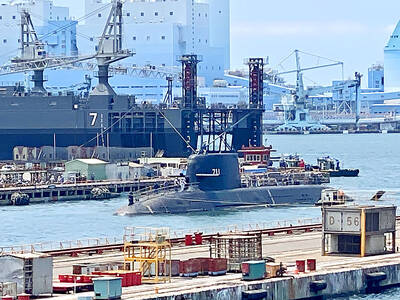
AGING: While Japan has 22 submarines, Taiwan only operates four, two of which were commissioned by the US in 1945 and 1946, and transferred to Taiwan in 1973 Taiwan would need at least 12 submarines to reach modern fleet capabilities, CSBC Corp, Taiwan chairman Chen Cheng-hung (陳政宏) said in an interview broadcast on Friday, citing a US assessment. CSBC is testing the nation’s first indigenous defense submarine, the Hai Kun (海鯤, Narwhal), which is scheduled to be delivered to the navy next month or in July. The Hai Kun has completed torpedo-firing tests and is scheduled to undergo overnight sea trials, Chen said on an SET TV military affairs program. Taiwan would require at least 12 submarines to establish a modern submarine force after assessing the nation’s operational environment and defense
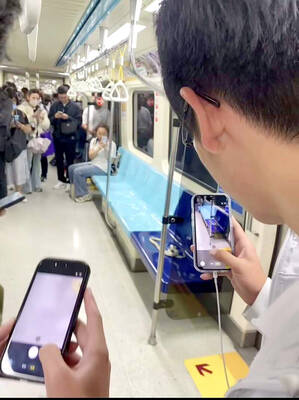
A white king snake that frightened passengers and caused a stir on a Taipei MRT train on Friday evening has been claimed by its owner, who would be fined, Taipei Rapid Transit Corp (TRTC) said yesterday. A person on Threads posted that he thought he was lucky to find an empty row of seats on Friday after boarding a train on the Bannan (Blue) Line, only to spot a white snake with black stripes after sitting down. Startled, he jumped up, he wrote, describing the encounter as “terrifying.” “Taipei’s rat control plan: Release snakes on the metro,” one person wrote in reply, referring
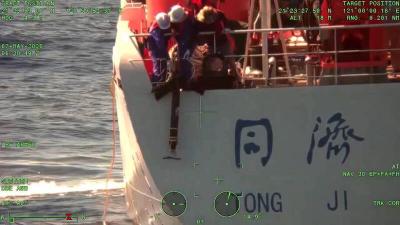
The coast guard today said that it had disrupted "illegal" operations by a Chinese research ship in waters close to the nation and driven it away, part of what Taipei sees a provocative pattern of China's stepped up maritime activities. The coast guard said that it on Thursday last week detected the Chinese ship Tongji (同濟號), which was commissioned only last year, 29 nautical miles (54km) southeast of the southern tip of Taiwan, although just outside restricted waters. The ship was observed lowering ropes into the water, suspected to be the deployment of scientific instruments for "illegal" survey operations, and the coast
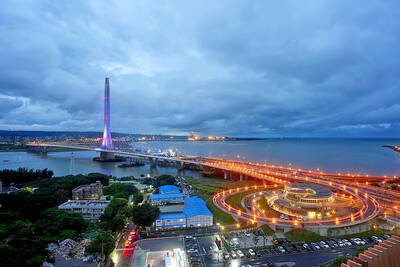
An inauguration ceremony was held yesterday for the Danjiang Bridge, the world’s longest single-mast asymmetric cable-stayed bridge, ahead of its official opening to traffic on Tuesday, marking a major milestone after nearly three decades of planning and construction. At the ceremony in New Taipei City attended by President William Lai (賴清德), Premier Cho Jung-tai (卓榮泰), Minister of Transportation and Communications Chen Shih-kai (陳世凱) and New Taipei City Mayor Hou Yu-ih (侯友宜), the bridge was hailed as both an engineering landmark and a long-awaited regional transport link connecting Tamsui (淡水) and Bali (八里)


 RSS
RSS