


The Chinese Nationalist Party (KMT) is on Jan. 6 to launch a nationwide signature drive to put the importation of US pork containing traces of ractopamine on the ballot, KMT caucus whip Lin Wei-chou (林為洲) said yesterday.
Lin is the lead proposer of a national referendum that would ask voters if they agree that the government should impose a complete ban on the importation of meat, offal and related products from pigs fed the controversial animal feed additive.
The KMT on Sept. 6 presented the referendum proposal at its National Congress in Taipei, after President Tsai Ing-wen (蔡英文) announced on Aug. 28 the government’s decision to ease restrictions on the importation of US pork containing traces of ractopamine and beef from cattle aged 30 months or older.
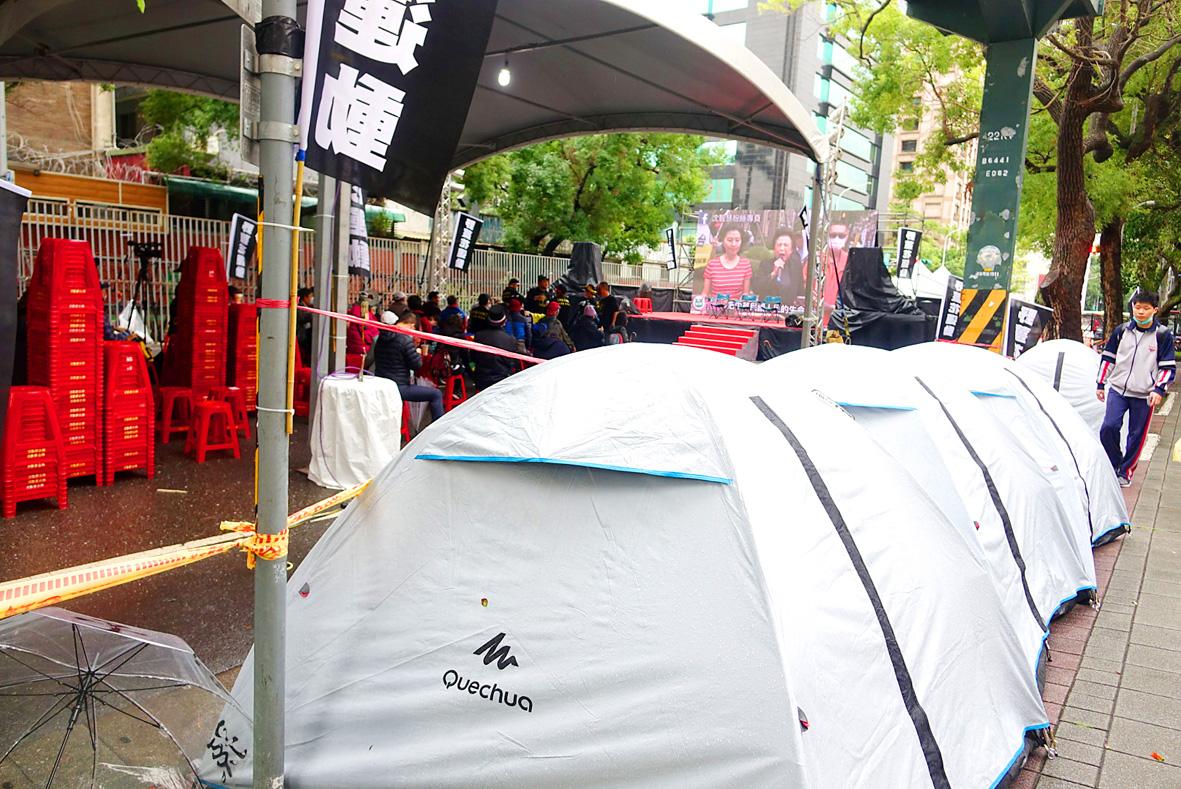
Photo: Wang Yi-sung, Taipei Times
The Central Election Commission (CEC) on Friday last week said that the proposal met the requirements of the first stage after satisfying a Nov. 25 request for clarification, and that it would ask household registration authorities to verify the list of proposers within 15 days.
In the second stage — the signature drive — the KMT has six months to submit a list of nearly 290,000 valid signatures, or no less than 1.5 percent of the total electorate in the most recent presidential election, to comply with the Referendum Act (公民投票法).
Commission data showed that 19,311,105 people were eligible to vote in the Jan. 11 election.
The KMT’s goal is to collect 500,000 signatures, Lin said early yesterday morning, before the start of the legislature’s review of administrative directives and proposed legal amendments related to the government’s decision on US pork.
Lin spoke to reporters in front of the Legislative Yuan’s Chun-hsien Building (群賢樓) in Taipei, where KMT lawmakers spent the night to demonstrate their “firm” opposition to the importation of pork with traces of ractopamine.
Speaking on Wednesday evening from a stage set up on Jinan Road (濟南路), KMT Chairman Johnny Chiang (江啟臣) said that yesterday’s vote would not be the “final battleground” in the bid by the KMT and its supporters to block such pork products.
“On Aug. 28 next year, let us use our votes to decide what kind of pork we want to eat,” he said, referring to the earliest possible date for the proposed referendum.
The Referendum Act stipulates that referendums from next year are to be held once every two years on the fourth Saturday of August.
The KMT was scheduled to hold a rally outside the Legislative Yuan yesterday, with former president Ma Ying-jeou (馬英九) expected to participate.
However, the KMT on Wednesday afternoon said that it canceled all protest activities planned for yesterday, after the Central Epidemic Command Center on Tuesday announced the nation’s first domestic COVID-19 case in more than eight months.
Despite the cancelation, dozens of supporters still gathered on Jinan Road to watch a live broadcast of the proceedings inside the legislative chamber on a large screen.
The KMT livestreamed the voting on Facebook, with KMT Chairman Office director Yeh Hsu-hung (葉旭鴻), KMT Youth Department director Chen Kuan-an (陳冠安), and KMT spokeswoman and New Taipei City Councilor Chiang I-chen (江怡臻) among those providing live commentary.

NATIONAL SECURITY: Authorities are working to confirm the identities of the military personnel involved and investigating possible illegal conduct and regulatory violations Authorities are probing possible national security implications after Kinmen police and immigration officers on Sunday found a Chinese woman allegedly posing as a tourist while engaging in prostitution involving more than 10 military personnel. The woman, surnamed Chen (陳), has since been deported, authorities said, adding that investigators are still working to confirm the identities of those implicated, as the records only listed code names and aliases. The case stemmed from a report received by the Kinmen District Prosecutors’ Office on Friday last week from the Jinhu Precinct of the Kinmen County Police Bureau. On Sunday, police, along with the National Immigration

GLOBALGIVING: ‘ Caving to external pressure is not acceptable for an organization that has cultivated justice reform and human rights for 30 years,’ one NGO said A slew of non-government organizations (NGOs) have withdrawn from the GlobalGiving fundraising platform after it announced it would use “Chinese Taipei” instead of “Taiwan” from next month. The Taiwan Good Rice Association wrote on Facebook on Friday that it was informed on April 28 via a teleconference call of the change, which was made because the platform wanted to operate in China. Taiwan Good Rice is to terminate all cooperative relationships with GlobalGiving in response to the platform’s “unilateral and non-negotiable” decision to remove references to Taiwan, the NGO said. “Taiwan is in the official name of Taiwan Good Rice Association and the

HEAVY WEATHER: Typhoon Jangmi is due to crash straight into the Ryukyus as airlines look to shift flights to larger aircraft or cancel flights to Okinawa entirely Taiwan’s international air carriers announced flight adjustments over the weekend as Typhoon Jangmi is forecast to hit the Ryukyu Islands today and tomorrow. The Central Weather Administration (CWA) upgraded Jangmi from a tropical storm to a typhoon at 8am yesterday, with the eye located 580km south of Naha city. It was moving north at 19kph. Today, China Airlines’ CI-120, CI-121, CI-122 and CI-123 flights between Taoyuan and Naha, Okinawa, have been canceled as well as CI-132 and CI-133 between Kaohsiung and Naha. EVA Air’s BR-112, BR-113, BR-186 and BR-185 flights between Taoyuan and Naha are also canceled. Low-cost carrier Tigerair Taiwan canceled IT-230,
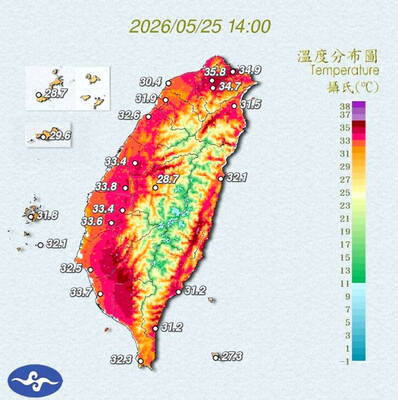
STAY COOL: The HPA recommended that people stay hydrated, use air-conditioning or fans while indoors, wear loose-fitting clothes and walk in the shade while outdoors Employers must implement measures such as installing cooling equipment, and providing drinking water and rest breaks for outdoor workers starting from Monday next week, the Taipei Department of Labor said on Sunday. Employers who fail to comply could face fines of NT$30,000 to NT$300,000 under the Occupational Safety and Health Act (職業安全衛生法), the department said. Businesses in Taipei employing fewer than 100 workers, as well as registered self-employed workers with labor insurance coverage, could receive on-site assessments and guidance from occupational safety consultants to help them apply for central government subsidies to implement or improve heat-protection measures, it said. Under the Ministry of


 RSS
RSS