


A gastric cancer screening and treatment program by National Taiwan University Hospital (NTUH) in Matsu has successfully reduced the gastric cancer incidence rate in the archipelago by 53 percent in 14 years.
Gastric cancer is the fifth-most common cancer and the third-biggest cause of cancer deaths worldwide.
The International Agency for Research on Cancer has predicted that the number of gastric cancer patients would continue to grow in the next 30 years due to the aging population.
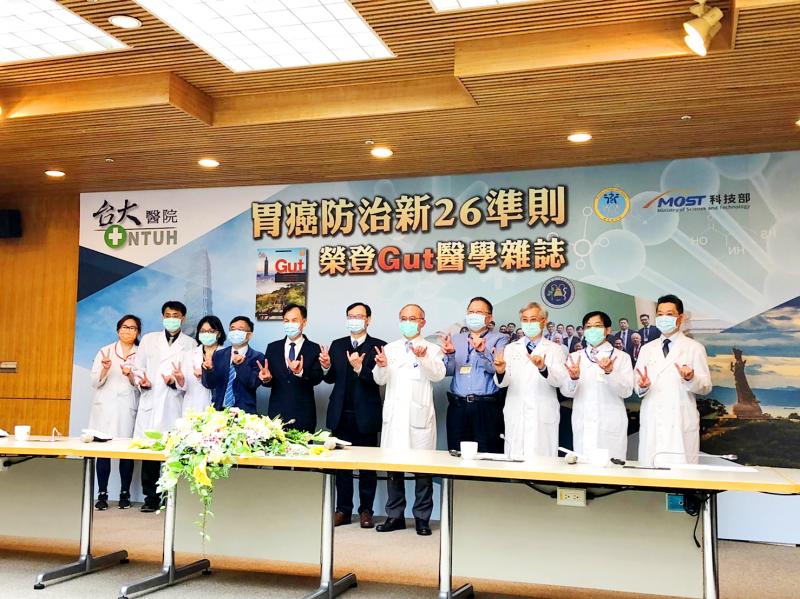
Photo: Yang Yuan-ting, Taipei Times
Due to dietary habits and limited medical resources, Matsu has the highest gastric cancer incidence rate in Taiwan, up to three times the nationwide average.
As Helicobacter pylori bacteria infection is the biggest known risk factor for gastric cancer, NTUH in 2004 launched a program to offer H. pylori screening to Matsu residents 30 years or older, and prescribed medication for H. pylori eradication when applicable.
NTUH department of internal medicine professor Lee Yi-chia (李宜家) said that the hospital screened 7,616 residents between 2004 and 2018, a coverage rate of about 85.5 percent, and among those who received treatment, the H. pylori eradication rate was 93.5 percent.
Due to the program, the H. pylori prevalence rate significantly dropped from nearly 70 percent in 2004 to about 10 percent in 2018, gastric cancer incidence decreased by 53 percent and the mortality rate fell 25 percent, Lee said.
The prevalence rate of H. pylori in adults nationwide is about 31.4 percent, or an estimated 5.9 million, while the prevalence rate in young people is estimated to be about 10 percent, he said.
The bacteria is commonly transmitted among family members through contaminated food or sharing eating utensils, and it can cause chronic gastric inflammation, with about 80 percent of gastric cancer cases found to be linked to H. pylori infection, he added.
NTUH superintendent Wu Ming-shiang (吳明賢) said that the hospital last year held a global consensus meeting on H. pylori screening and gastric cancer prevention, and participants produced 26 guidelines for gastric cancer prevention based on the scientific evidence from the hospital’s study in Matsu.
To highlight Taiwan’s contributions, Gut — a leading international journal on gastroenterology and hepatology — used images of Taiwan, including Taipei 101, on the front cover of its issue this month.
NTUH gastroenterology department attending physician Liou Yh-ming (劉志銘) said that people who often suffer discomfort in the upper stomach or who feel bloated should to undergo an H. pylori screening.
People 50 years or older with a family history of gastric cancer should undergo an H. pylori screening with their regular gastroscopy, Liou said, adding that eradicating H. pylori infection can prevent gastric cancer.

The Grand Hotel Taipei on Saturday confirmed that its information system had been illegally accessed and expressed its deepest apologies for the concern it has caused its customers, adding that the issue is being investigated by the Ministry of Justice Investigation Bureau. The hotel said that on Tuesday last week, it had discovered an external illegal intrusion into its information system. An initial digital forensic investigation confirmed that parts of the system had been accessed, it said, adding that the possibility that some customer data were stolen and leaked could not be ruled out. The actual scope and content of the affected data

DO THEY BITE IT? Cats have better memories than people might think, but their motivation is based entirely around the chance of getting fed Cats can remember the identity of the people who fed them the day before, Taipei-based veterinarians said on Friday, debunking a popular myth that cats have a short memory. If a stray does not recognize the person who fed them the previous day, it is likely because they are not carrying food and the cat has no reason to recognize them, said Wu Chou Animal Hospital head Chen Chen-huan (陳震寰). “When cats come to a human bearing food, it is coming for the food, not the person,” he said. “The food is the key.” Since the cat’s attention is on the food, it

A New York-based NGO has launched a global initiative to rename the nation’s overseas missions, most of which operate under the name "Taipei," to "Taiwan Representative Office (TRO)," according to a news release. Ming Chiang (江明信), CEO of Hello Taiwan, announced the campaign at a news conference in Berlin on Monday, coinciding with the World Forum held from Monday through Wednesday, the institution stated in the release. Speaking at the event, Democratic Progressive Party Legislator Huang Jie (黃捷) said she believed this renaming campaign would enable the international community to see Taiwan

TOO DANGEROUS: The families agreed to suspend crewed recovery efforts that could put rescuers in danger from volcanic gases and unstable terrain The bodies of two Taiwanese tourists and a Japanese pilot have been located inside a volcanic crater, Japanese authorities said yesterday, nearly a month after a sightseeing helicopter crashed during a flight over southwestern Japan. Drone footage taken at the site showed three bodies near the wreckage of the aircraft inside a crater on Mount Aso in Kumamoto Prefecture, police and fire officials said. The helicopter went missing on Jan. 20 and was later found on a steep slope inside the Nakadake No. 1 Crater, about 50m below the rim. Authorities said that conditions at the site made survival highly unlikely, and ruled


 RSS
RSS