


US president-elect Joe Biden is likely to pursue a softer policy on China, focusing on cybersecurity and information technology challenges, as opposed to the “hard containment” direction favored by US President Donald Trump, an academic said yesterday.
At a seminar hosted by the Prospect Foundation in Taipei, Academia Sinica Institute of European and American Studies research fellow Lin Cheng-yi (林正義) and others shared their predictions for US policy in the Indo-Pacific region under the Biden administration.
Biden would likely maintain the current administration’s definition of China as a “strategic competitor,” Lin said.
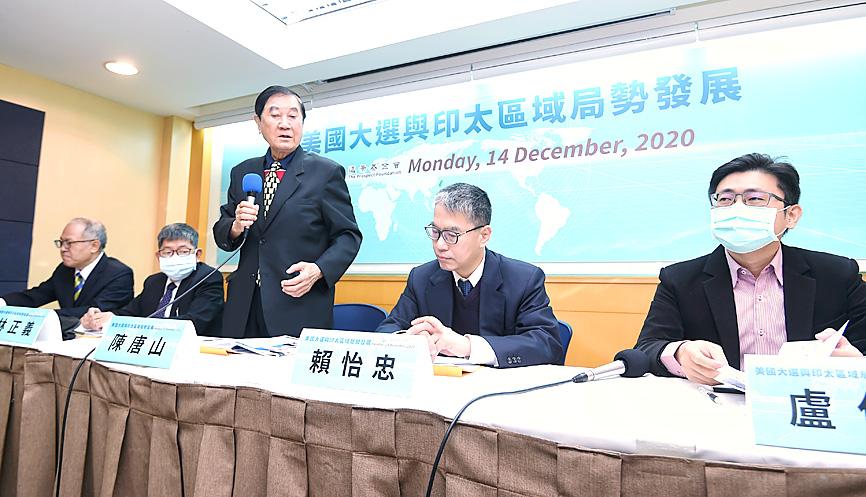
Photo: Fang Pin-chao, Taipei Times
Foundation chairman and former minister of foreign affairs Mark Chen (陳唐山) said there is concern as to whether the next administration would continue the current policy direction toward Taiwan.
Foundation executive director Lai I-chung (賴怡忠) said that many Taiwanese Trump supporters are focusing on his claims of election fraud, but Taiwan should look to see how its neighbors are responding.
This includes China, which is not waiting to make moves, he said.
Lin said that Biden’s continued use of the phrase “Indo-Pacific” signals a fundamental continuation of Trump’s “free and open Indo-Pacific” strategy with a focus on China, even while changing the phrasing.
Although Biden would likely keep the economic tools established under Trump’s policy, many challenges remain, he added.
Biden is to face internal pressure from the Democratic Party to reduce defense spending, coupled with lowering the frequency of troop deployments to the South China Sea, Lin said.
Lu Chun-wei (盧俊偉), a researcher at the Taiwan Institute of Economic Research, said that from an economic perspective, the problems facing China and the US are structural.
Biden is to be tasked with maintaining manufacturing growth, but the landscape remains unclear, Lu said, adding that economic relations in the Asia-Pacific region are complex and cannot be decided by a single factor.
The US would technically have no problem rejoining the Comprehensive and Progressive Agreement for Trans-Pacific Partnership, he said.
For Taiwan, supply chain reorganizations should strengthen its partnerships with ASEAN and other markets, Lu added, suggesting that Taiwan and Japan could work together in Southeast Asia.
Yen Chien-fa (顏建發), a professor of business administration at Chien Hsin University of Science and Technology, said that Biden would center his foreign policy around strengthening cooperation with US allies in the Indo-Pacific region to stem the expansion of Chinese influence.
As both US political parties and most Americans oppose China and support Taiwan, US policy toward Beijing would continue under Biden, reducing Beijing’s hope for the resurrection of former US secretary of state Henry Kissinger-style policy to merely wishful thinking, Yen said.
China is making its neighbors anxious with its expansions into the South China Sea and South Pacific, and across the first and second island chains, he added.
As the confrontation between the US and China takes shape, Taiwan would be deluged with increasingly underhanded threats and harassment, Yen said.
However, Taiwan should remain secure thanks to its domestic security and economic development, as well as external help from the US and neighboring democracies, which have not lost sight of Taiwan’s value, he added.

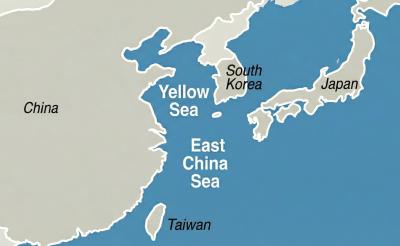
China has reserved offshore airspace in the Yellow Sea and East China Sea from March 27 to May 6, issuing alerts usually used to warn of military exercises, although no such exercises have been announced, the Wall Street Journal (WSJ) reported yesterday. Reserving such a large area for 40 days without explanation is an “unusual step,” as military exercises normally only last a few days, the paper said. These alerts, known as Notice to Air Missions (Notams), “are intended to inform pilots and aviation authorities of temporary airspace hazards or restrictions,” the article said. The airspace reserved in the alert is
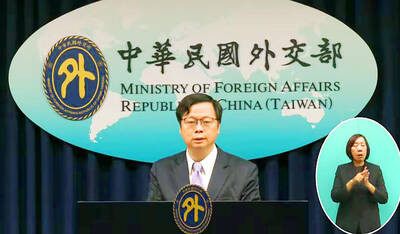
NAMING SPAT: The foreign ministry called on Denmark to propose an acceptable solution to the erroneous nationality used for Taiwanese on residence permits Taiwan has revoked some privileges for Danish diplomatic staff over a Danish permit that lists “Taiwan” as “China,” Eric Huang (黃鈞耀), head of the Ministry of Foreign Affairs’ Department of European Affairs, told a news conference in Taipei yesterday. Reporters asked Huang whether the Danish government had responded to the ministry’s request that it correct the nationality on Danish residence permits of Taiwanese, which has been listed as “China” since 2024. Taiwan’s representative office in Denmark continues to communicate with the Danish government, and the ministry has revoked some privileges previously granted to Danish representatives in Taiwan and would continue to review

More than 6,000 Taiwanese students have participated in exchange programs in China over the past two years, despite the Mainland Affairs Council’s (MAC) “orange light” travel advisory, government records showed. The MAC’s publicly available registry showed that Taiwanese college and university students who went on exchange programs across the Strait numbered 3,592 and 2,966 people respectively. The National Immigration Agency data revealed that 2,296 and 2,551 Chinese students visited Taiwan for study in the same two years. A review of the Web sites of publicly-run universities and colleges showed that Taiwanese higher education institutions continued to recruit students for Chinese educational programs without
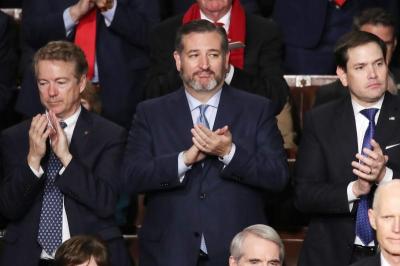
A bipartisan group of US senators has introduced a bill to enhance cooperation with Taiwan on drone development and to reduce reliance on supply chains linked to China. The proposed Blue Skies for Taiwan Act of 2026 was introduced by Republican US senators Ted Cruz and John Curtis, and Democratic US senators Jeff Merkley and Andy Kim. The legislation seeks to ease constraints on Taiwan-US cooperation in uncrewed aerial systems (UAS), including dependence on China-sourced components, limited access to capital and regulatory barriers under US export controls, a news release issued by Cruz on Wednesday said. The bill would establish a "Blue UAS


 RSS
RSS