


Eight Taiwan Railways Administration (TRA) stations are soon to have VIP rooms as the agency prepares for the launch of the Year of the Railway Tourism in 2022.
TRA Director-General Chang Cheng-yuan (張政源) told a forum yesterday that one of the agency’s strategies involves having eight railway stations serving as regional tourism hubs, and that the plan would be implemented in two phases.
The first phase would see the establishment of hubs in Taipei’s Nangang (南港), Taichung’s Xinwuri (新烏日), Kaohsiung’s Xinzuoying (新左營), Pingtung’s Fangliao (枋寮) and Hualien stations, while the second phase would cover Taitung, Luodong (羅東) and Keelung railway stations.
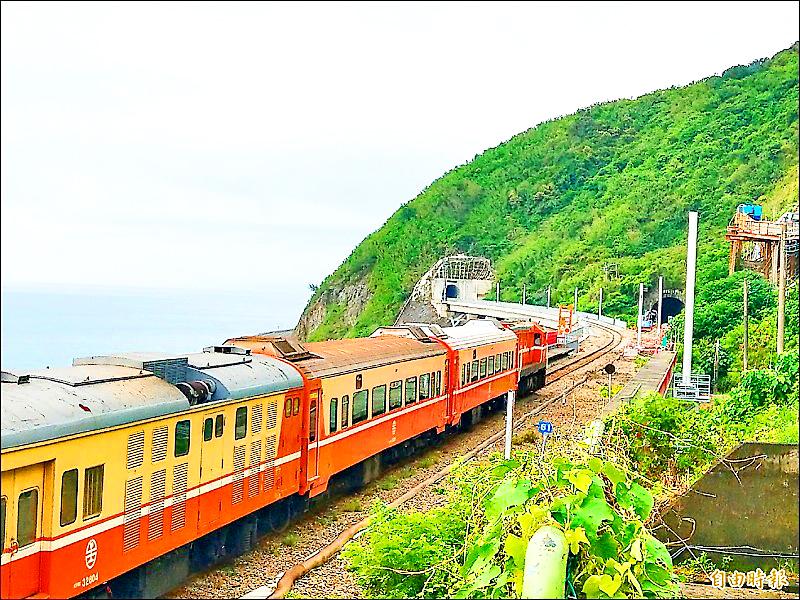
Photo: Cheng Wei-chi, Taipei Times
Each hub would be equipped with a VIP room, Chang said, adding that the one in Hualien is to open on Dec. 30, when the Mingri excursion train is scheduled to transport passengers to the east coast for New Year’s Eve.
Passengers must pay to access services at VIP rooms, except those taking tourist trains, and passengers with a TRA membership would receive a discount, Chang said.
Chang explained how the agency selected some of the regional tourism hubs.
The Nangang Railway Station houses the TRA, high-speed rail and Taipei MRT systems, and is the center of the Taipei City Government’s east gateway project, he said, adding that the station is also the starting point of the proposed high-speed rail extension from Taipei to Yilan.
Xinwuri and Xinzuoying stations were chosen because they also house three railway systems, Chang said.
Fangliao is the terminal station of the agency’s railway line on the west coast and the starting point of the South Link Line, he said.
It is also the starting and terminal points of blue-colored diesel commuter trains, a tourist train service, he added.
To prepare for the Year of Railway Tourism, Chang said the agency has begun upgrading antiquated facilities at the stations at the previously defunct Old Mountain Line and branch lines before turning them into tourist railway lines.
The TRA has allocated more than NT$4 billion (US$139 million) to revamp the Old Mountain Line and the Jiji Branch Line, he said.
It has also purchased 60 tourist train cars for the branch lines, he said.
In addition to the Mingri excursion train and blue commuter train that would begin operations next year, the agency plans to introduce a series of tour train services in 2022 and 2024, he said.
In 2022, it would introduce two excursion train services, he said.
One of them would use refurbished EMU-100 train cars and would carry passengers from Yilan to Taipei via the North Link Line, where passengers can have tea aboard and view the Turtle Island.
Another tourist train service would feature revamped EMU-300 train cars, which would be equipped with large windows, observation decks and a dining bar.
A diamond-class luxury sleeper train is to be unveiled in 2024, Chang said, adding that the agency would work with local designers to build the train.
“In the future, our tour train services would be available at different prices. The food served on board would be different as well,” he said.

NATIONAL SECURITY: Authorities are working to confirm the identities of the military personnel involved and investigating possible illegal conduct and regulatory violations Authorities are probing possible national security implications after Kinmen police and immigration officers on Sunday found a Chinese woman allegedly posing as a tourist while engaging in prostitution involving more than 10 military personnel. The woman, surnamed Chen (陳), has since been deported, authorities said, adding that investigators are still working to confirm the identities of those implicated, as the records only listed code names and aliases. The case stemmed from a report received by the Kinmen District Prosecutors’ Office on Friday last week from the Jinhu Precinct of the Kinmen County Police Bureau. On Sunday, police, along with the National Immigration

GLOBALGIVING: ‘ Caving to external pressure is not acceptable for an organization that has cultivated justice reform and human rights for 30 years,’ one NGO said A slew of non-government organizations (NGOs) have withdrawn from the GlobalGiving fundraising platform after it announced it would use “Chinese Taipei” instead of “Taiwan” from next month. The Taiwan Good Rice Association wrote on Facebook on Friday that it was informed on April 28 via a teleconference call of the change, which was made because the platform wanted to operate in China. Taiwan Good Rice is to terminate all cooperative relationships with GlobalGiving in response to the platform’s “unilateral and non-negotiable” decision to remove references to Taiwan, the NGO said. “Taiwan is in the official name of Taiwan Good Rice Association and the

HEAVY WEATHER: Typhoon Jangmi is due to crash straight into the Ryukyus as airlines look to shift flights to larger aircraft or cancel flights to Okinawa entirely Taiwan’s international air carriers announced flight adjustments over the weekend as Typhoon Jangmi is forecast to hit the Ryukyu Islands today and tomorrow. The Central Weather Administration (CWA) upgraded Jangmi from a tropical storm to a typhoon at 8am yesterday, with the eye located 580km south of Naha city. It was moving north at 19kph. Today, China Airlines’ CI-120, CI-121, CI-122 and CI-123 flights between Taoyuan and Naha, Okinawa, have been canceled as well as CI-132 and CI-133 between Kaohsiung and Naha. EVA Air’s BR-112, BR-113, BR-186 and BR-185 flights between Taoyuan and Naha are also canceled. Low-cost carrier Tigerair Taiwan canceled IT-230,
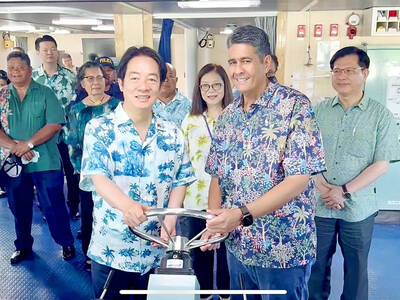
MULTIPRONGED APPROACH: China has sought to pressure Palau across a number of fronts, but the island nation has staunchly resisted overtures to ditch Taiwan Palau has been firm in backing Taiwan despite Chinese pressure that uses tourism economics, cyberattacks and criminal infiltration as tools to threaten the Pacific ally into renouncing its recognition of Taiwan as a sovereign state. The Presidential Office yesterday announced that Vice President Hsiao Bi-khim (蕭美琴) would visit Palau from Saturday to Wednesday next week at the invitation of Palauan President Surangel Whipps Jr. Whipps in April said in an interview that China had outspokenly asked Palau to “denounce Taiwan.” “And we have said: ‘We have no enemies, but nobody tells us who our friends are,’” he said. Whipps has told reporters multiple times


 RSS
RSS