


My Missing Valentine (消失的情人節) on Saturday won big at the 57th Golden Horse Awards, taking home awards in five of the 11 categories in which it was nominated.
The romantic comedy had the most nominations going into the ceremony at the Sun Yat-sen Memorial Hall in Taipei, and it came out with the honors for Best Narrative Feature, Best Director, Best Original Screenplay, Best Film Editing and Best Visual Effects.
“I want to thank my parents for giving birth to such an adorable and kind child,” director Chen Yu-hsun (陳玉勳) joked during his acceptance speech.

Photo: CNA
“I also would like to thank the cast and crew,” he added.
The film follows a quirky woman in her 30s who has never been in a romantic relationship. The day before Valentine’s Day, she meets a handsome man on her way home from work, who asks her out on a date. When she wakes up, she finds that the holiday has mysteriously passed without her knowing.
The other Best Feature Film nominees were Days (日子), directed by Taiwan-based Malaysian director Tsai Ming-liang (蔡明亮); Hand Rolled Cigarette (手捲煙) by Hong Kong director Chan Kin-long (陳健朗); Classmates Minus (同學麥娜絲) by Huang Hsin-yao (黃信堯); and Dear Tenant (親愛的房客) by Cheng Yu-chieh (鄭有傑).
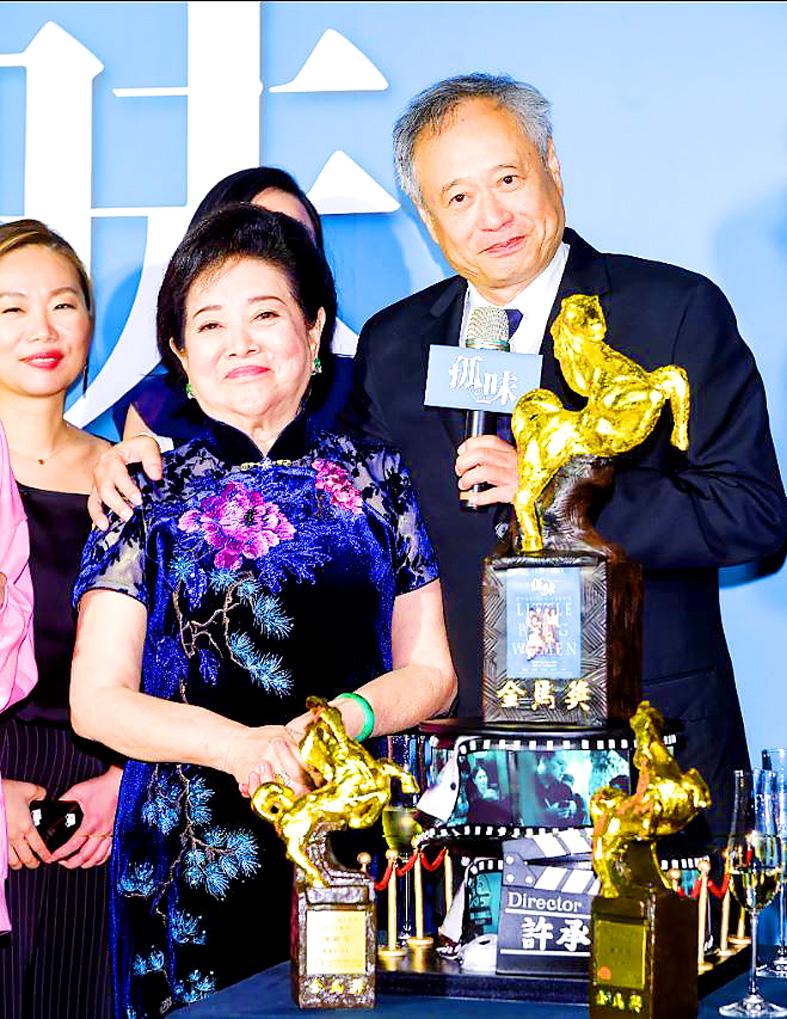
Photo: Wang Wen-lin, Taipei Times
Dear Tenant had the second-most wins of the night, taking home awards for Best Leading Actor, Best Supporting Actress and Best Original Film Score.
The most discussed films in the Best Narrative Feature category were My Missing Valentine, Days and Classmates Minus, said Wen Tien-hsiang (聞天祥), chief executive officer of the Taipei Golden Horse Film Festival’s Executive Committee.
A sentimental moment came when 81-year-old actress Chen Shu-fang (陳淑芳), who had never been nominated for a Golden Horse Award in an acting career that has spanned more than 60 years, took home two trophies.
She won Best Actress for her performance in the family drama Little Big Women (孤味) and Best Supporting Actress for her role in the family drama Dear Tenant.
While introducing the nominees, Taiwanese-American director Ang Lee (李安), the chairman of the Golden Horse Executive Committee, said it was moving to see people attend a film awards ceremony in person amid the COVID-19 pandemic.
“We are probably the only people who can do this now, because Taiwan has done such a good job in containing the pandemic,” Lee said.
Two Hong Kong films also won accolades at the Golden Horse Awards.
Lost Course (迷航), about the southern Chinese village of Wukan that became a symbol of resistance against corruption in 2011, won Best Documentary, while Night is Young (夜更), about a taxi driver during last year’s pro-democracy protests in the territory, won Best Live Action Short Film.
Night is Young’s director Kwok Zune (郭臻) did not collect accept the award in person, but in an acceptance speech read by a representative, he said: “May freedom belong to the people. The night is young, we keep on fighting. Save 12,” referring to 12 Hong Kong pro-democracy activists detained in China.
China last year banned all Chinese filmmakers, actors and actresses from participating after Taiwanese director Fu Yue (傅榆) in her acceptance speech for Best Documentary in 2018 called for Taiwan to be treated as an “independent entity.”
The committee in late September announced that 100 entries had been received from China for this year’s awards.

NATIONAL SECURITY: Authorities are working to confirm the identities of the military personnel involved and investigating possible illegal conduct and regulatory violations Authorities are probing possible national security implications after Kinmen police and immigration officers on Sunday found a Chinese woman allegedly posing as a tourist while engaging in prostitution involving more than 10 military personnel. The woman, surnamed Chen (陳), has since been deported, authorities said, adding that investigators are still working to confirm the identities of those implicated, as the records only listed code names and aliases. The case stemmed from a report received by the Kinmen District Prosecutors’ Office on Friday last week from the Jinhu Precinct of the Kinmen County Police Bureau. On Sunday, police, along with the National Immigration

GLOBALGIVING: ‘ Caving to external pressure is not acceptable for an organization that has cultivated justice reform and human rights for 30 years,’ one NGO said A slew of non-government organizations (NGOs) have withdrawn from the GlobalGiving fundraising platform after it announced it would use “Chinese Taipei” instead of “Taiwan” from next month. The Taiwan Good Rice Association wrote on Facebook on Friday that it was informed on April 28 via a teleconference call of the change, which was made because the platform wanted to operate in China. Taiwan Good Rice is to terminate all cooperative relationships with GlobalGiving in response to the platform’s “unilateral and non-negotiable” decision to remove references to Taiwan, the NGO said. “Taiwan is in the official name of Taiwan Good Rice Association and the

HEAVY WEATHER: Typhoon Jangmi is due to crash straight into the Ryukyus as airlines look to shift flights to larger aircraft or cancel flights to Okinawa entirely Taiwan’s international air carriers announced flight adjustments over the weekend as Typhoon Jangmi is forecast to hit the Ryukyu Islands today and tomorrow. The Central Weather Administration (CWA) upgraded Jangmi from a tropical storm to a typhoon at 8am yesterday, with the eye located 580km south of Naha city. It was moving north at 19kph. Today, China Airlines’ CI-120, CI-121, CI-122 and CI-123 flights between Taoyuan and Naha, Okinawa, have been canceled as well as CI-132 and CI-133 between Kaohsiung and Naha. EVA Air’s BR-112, BR-113, BR-186 and BR-185 flights between Taoyuan and Naha are also canceled. Low-cost carrier Tigerair Taiwan canceled IT-230,

MULTIPRONGED APPROACH: China has sought to pressure Palau across a number of fronts, but the island nation has staunchly resisted overtures to ditch Taiwan Palau has been firm in backing Taiwan despite Chinese pressure that uses tourism economics, cyberattacks and criminal infiltration as tools to threaten the Pacific ally into renouncing its recognition of Taiwan as a sovereign state. The Presidential Office yesterday announced that Vice President Hsiao Bi-khim (蕭美琴) would visit Palau from Saturday to Wednesday next week at the invitation of Palauan President Surangel Whipps Jr. Whipps in April said in an interview that China had outspokenly asked Palau to “denounce Taiwan.” “And we have said: ‘We have no enemies, but nobody tells us who our friends are,’” he said. Whipps has told reporters multiple times


 RSS
RSS