


Several US senators across party lines on Friday expressed disappointment with Taiwan’s exclusion from the annual World Health Assembly (WHA), the decisionmaking body of the WHO, and urged the organization to allow the nation meaningful participation in its activities.
“Despite its indisputable accomplishments and contributions to global health, the WHO continues to exclude Taiwan from the WHA due to pressure from Beijing,” the senators said in a joint letter to WHO Director-General Tedros Adhanom Ghebreyesus.
“This places the political agenda of a single member over the health of the global community,” it said.
The letter was signed by senators Marco Rubio and Ted Cruz of the Republican Party, as well as Democratic senators Ed Markey, Jeff Merkley and Sherrod Brown.
The signatories voiced their disappointment after Taiwan did not receive an invitation to attend the resumption of the annual WHA session, held from Monday to Saturday last week, after a shortened online conference was held in May.
The senators praised Taiwan’s efforts containing its local COVID-19 outbreak, “which it was able to do without resorting to strict restrictions on its people,” they said.
The senators said that Taiwan’s success “should serve as a model to the rest of us, and it is further evidence that Taiwan is extraordinarily qualified to contribute to the WHA.”
They also lauded Taiwan for reporting no new locally transmitted cases of COVID-19 for more than 200 consecutive days, setting a world record.
“Allowing Taiwan’s meaningful participation in future events will ensure that their public health experts have the opportunity to share best practices and contribute to an effective global response to the pandemic,” the senators said.
They said that Taiwan has been one of the most generous donors in the world of COVID-19-related materials, as the nation has given personal protective equipment and other medical supplies and technologies to countries in need.
The senators urged the WHO not to bow to pressure from Beijing, as marshaling all available resources to respond to the COVID-19 pandemic should be the health organization’s top priority.
“The WHO cannot fulfill its stated mission of ‘building a better, healthier future for people all over the world’ if it continues to deny Taiwan observer status,” they said. “It is in the interest of all nations that the world’s leading health agency be able to withstand the influence of bad actors who are motivated by interests that have nothing to do with advancing global health security.”

LOUD AND PROUD Taiwan might have taken a drubbing against Australia and Japan, but you might not know it from the enthusiasm and numbers of the fans Taiwan might not be expected to win the World Baseball Classic (WBC) but their fans are making their presence felt in Tokyo, with tens of thousands decked out in the team’s blue, blowing horns and singing songs. Taiwanese fans have packed out the Tokyo Dome for all three of their games so far and even threatened to drown out home team supporters when their team played Japan on Friday. They blew trumpets, chanted for their favorite players and had their own cheerleading squad who dance on a stage during the game. The team struggled to match that exuberance on the field, with
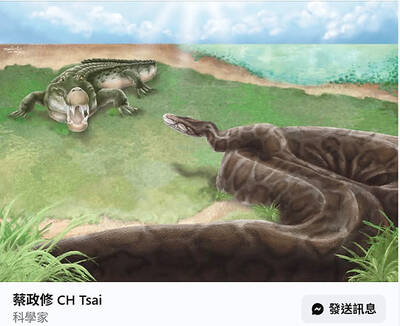
Taiwanese paleontologists have discovered fossil evidence that pythons up to 4m long inhabited Taiwan during the Pleistocene epoch, reporting their findings in the international scientific journal Historical Biology. National Taiwan University (NTU) Institute of Ecology and Evolutionary Biology associate professor Tsai Cheng-hsiu (蔡政修) led the team that discovered the largest snake fossil ever found in Taiwan. The single trunk vertebra was discovered in Tainan at the Chiting Formation, dated to between 400,000 and 800,000 years ago in the Middle Pleistocene, the paper said. The area also produced Taiwan’s first avian fossil, as well as crocodile, mammoth, saber-toothed cat and rhinoceros fossils, it said. Discoveries

Taiwanese paleontologists have discovered fossil evidence that pythons up to 4m long inhabited Taiwan during the Pleistocene epoch, reporting their findings in the international scientific journal Historical Biology. National Taiwan University (NTU) Institute of Ecology and Evolutionary Biology associate professor Tsai Cheng-hsiu (蔡政修) led the team that discovered the largest snake fossil ever found in Taiwan. A single trunk vertebra was discovered in Tainan at the Chiting Formation, dated to between 800,000 to 400,000 years ago in the Middle Pleistocene, the paper said. The area also produced Taiwan’s first avian fossil, as well as crocodile, mammoth, sabre-toothed cat and rhinoceros fossils, it said. Discoveries

Whether Japan would help defend Taiwan in case of a cross-strait conflict would depend on the US and the extent to which Japan would be allowed to act under the US-Japan Security Treaty, former Japanese minister of defense Satoshi Morimoto said. As China has not given up on the idea of invading Taiwan by force, to what extent Japan could support US military action would hinge on Washington’s intention and its negotiation with Tokyo, Morimoto said in an interview with the Liberty Times (sister paper of the Taipei Times) yesterday. There has to be sufficient mutual recognition of how Japan could provide


 RSS
RSS