


The Central Election Commission yesterday said that a motion to recall Democratic Progressive Party (DPP) Taoyuan City Councilor Wang Hao-yu (王浩宇) had been approved and the vote would be held on Jan. 16.
The motion was proposed by Hope Media executive officer Tang Ping-jung (唐平榮).
Eligible voters in the constituency represented by Wang number 315,143, of which 31,515 had to sign for the recall motion to proceed, the commission said.

Photo: Tsai Ching-hua, Taipei Times
The commission received 38,922 signatures, of which 5,506 were invalid, it said, adding that the number of valid signatures exceeded the threshold.
Wang would be asked to provide by Dec. 3 documents in his defense, while a televised debate on the recall would be held between Jan. 6 and Jan. 15, the commission said, adding that voting on Jan. 16 would run from 8am to 4pm.
The count would be verified and the result announced by Jan. 22, it said.
In related news, a group seeking to recall independent Kaohsiung City Councilor Huang Chieh (黃捷) yesterday delivered the second phase of signatures — totaling 40,918 — to the Kaohsiung City Election Commission.
Group spokesman Hsu Shang-hsien (徐尚賢) said that Fongshan District (鳳山) — which Huang represents — “does not need to be represented by someone who contributes to social instability and fails to live up to their own ideals.”
Huang has said that she wants to develop “rainbow” industries in Fongshan.
Critics have said that the plan would lead to social instability and would not respect heterosexuals.
They say that Huang’s absence when the city council voted on a measure to not permit residue of leanness-enhancing feed additives in meat showed that she does not live up to her own standards.
Huang yesterday said that she would remain focused on issues that require attention.
She called on her supporters who said that they wanted to protest the recall to stand down and continue with their lives.

Taiwanese paleontologists have discovered fossil evidence that pythons up to 4m long inhabited Taiwan during the Pleistocene epoch, reporting their findings in the international scientific journal Historical Biology. National Taiwan University (NTU) Institute of Ecology and Evolutionary Biology associate professor Tsai Cheng-hsiu (蔡政修) led the team that discovered the largest snake fossil ever found in Taiwan. The single trunk vertebra was discovered in Tainan at the Chiting Formation, dated to between 400,000 and 800,000 years ago in the Middle Pleistocene, the paper said. The area also produced Taiwan’s first avian fossil, as well as crocodile, mammoth, saber-toothed cat and rhinoceros fossils, it said. Discoveries

Taiwanese paleontologists have discovered fossil evidence that pythons up to 4m long inhabited Taiwan during the Pleistocene epoch, reporting their findings in the international scientific journal Historical Biology. National Taiwan University (NTU) Institute of Ecology and Evolutionary Biology associate professor Tsai Cheng-hsiu (蔡政修) led the team that discovered the largest snake fossil ever found in Taiwan. A single trunk vertebra was discovered in Tainan at the Chiting Formation, dated to between 800,000 to 400,000 years ago in the Middle Pleistocene, the paper said. The area also produced Taiwan’s first avian fossil, as well as crocodile, mammoth, sabre-toothed cat and rhinoceros fossils, it said. Discoveries

Whether Japan would help defend Taiwan in case of a cross-strait conflict would depend on the US and the extent to which Japan would be allowed to act under the US-Japan Security Treaty, former Japanese minister of defense Satoshi Morimoto said. As China has not given up on the idea of invading Taiwan by force, to what extent Japan could support US military action would hinge on Washington’s intention and its negotiation with Tokyo, Morimoto said in an interview with the Liberty Times (sister paper of the Taipei Times) yesterday. There has to be sufficient mutual recognition of how Japan could provide
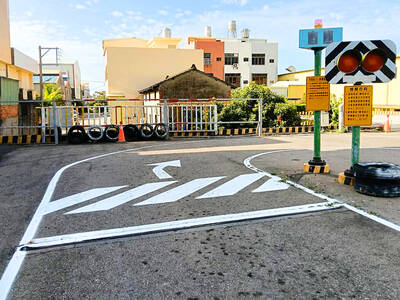
UPDATED TEST: The new rules aim to assess drivers’ awareness of risky behaviors and how they respond under certain circumstances, the Highway Bureau said Driver’s license applicants who fail to yield to pedestrians at intersections or to check blind spots, or omit pointing-and-calling procedures would fail the driving test, the Highway Bureau said yesterday. The change is set to be implemented at the end of the month, and is part of the bureau’s reform of the driving portion of the test, which has been criticized for failing to assess whether drivers can operate vehicles safely. Sedan drivers would be tested regarding yielding to pedestrians and turning their heads to check blind spots, while drivers of large vehicles would be tested on their familiarity with pointing-and-calling


 RSS
RSS