

Starting on Dec. 1, people aged between 50 and 64 without underlying conditions can get a government-funded influenza vaccination, the Central Epidemic Command Center (CECC) said yesterday.
Minister of Health and Welfare Chen Shih-chung (陳時中), who heads the center, said the decision was made to make more free shots available because the coverage rates for people 65 years or above and pre-elementary-school children — those older than six months — have almost reached their targets.
Due to the rush to get the free shots when the program was launched on Oct. 5, the Centers for Disease Control on Oct. 16 announced to temporary halt to the eligibility of people aged between 50 and 64 who have no chronic diseases for the vaccinations.
Suspending the eligibility of this age group was aimed at giving priority to the groups with a higher infection risk — the elderly and pre-elementary school children — and to achieve a more effective herd immunity, Chen said on Oct. 16.
As of Tuesday, about 5.45 million doses had been given, and the vaccination coverage rates of the elderly and pre-elementary school children had reached 49.3 percent and 44.6 percent respectively, he said yesterday.
The coverage rates for those two groups were expected to reach 51 percent and 48 percent respectively, by the end of the month, close to the target coverage rates of 52.5 percent and 55.5 percent, he said.
Moreover, the vaccination coverage rate for healthcare professionals has reached 72.1 percent, close to the target of 75 percent, he said.
Excluding the doses reserved for students being vaccinated on their campuses, there would be about 200,000 doses remaining by the end of the month, and an additional 60,000 doses have been procured and are expected to be available by the middle of next month, he said.
“We hope to reach an overall vaccination coverage rate of about 32 percent, including government-funded and pay-out-of-pocket vaccinations, by the end of the year,” he said.
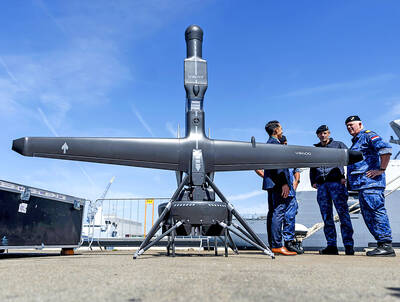
DEFENSE PROCUREMENT: Taiwan could become the largest operator of V-BAT drones outside the US once they are delivered, the Ministry of National Defense said The navy and the coast guard are acquiring 292 units of MQ-35A V-BAT vertical takeoff and landing (VTOL) surveillance drones manufactured by US-based defense technology company Shield AI, making Taiwan one of the largest buyers of the drone. The Coast Guard Administration budgeted NT$1.2 billion (US$37.1 million) to buy 12 drones, which have been delivered, Shield AI said in a report on Oct 13. The navy is planning to spend NT$36 billion under a four-year program code-named Project Yuan Xiao (遠鴞) to acquire 280 V-BAT drones, the Ministry of National Defense’s fiscal 2027 report showed. The combined procurement is expected

MAYORAL RACE: Su Chiao-hui made gains by persuading undecided voters and winning over voters in KMT-leaning districts, a pollster said Legislator Su Chiao-hui (蘇巧慧), the Democratic Progressive Party’s (DPP) candidate for New Taipei City mayor, has a 13.1 percentage point lead over her Chinese Nationalist Party (KMT) rival Lee Shu-chuan (李四川), a poll released yesterday showed. The poll, commissioned by the Taipei Trust in Democracy Association, showed that 43.1 percent of respondents said they would vote for Su, up 7.9 percentage points from a poll conducted in late August, while support for Lee was at 30 percent, down 4.7 percentage points. It showed that 48.6 percent of respondents thought Su would make a suitable mayor, compared with 35.9 percent for Lee. Independent candidate
A Chinese People's Liberation Army (PLA) Navy aircraft carrier group was being monitored after entering the western Pacific, the Ministry of National Defense said today, after Beijing yesterday criticized Taiwan for using a water cannon against a Chinese fishing boat near the Pratas Islands (Dongsha Islands, 東沙群島). A Chinese naval task group led by the aircraft carrier Liaoning (遼寧) yesterday sailed to the western Pacific for training, Chinese state-run Xinhua news agency quoted the PLA Navy as saying. “The drill is part of the annual routine training plan aimed at testing and improving the troops’ combat readiness and enhancing their ability to

Pulled aside onto the balcony of an empty hotel room by Chinese state security officers, a Taiwanese tourist on a trip to Tibet described facing an unnerving barrage of questions about his military background and political loyalties. The man surnamed Lin (林) reported his experience in a viral post on Threads before accepting an interview with the Central News Agency (CNA) yesterday. Lin, who works as a nurse, told CNA that he knew some Taiwanese had run afoul of Chinese law enforcement, but he thought he would be safe, as he did not post much about his personal political views online. It came


 RSS
RSS