


Customs officers at Kaohsiung Port yesterday said they have seized 2,000 boxes of cigarettes holding 1 million cartons of cigarettes inside two shipping containers from China, while Penghu County authorities said they last month confiscated more than 11,000 boxes of contraband Chinese cigarettes aboard a Panama-registered cargo ship operated by a Chinese crew.
Customs Administration officials said both were likely smuggling operations run by criminal elements from several countries, as the seized cigarettes were undeclared and untaxed, and the ships originated from Chinese ports.
The cigarettes seized in Penghu had an estimated value of NT$500 million (US$17.36 million), while those in Kaohsiung were valued at NT$70 million, the agency said in a statement.
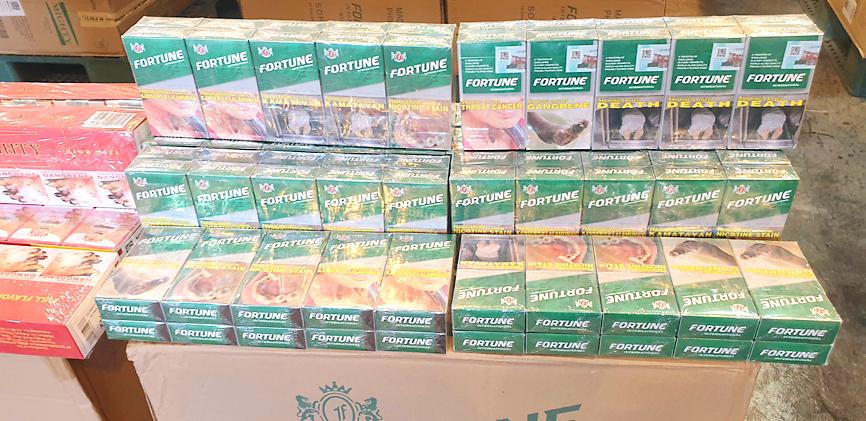
Photo: CNA
Kaohsiung customs officers became suspicious of the two 40-foot containers waiting for transshipment at the port’s No. 70 pier after they were unloaded from a cargo vessel originating from China’s Guangdong Province. The containers were listed as being destined for the Philippines’ Subic Bay Port.
Shipping documents for the containers declared their contents as “stretch film,” but customs officers discovered they were loaded with boxes of leading cigarette brands from the Philippines, including Fortune, Two Moon and Mighty, the statement said.
Customs officers seized the boxes due to falsified information on the bill of lading and other shipping documents, and for not paying taxes.
They said they would also investigate possible contraventions of the Customs Anti-smuggling Act (海關緝私條例) and the Tobacco and Alcohol Administration Act (菸酒管理法).
In Penghu on Sunday, prosecutors concluded a preliminary investigation into the seizure of contraband cigarettes on Oct. 30 at Suogang Harbor.
Charges of smuggling and other offenses were laid against the 13 Chinese crew members of the cargo ship, along with contraventions of the Tobacco and Alcohol Administration Act, and the laws governing relations between peoples of Taiwan and China, the prosecutors said in a statement.
The investigation found that the ship left Ningde Port in China’s Fujian Province early last month.
It first headed to Cai Lan Port in Vietnam, where it allegedly picked up the illicit cargo of 11,158 cardboard boxes of contraband Chinese cigarettes, including popular brands such as Panda, Baisha and Zhonghua, along with some high-priced luxury brands that cost up to 100 yuan (US$15.20) a pack in China, prosecutors said.
The modus operandi of Chinese smugglers has been to have cargo ships sail along the Chinese side of the Taiwan Strait and divide the illicit cargo among civilian Chinese fishing boats, which then either try to sneak into small Taiwanese harbors at night or transfer the contraband goods to colluding Taiwanese fishing boats, with criminal rings coordinating communication, prosecutors said.
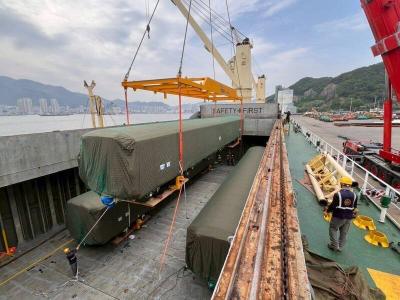
The first of 10 new high-capacity trains purchased from South Korea’s Hyundai Rotem arrived at the Port of Taipei yesterday to meet the demands of an expanding metro network, Taipei Rapid Transit Corp (TRTC) said yesterday. The train completed a three-day, 1,200km voyage from the Port of Masan in South Korea, the company said. Costing NT$590 million (US$18.79 million) each, the new six-carriage trains feature a redesigned interior based on "human-centric" transportation concepts, TRTC said. The design utilizes continuous longitudinal seating to widen the aisles and optimize passenger flow, while also upgrading passenger information displays and driving control systems for a more comfortable
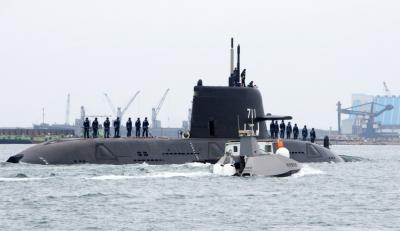
Taiwan's first indigenous defense submarine, the SS-711 Hai Kun (海鯤, or Narwhal), departed for its 13th sea trial at 7am today, marking its seventh submerged test, with delivery to the navy scheduled for July. The outing also marked its first sea deployment since President William Lai (賴清德) boarded the submarine for an inspection on March 19, drawing a crowd of military enthusiasts who gathered to show support. The submarine this morning departed port accompanied by CSBC Corp’s Endeavor Manta (奮進魔鬼魚號) uncrewed surface vessel and a navy M109 assault boat. Amid public interest in key milestones such as torpedo-launching operations and overnight submerged trials,
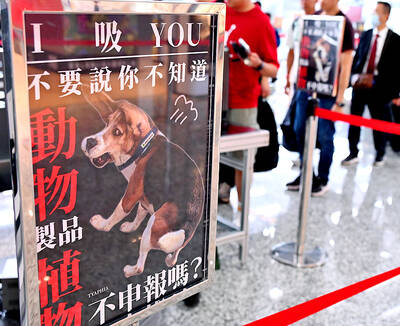
Quarantine awareness posters at Taiwan Taoyuan International Airport have gone viral for their use of wordplay. Issued by the airport branch of the Animal and Plant Health Inspection Agency, the posters feature sniffer dogs making a range of facial expressions, paired with advisory messages built around homophones. “We update the messages for holidays and campaign needs, periodically refreshing materials to attract people’s attention,” quarantine officials said. “The aim is to use the dogs’ appeal to draw focus to quarantine regulations.” A Japanese traveler visiting Taiwan has posted a photo on X of a poster showing a quarantine dog with a

Taiwan’s coffee community has launched a “one-person-one-e-mail” campaign, calling for people to send a protest-e-mail to the World Coffee Championships (WCC) urging it to redesignate Taiwanese competitors as from “Taiwan,” rather than “Chinese Taipei.” The call followed sudden action last week after the WCC changed all references to Taiwanese competitors from “Taiwan” to “Chinese Taipei,” including recent World Latte Art champion Bala (林紹興), who won the World Latte Art Championship in San Diego earlier this month. When Bala received the trophy, he was referred to as representing Taiwan, as well as in the announcement on the WCC’s Web site, until it


 RSS
RSS