


Cathay Pacific Airways yesterday announced that it would resume services to southern Taiwan by offering two flights from Kaohsiung to Hong Kong this month, starting on Saturday next week.
The airline’s subsidiary Cathay Dragon operated the Kaohsiung-Hong Kong route, but suspended services on Feb. 13 due to the COVID-19 pandemic.
The subsidiary ceased operations on Oct. 21.
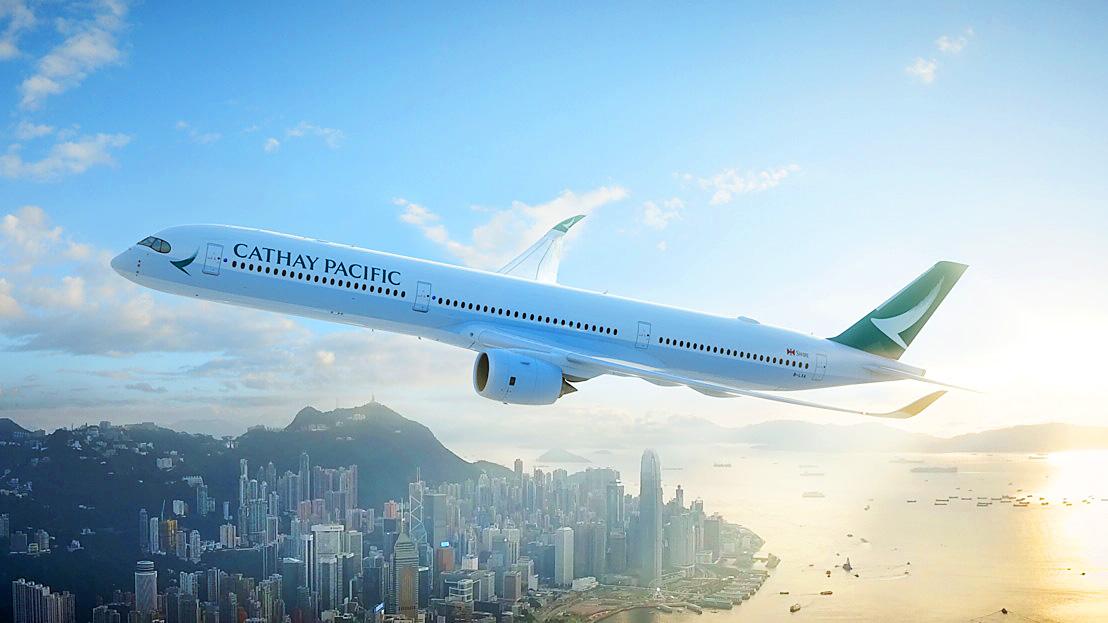
Photo courtesy of Cathay Pacific Airways
Cathay Pacific said that the resumption shows its unwavering commitment to serving passengers in southern Taiwan.
It is to use an Airbus 330-300 aircraft for the two flights, with the first one leaving on Saturday next week and the second one on Nov. 28.
The plane is to depart Hong Kong at 8:50am and arrive in Kaohsiung at 10:20am, and then leave Kaohsiung at 11:20am and arrive in Hong Kong at 12:55pm, it said.
Schedules for the Kaohsiung-Hong Kong flights in the next few months would be arranged based on market demand, it said.
Cathay Pacific currently offers four flights per week to Hong Kong from the Taiwan Taoyuan International Airport.
In related news, United Airlines said earlier this week that from Dec. 5, it would increase its flights to San Francisco from Taipei from three to five.
The Chicago-based airline resumed Taipei-San Francisco flights on Tuesday last week after having suspended the service for about seven months.
Under the new flight schedule, flights to San Francisco would leave from Taipei on Tuesdays, Wednesdays, Fridays, Saturdays and Sundays.
From San Francisco, flights to Taipei would depart on Mondays Wednesdays, Thursdays, Fridays and Sundays.
The increased services show that there is steady and reliable demand for passenger and cargo services between Taipei and San Francisco, United Airlines managing director for greater China and Korea Walter Dias said in a statement.
The airline will continue to explore growth opportunities and facilitate air services between Taiwan and the US, Dias added.
In other developments, there are a few conditions that need to be met before Boeing 737 Max 8 aircraft could be allowed to land at the nation’s airports or fly through the nation’s airspace, a source familiar with the process said.
Taiwan in March last year joined other nations around the world in suspending all commercial operations of the Boeing 737 Max aircraft following an Indonesian Lion Air crash in October 2018 and an Ethiopian Airlines crash last year.
No Taiwanese airlines own Boeing 737-MAX 8 aircraft.
Media reports said that the US Federal Aviation Administration (FAA) could announce safety certification of the grounded jetliner as soon as Wednesday next week, and that the agency is to approve new training for pilots and set new maintenance requirements to ensure the planes can return to service.
“Boeing must state what changes it has made to address safety issues that have been identified and convince airlines as well as aviation authorities around the world that such issues no longer exist,” the source said, adding that Boeing and the FAA have yet to release relevant information about the corrective measures.
The government would only consider evaluating if it should allow the aircraft to operate in Taiwan after it has reviewed and accepted the data, the source said.
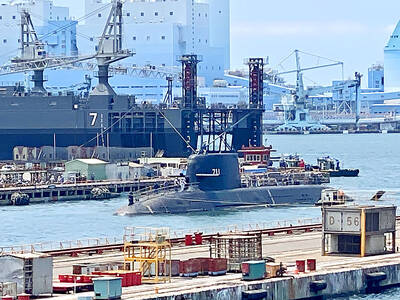
AGING: While Japan has 22 submarines, Taiwan only operates four, two of which were commissioned by the US in 1945 and 1946, and transferred to Taiwan in 1973 Taiwan would need at least 12 submarines to reach modern fleet capabilities, CSBC Corp, Taiwan chairman Chen Cheng-hung (陳政宏) said in an interview broadcast on Friday, citing a US assessment. CSBC is testing the nation’s first indigenous defense submarine, the Hai Kun (海鯤, Narwhal), which is scheduled to be delivered to the navy next month or in July. The Hai Kun has completed torpedo-firing tests and is scheduled to undergo overnight sea trials, Chen said on an SET TV military affairs program. Taiwan would require at least 12 submarines to establish a modern submarine force after assessing the nation’s operational environment and defense

Yangmingshan National Park authorities yesterday urged visitors to respect public spaces and obey the law after a couple was caught on a camera livestream having sex at the park’s Qingtiangang (擎天崗) earlier in the day. The Shilin Police Precinct in Taipei said it has identified a suspect and his vehicle registration number, and would summon him for questioning. The case would be handled in accordance with public indecency charges, it added. The couple entered the park at about 11pm on Thursday and began fooling around by 1am yesterday, the police said, adding that the two were unaware of the park’s all-day live
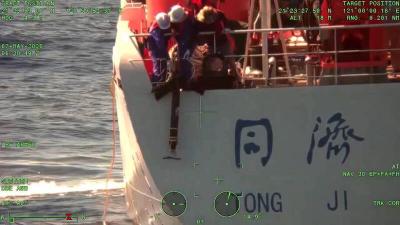
The coast guard today said that it had disrupted "illegal" operations by a Chinese research ship in waters close to the nation and driven it away, part of what Taipei sees a provocative pattern of China's stepped up maritime activities. The coast guard said that it on Thursday last week detected the Chinese ship Tongji (同濟號), which was commissioned only last year, 29 nautical miles (54km) southeast of the southern tip of Taiwan, although just outside restricted waters. The ship was observed lowering ropes into the water, suspected to be the deployment of scientific instruments for "illegal" survey operations, and the coast

A former soldier and an active-duty army officer were yesterday indicted for allegedly selling classified military training materials to a Chinese intelligence operative for a total of NT$79,440. The Taipei District Prosecutors’ Office indicted Chen Tai-yin (陳泰尹) and Lee Chun-ta (李俊達) for contravening the National Security Act (國家安全法) and the Anti-Corruption Act (貪污治罪條例). Chen left the military in September 2013 after serving alongside then-staff sergeant Lee, now an army lieutenant, at the 21st Artillery Command of the army’s Sixth Corps from 2011 to 2013, according to the indictment. Chen met a Chinese intelligence operative identified as “Wang” (王) through a friend in November


 RSS
RSS