


Former New Power Party legislator Huang Kuo-chang (黃國昌) yesterday accused Want Want China Times Media Group founder Tsai Eng-meng (蔡衍明) of lying to the National Communications Commission (NCC) during a public hearing on CTi News’ license renewal.
Tsai is the cable news channel’s largest shareholder, and he attended the commission’s administrative hearing on Monday, where he denied meddling in the channel’s operations.
He told the hearing that he only visited CTi News, as well as other media outlets belonging to the group, two to three times per year — at the Ghost Festival and other occasions — to offer prayers with the employees.
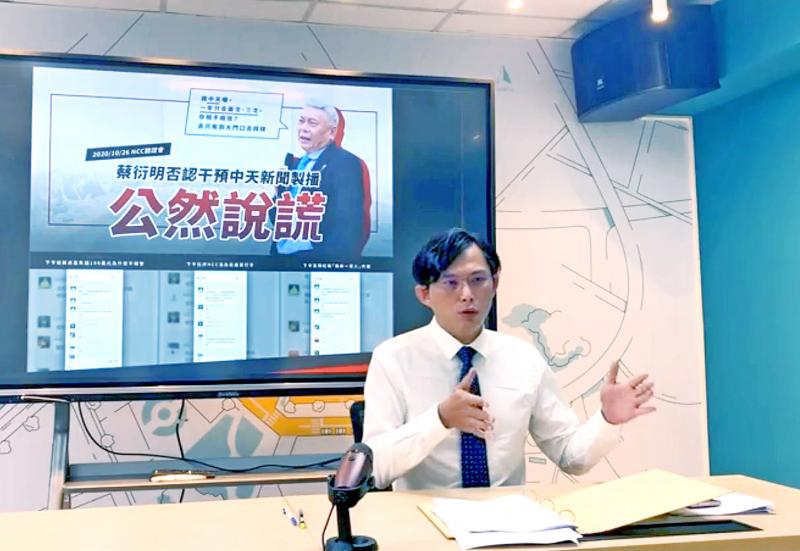
Screen grab from Facebook.
He and group executives use a group chat on WeChat to communicate, and he would sometimes use it to express his views on certain news, but the executives did not necessarily take his views when deciding how to cover stories, Tsai said.
Huang said that was an outright lie.
“Tsai and Want Want China Times Group executives are all in a WeChat group, which is filled with instructions from Tsai on how certain new stories should be covered. Instead of defying Tsai, the executives all say that they receive his messages and follow his instructions,” Huang said.
“These conversations clearly show how Tsai manipulates the news by using the group’s news media and CTi News is no exception,” he said.
“It is ludicrous to read these conversations and then hear the channel’s management speak about ‘internal control mechanisms,’ ‘media ethics guidelines’ and ‘independence in the editorial department’ at the hearing,” Huang said.
One screenshot that Huang posted on Facebook is of Tsai giving the group’s news media the green light to pummel the commission after CTi News was fined NT$200,000 for misreporting a statement from a campaign rally host before the 2018 nine-in-one local election.
In the screenshot, Tsai says that the commission has no right to become “a hitman” for the Democratic Progressive Party.
China Times president Wang Feng (王丰) and then-Want Want China Times Group vice president Chiu Chia-yu (邱佳瑜) said that they had received Tsai’s message, Huang said, adding that Chiu had told him that she could criticize NCC during CTi News’ evening news programs and News Tornado (新聞龍捲風) talk show.
Tsai responded by saying that Huang was engaged in a mudslinging campaign and spreading rumors about him.
“He [Huang] accused me of using a chat room that I share with my colleagues to control CTi News by showing conversations that were taken out of context,” Tsai said yesterday.
“I am an ordinary person and can talk with whomever I want. Why did not the person who took the screenshots show what I said about President Tsai Ing-wen (蔡英文) and how I wished for her to be not stuck in the strife between the pan-green and pan-blue camps,” he said.
Many of the news stories that he commented on had been reported by other news channels, he said.
He uses his own YouTube channel to publicize his personal beliefs, so he has no need to use CTi News to do so, Tsai said.
One of his chatroom messages in April last year said that former Chinese Nationalist Party (KMT) legislator Lee Yung-ping (李永萍) should not be invited to appear on CTi News’ talk shows, because she was critical of then-Kaohsiung mayor Han Kuo-yu (韓國瑜), but Lee appeared in one of its shows on May 29 last year, Tsai said.
That showed that what he said in the chat room had no bearing on the channel’s decisions, he added.
Meanwhile, Huang has accused CTi News of being part of the “red media,” without offering any proof, Tsai said.
The channel has received a lot of criticism from other news media outlets and the public, he said.
“Everyone can see clearly what we have been going through, so it is no wonder that more than 53 percent of the people said they do not want the government to shut down CTi News,” Tsai said.
The commission said it was continuing to collect and review material on CTi’s license renewal application.
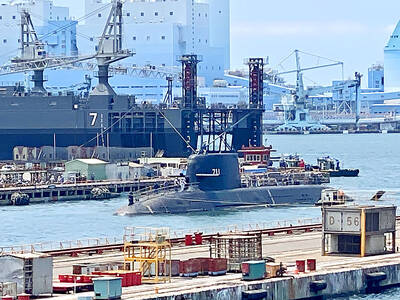
AGING: While Japan has 22 submarines, Taiwan only operates four, two of which were commissioned by the US in 1945 and 1946, and transferred to Taiwan in 1973 Taiwan would need at least 12 submarines to reach modern fleet capabilities, CSBC Corp, Taiwan chairman Chen Cheng-hung (陳政宏) said in an interview broadcast on Friday, citing a US assessment. CSBC is testing the nation’s first indigenous defense submarine, the Hai Kun (海鯤, Narwhal), which is scheduled to be delivered to the navy next month or in July. The Hai Kun has completed torpedo-firing tests and is scheduled to undergo overnight sea trials, Chen said on an SET TV military affairs program. Taiwan would require at least 12 submarines to establish a modern submarine force after assessing the nation’s operational environment and defense

Yangmingshan National Park authorities yesterday urged visitors to respect public spaces and obey the law after a couple was caught on a camera livestream having sex at the park’s Qingtiangang (擎天崗) earlier in the day. The Shilin Police Precinct in Taipei said it has identified a suspect and his vehicle registration number, and would summon him for questioning. The case would be handled in accordance with public indecency charges, it added. The couple entered the park at about 11pm on Thursday and began fooling around by 1am yesterday, the police said, adding that the two were unaware of the park’s all-day live
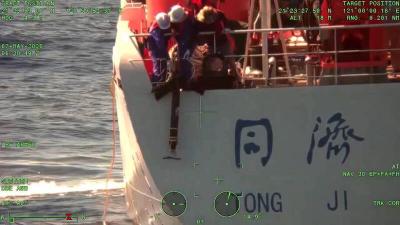
The coast guard today said that it had disrupted "illegal" operations by a Chinese research ship in waters close to the nation and driven it away, part of what Taipei sees a provocative pattern of China's stepped up maritime activities. The coast guard said that it on Thursday last week detected the Chinese ship Tongji (同濟號), which was commissioned only last year, 29 nautical miles (54km) southeast of the southern tip of Taiwan, although just outside restricted waters. The ship was observed lowering ropes into the water, suspected to be the deployment of scientific instruments for "illegal" survey operations, and the coast

A former soldier and an active-duty army officer were yesterday indicted for allegedly selling classified military training materials to a Chinese intelligence operative for a total of NT$79,440. The Taipei District Prosecutors’ Office indicted Chen Tai-yin (陳泰尹) and Lee Chun-ta (李俊達) for contravening the National Security Act (國家安全法) and the Anti-Corruption Act (貪污治罪條例). Chen left the military in September 2013 after serving alongside then-staff sergeant Lee, now an army lieutenant, at the 21st Artillery Command of the army’s Sixth Corps from 2011 to 2013, according to the indictment. Chen met a Chinese intelligence operative identified as “Wang” (王) through a friend in November


 RSS
RSS