


The Chinese Nationalist Party (KMT) plans on Nov. 22 to join groups in protesting the government’s decision to allow the importation of US pork containing traces of ractopamine, KMT Chairman Johnny Chiang (江啟臣) said yesterday.
President Tsai Ing-wen (蔡英文) on Aug. 28 announced that, starting on Jan. 1, Taiwan would ease restrictions on imports of US pork containing the leanness-enhancing drug, as well as beef from cattle aged 30 months or older.
The policy “lacks not only supporting administrative actions, but also a complete risk assessment,” Chiang said at a weekly KMT Central Standing Committee meeting in Taipei. “It directly affects the food safety environment of people.”
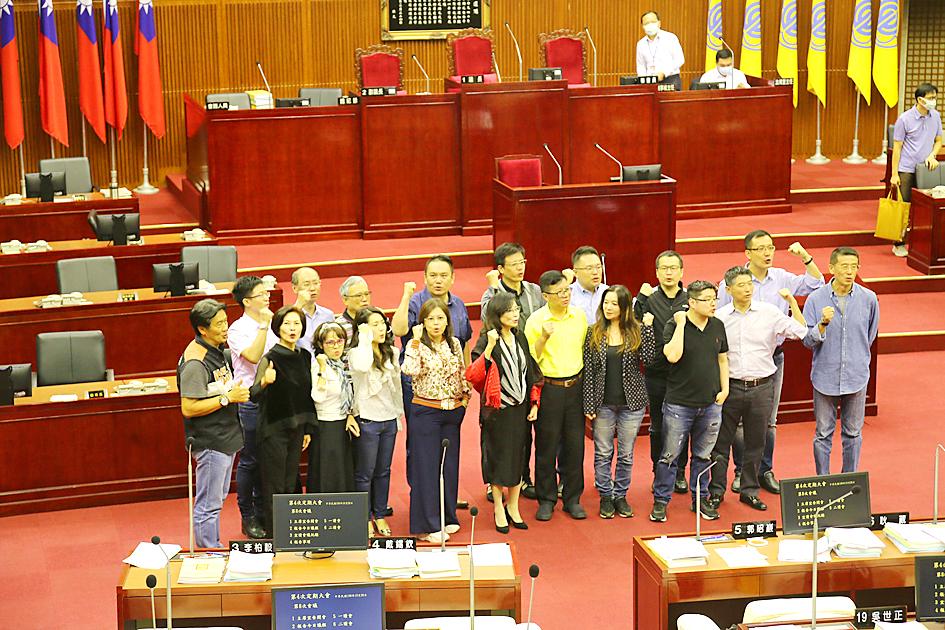
Photo: Cheng Ming-hsiang, Taipei Times
Two months after Tsai’s announcement of the policy, the Democratic Progressive Party (DPP) administration “is still unable to give the people a reasonable decisionmaking process and reason” for allowing the imports, Chiang said.
“As the decisionmaker, President Tsai ... must face the scrutiny of public opinion and the supervision of the legislature,” he said.
The DPP caucus on Tuesday used its majority in the legislature to reject the KMT caucus’ proposal to have Tsai report to lawmakers on the government’s decision to allow US pork containing the additive, he said, adding that the proposal was supported by other opposition parties.
The proposal, which the KMT caucus presented on Sept. 18, was put to a vote on Tuesday after the DPP and opposition parties failed to reach a consensus. It was rejected 55-40.
Another KMT proposal requesting that Tsai apologize and the government make public its process of negotiating with the US to allow imports of pork containing ractopamine was also voted down 58-38.
Chiang yesterday accused Tsai of wanting to make decisions without supervision, and wanting to hold power without communication.
“Communication is the inherent duty of people in power, and a promise President Tsai Ing-wen made to the people,” he said.
“We want to once again urge President Tsai Ing-wen to bravely face the legislature, and to bravely face the public’s doubts,” he added.
“The voice of the public will not only be voiced within the system, but also shouted on the streets,” Chiang said.
He said that following discussions with various groups, they are to take to the streets on Nov. 22 to demonstrate their belief that there is “only right and wrong in the issue of food safety, and no blue and green,” referring to the colors representing the KMT and the DPP respectively.
Once details of the demonstration are confirmed, the KMT would call on its supporters to join the protest and “block the incorrect policy together,” he said.
Additional reporting by CNA

Considering that most countries issue more than five denominations of banknotes, the central bank has decided to redesign all five denominations, the bank said as it prepares for the first major overhaul of the banknotes in more than 24 years. Central bank Governor Yang Chin-lung (楊金龍) is expected to report to the Legislative Yuan today on the bank’s operations and the redesign’s progress. The bank in a report sent to the legislature ahead of today’s meeting said it had commissioned a survey on the public’s preferences. Survey results showed that NT$100 and NT$1,000 banknotes are the most commonly used, while NT$200 and NT$2,000

The Centers for Disease Control (CDC) yesterday reported the first case of a new COVID-19 subvariant — BA.3.2 — in a 10-year-old Singaporean girl who had a fever upon arrival in Taiwan and tested positive for the disease. The girl left Taiwan on March 20 and the case did not have a direct impact on the local community, it said. The WHO added the BA.3.2 strain to its list of Variants Under Monitoring in December last year, but this was the first imported case of the COVID-19 variant in Taiwan, CDC Deputy Director-General Lin Ming-cheng (林明誠) said. The girl arrived in Taiwan on

South Korea is planning to revise its controversial electronic arrival card, a step Taiwanese officials said prompted them to hold off on planned retaliatory measures, a South Korean media report said yesterday. A Yonhap News Agency report said that the South Korean Ministry of Foreign Affairs is planning to remove the “previous departure place” and “next destination” fields from its e-arrival card system. The plan, reached after interagency consultations, is under review and aims to simplify entry procedures and align the electronic form with the paper version, a South Korean ministry official said. The fields — which appeared only on the electronic form

The Ministry of Foreign Affairs (MOFA) is suspending retaliation measures against South Korea that were set to take effect tomorrow, after Seoul said it is updating its e-arrival system, MOFA said today. The measures were to be a new round of retaliation after Taiwan on March 1 changed South Korea's designation on government-issued alien resident certificates held by South Korean nationals to "South Korea” from the "Republic of Korea," the country’s official name. The move came after months of protests to Seoul over its listing of Taiwan as "China (Taiwan)" in dropdown menus on its new online immigration entry system. MOFA last week


 RSS
RSS