


Recommendations for amendments to the Constitution and plans for public hearings to solicit input from across society were presented at the legislature in Taipei yesterday by lawmakers from the Democratic Progressive Party (DPP) and other parties.
DPP Legislator Chen Ting-fei (陳亭妃) outlined several main recommendations, including changes to define the nation’s territory and existing national boundaries in Article 4 of the Constitution, and to amend a call for “national unification” in the Preamble to the Additional Articles of the Constitution, which was added in 2005.
Chen and Legislator Tsai Shih-ying (蔡適應), who also attended, are members of the DPP’s Taiwan Normal Country Promotion Association, which is headed by Legislative Speaker You Si-kun (游錫堃).
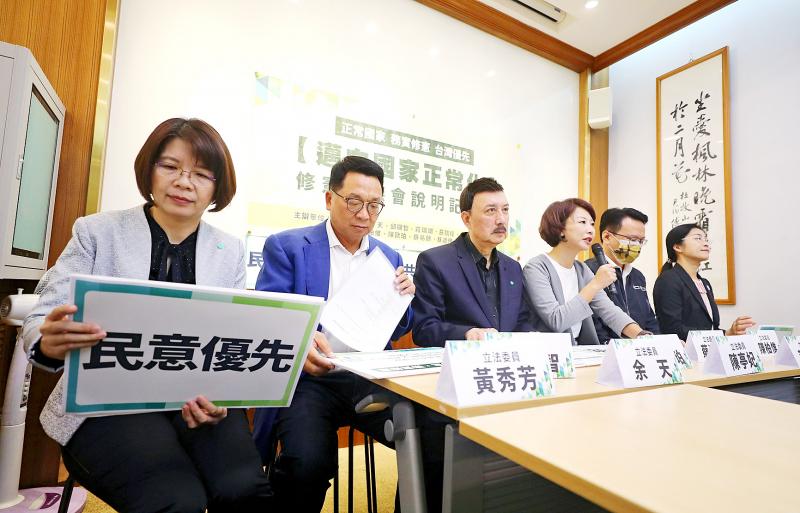
Photo: CNA
The DPP lawmakers proposed abolishing references to the nation as a “province,” and adding provisions to require that the nation be referred to as Taiwan in foreign affairs, when joining international organizations and when conducting humanitarian aid abroad.
When asked about removing references to “national unification” from the Constitution, Chen said that the wording was a holdover from the Chinese Civil War, the arrival of the former Chinese Nationalist Party (KMT) government and its troops from China, and the imposition of martial law in Taiwan.
Martial law was lifted in 1987.
“With martial law having ended as Taiwan transitioned into a democracy, the aim of ‘national unification’ is history,” Chen said, “Taiwan must not remain burdened by that history by the constitutional framework. The call for ‘national unification’ is no longer fitting in the political and social realities of today.”
DPP legislators Yu Tian (余天), Huang Hsiu-fang (黃秀芳), Chen Ou-po (陳歐珀), Chuang Ching-cheng (莊競程) and Chen Hsiu-pao (陳秀?) also signed the draft proposal and attended the news briefing, along with New Power Party (NPP) caucus whip Chiu Hsien-chih (邱顯智), who said that other NPP legislators, including Claire Wang (王婉諭) and Chen Jiau-hua (陳椒華), also backed the proposal.
Independent Legislator Freddy Lim (林昶佐) and Taiwan Statebuilding Party Legislator Chen Po-wei (陳柏惟) were also named as signatories on the DPP association’s proposal.
Four public hearings have been planned for next month, at which people from across society would be able to voice their opinions on possible amendments to the Constitution, Yu said.
The public hearings would focus on four themes: “Upgrading digital information and governance innovation,” “balanced national land development,” “deepening democracy through pragmatic constitutional amendments” and “using the name Taiwan to link up with the world,” he said.
Amending the Constitution to fix references to the “nation’s territory” and “existing national boundaries” is necessary, because a claim to all of China by the former KMT government is obsolete, Chen Ou-po said.
No nation agrees with such claims by Taiwan, because the People’s Republic of China is the internationally recognized legitimate government of China, he said.

Fast food chain McDonald's is to raise prices by up to NT$5 on some products at its restaurants across Taiwan, starting on Wednesday next week, the company announced today. The prices of all extra value meals and sharing boxes are to increase by NT$5, while breakfast combos and creamy corn soup would go up by NT$3, the company said in a statement. The price of the main items of those meals, if ordered individually, would remain the same. Meanwhile, the price of a medium-sized lemon iced tea and hot cappuccino would rise by NT$3, extra dipping sauces for chicken nuggets would go up
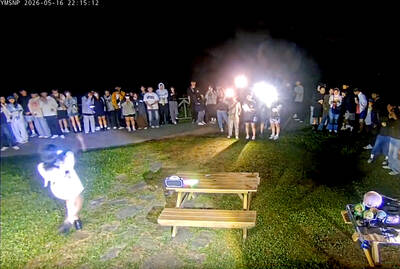
Yangmingshan National Park’s Qingtiangang (擎天崗) nature area has gone viral after a park livestream camera observed a couple in the throes of intimate congress, which was broadcast live on YouTube, drawing large late-night crowds and sparking a backlash over noise, bright lights and disruption to wildlife habitat. The area’s livestream footage appeared to show a couple engaging in sexual activity on a picnic table in the park on Friday last week, with the uncensored footage streamed publicly online. The footage quickly spread across social media, prompting a tide of visitors to travel to the site to “check in” and recreate the

Minister of Digital Affairs Lin Yi-ching (林宜敬) yesterday cited regulatory issues and national security concerns as an expert said that Taiwan is among the few Asian regions without Starlink. Lin made the remarks on Facebook after funP Innovation Group chief executive officer Nathan Chiu (邱繼弘) on Friday said Taiwan and four other countries in Asia — China, North Korea, Afghanistan and Syria — have no access to Starlink. Starlink has become available in 166 countries worldwide, including Ukraine, Malaysia, the Philippines and Vietnam, in the six years since it became commercial, he said. While China and North Korea block Starlink, Syria is not
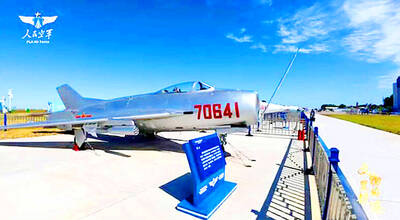
GROUNDED: A KMT lawmaker proposed eliminating drone development programs and freezing funding for counterdrone systems, despite China’s adoption of the technology China has deployed attack drones at air bases near the Taiwan Strait in a strategy aimed at overwhelming Taiwan’s air defense systems through saturation attacks, the Mainland Affairs Council (MAC) said. The council’s latest quarterly report on China said that satellite imagery and open-source intelligence indicate that the Chinese People’s Liberation Army (PLA) had converted retired J-6 fighter jets into J-6W drones, which the PLA has stationed at six air bases near Taiwan, five in China’s Fujian Province and one in Guangdong Province. The report cited J. Michael Dahm, a senior fellow at the US-based Mitchell Institute, as saying that China has


 RSS
RSS