


A Taiwanese man who returned from China’s Jiangsu Province yesterday became the nation’s 530th confirmed COVID-19 case, the Central Epidemic Command Center (CECC) said yesterday.
The man, who is in his 40s, when to Jiangsu in February for work and returned to Taiwan on Sunday for vacation, Centers for Disease Control (CDC) Deputy Director-General Chuang Jen-hsiang (莊人祥), who is also CECC spokesman, told a news conference in Taipei.
The man told health officials that he developed a runny nose with thick mucus on Oct. 1, but took over-the-counter medication to relieve the symptoms, and that two of his office colleagues had also had cold-like symptoms, for which they also took over-the-counter medication, Chuang said.
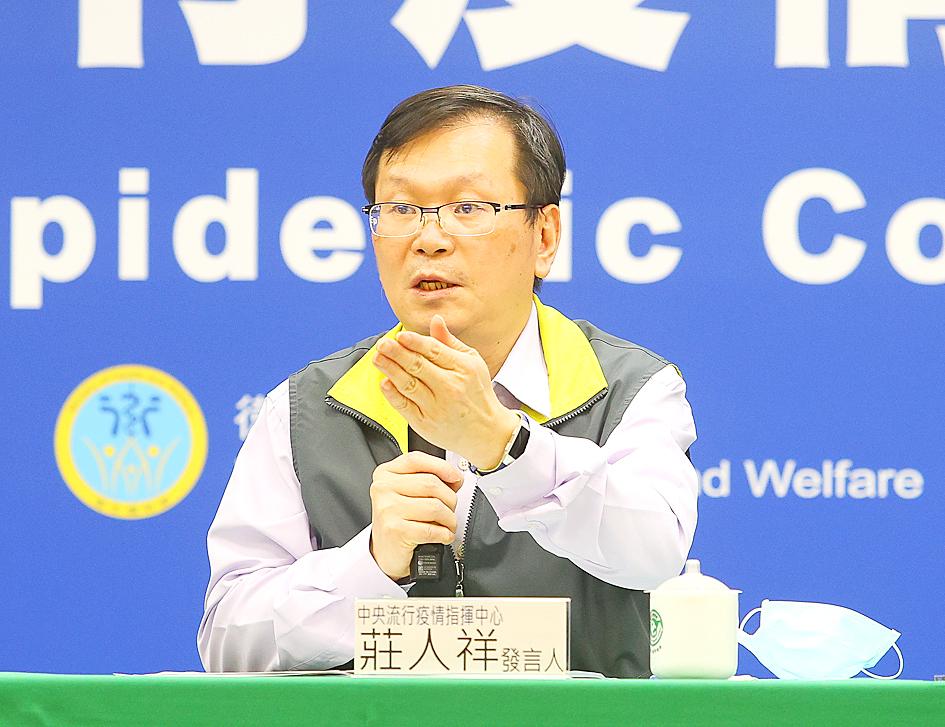
Photo: CNA
The man had a cough, runny nose and nasal congestion when he arrived at Taiwan Taoyuan International Airport, so he was tested for COVID-19 at the airport and a positive test result was received yesterday, Chuang said.
Seventeen close contacts of the man have been identified, including 10 passengers who sat near him on the flight to Taiwan, and they have been put in home isolation, Chuang said.
As the man is the first imported case from China since early February, reporters asked Chuang if the COVID-19 situation in China had worsened.
Cases have recently been reported in Shandong Province, but the COVID-19 situation in Jiangsu is unclear, he said.
The CT value of the man’s polymerase chain reaction (PCR) test was 26, indicating that he was likely infected recently, but not in Taiwan, Chuang said, adding that the government would report the case to Chinese authorities.
In other news, a case of indigenous dengue was reported last week, a man in his 50s who lives in Chiatien Borough (嘉添里) of New Taipei City’s Sansia District (三峽), CDC physician Lin Yung-ching (林詠青) told the news conference.
He developed a high fever, bone and muscle pain, nausea and diarrhea on Wednesday last week and sought medical treatment that day, as well as the next and again on Saturday, when he tested positive for dengue fever, Lin said, adding that the public should be alert for symptoms of dengue.
The New Taipei City Department of Health was investigating the possible sources of infection, as besides his home and office, the man often went with family members to a vegetable farm near his home, the CDC said.
The man did develop rashes, a common dengue symptom that occurs in 50 to 80 percent of dengue cases, so if people think that they have dengue-like symptoms and that they have been to places where there might be a lot of mosquitoes, they should inform their doctor when seeking treatment, Lin said.
CDC Epidemic Intelligence Center Director Liu Ting-ping (劉定萍) said 61 indigenous dengue cases have been reported so far this year, 41 in New Taipei City — including 35 in Sansia District — and 20 cases in Taoyuan — including 15 in Taoyuan District (桃園).

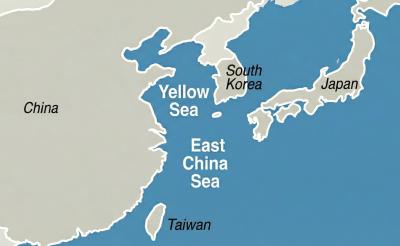
China has reserved offshore airspace in the Yellow Sea and East China Sea from March 27 to May 6, issuing alerts usually used to warn of military exercises, although no such exercises have been announced, the Wall Street Journal (WSJ) reported yesterday. Reserving such a large area for 40 days without explanation is an “unusual step,” as military exercises normally only last a few days, the paper said. These alerts, known as Notice to Air Missions (Notams), “are intended to inform pilots and aviation authorities of temporary airspace hazards or restrictions,” the article said. The airspace reserved in the alert is
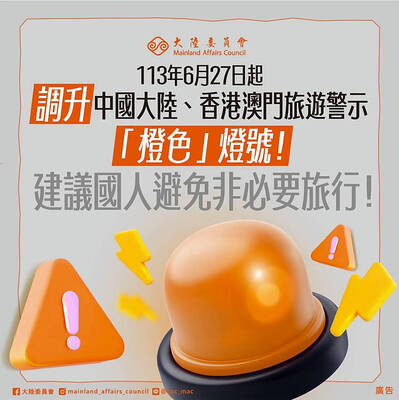
More than 6,000 Taiwanese students have participated in exchange programs in China over the past two years, despite the Mainland Affairs Council’s (MAC) “orange light” travel advisory, government records showed. The MAC’s publicly available registry showed that Taiwanese college and university students who went on exchange programs across the Strait numbered 3,592 and 2,966 people respectively. The National Immigration Agency data revealed that 2,296 and 2,551 Chinese students visited Taiwan for study in the same two years. A review of the Web sites of publicly-run universities and colleges showed that Taiwanese higher education institutions continued to recruit students for Chinese educational programs without

A bipartisan group of US senators has introduced a bill to enhance cooperation with Taiwan on drone development and to reduce reliance on supply chains linked to China. The proposed Blue Skies for Taiwan Act of 2026 was introduced by Republican US senators Ted Cruz and John Curtis, and Democratic US senators Jeff Merkley and Andy Kim. The legislation seeks to ease constraints on Taiwan-US cooperation in uncrewed aerial systems (UAS), including dependence on China-sourced components, limited access to capital and regulatory barriers under US export controls, a news release issued by Cruz on Wednesday said. The bill would establish a "Blue UAS
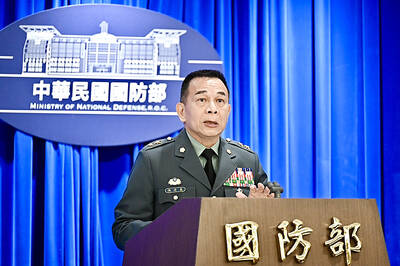
The Republic of China Army Command yesterday relieved Kinmen Defense Battalion commander after authorities indicted the officer on charges connected to using methamphetamine. The Kinmen District Prosecutors’ Office on Wednesday detained Colonel He (何) after the Coast Guard linked him to drug shipments and proceeded to charge him yesterday for using and possessing crystal meth. The man was released on a NT$50,000 bail and banned from leaving Kinmen, the office said. Army Chief of Staff Lieutenant General Chen Chien-yi (陳建義) told a news conference yesterday that He has been removed and another officer is taking over the unit as the acting commander. The military


 RSS
RSS