


The Taiwan People’s Party (TPP) caucus has launched a petition calling for stricter penalties on illegal pork imports, the introduction of specialized codes to identify firms that use meat containing ractopamine and clear product labeling, it said yesterday.
The government has been pushing ahead with its plan to ease restrictions on US pork and beef imports from Jan. 1 next year, even though public debate on the issue continues to rage, the caucus said.
It said that it launched the petition on the National Development Council’s Public Policy Network Participation Platform to better gauge public opinion and reach a consensus on the issue.
The petition passed a review on Thursday and would be open until Dec. 8. There were 1,133 signatories as of press time last night.
The government must respond to the petition if it collects at least 5,000 signatures.
The petition contains three demands, all of which would require amending the Act Governing Food Safety and Sanitation (食品安全衛生管理法).
First, it calls for stringent enforcement of import controls and heightened penalties to ensure that packaging on remanufactured products, mixed goods and food additives clearly indicates whether they contain ractopamine.
Second, a specialized coding system should be implemented to better identify firms that import products containing ractopamine, the petition says.
Last, it calls for amending food labeling regulations to require clear labeling of food products or additives that contain ractopamine.
The caucus said that it hopes to collate public opinion to show the government how deeply people care about food safety.
Through the process, the Democratic Progressive Party would hopefully revive its people-centric founding spirit and refrain from sacrificing public health for political gains, it added.
In related news, the New Taipei City Government yesterday announced that it would update its contracts with school lunch providers to ensure the exclusive use of domestically produced pork and beef in students’ meals.
The city government would by the end of this year update the contracts to impose penalties on lunch providers that use imported meat, ensuring a ractopamine-free school environment for students up to age 18, it said.
The policy is only meant to reassure parents, as meal providers have been exclusively using domestically produced pork for a long time, New Taipei City Boxed Food Commercial Association chairman Cheng Te-hsing (鄭得興) said.
The price of domestic pork is expected to increase due to inspection and testing costs once the eased import regulations take effect, Cheng said.
Because of that, “a slight price increase will be necessary,” Cheng said, urging the central government to make good on its promise to raise its reward for using fully certified ingredients to NT$6 per school lunch from NT$3.5 per meal.
As preschools and daycare centers are not subjected to “nutritious lunch” contract regulations and would therefore not be penalized for using pork containing ractopamine, New Taipei City Infant and Child Care Association representative and Sijhih Chunghou Public Daycare Center director Pao Chung-ming (包崇明) vowed transparency.
Pao promised that his center would only provide never-frozen meat and display certification of origin to parents and officials, as well as on Facebook.
Additional reporting by Chen Hsin-yu

Actor Darren Wang (王大陸) was sentenced to six months in prison, commutable to a fine, by the New Taipei District Court today for contravening the Personal Data Protection Act (個人資料保護法) in a case linked to an alleged draft-dodging scheme. Wang allegedly paid NT$3.6 million (US$114,380) to an illegal group to help him evade mandatory military service through falsified medical documents, prosecutors said. He transferred the funds to Chen Chih-ming (陳志明), the alleged mastermind of a draft-evasion ring, although he lost contact with him as he was already in detention on fraud charges, they said. Chen is accused of helping a

SECURITY: Starlink owner Elon Musk has taken pro-Beijing positions, and allowing pro-China companies to control Taiwan’s critical infrastructure is risky, a legislator said Starlink was reluctant to offer services in Taiwan because of the nation’s extremely high penetration rates in 4G and 5G services, the Ministry of Digital Affairs said yesterday. The ministry made the comments at a meeting of the legislature’s Transportation Committee, which reviewed amendments to Article 36 of the Telecommunications Management Act (電信管理法). Article 36 bans foreigners from holding more than 49 percent of shares in public telecommunications networks, while shares foreigners directly and indirectly hold are also capped at 60 percent of the total, unless specified otherwise by law. The amendments, sponsored by Chinese Nationalist Party (KMT) Legislator Ko

The eastern extension of the Taipei MRT Red Line could begin operations as early as late June, the Taipei Department of Rapid Transit Systems said yesterday. Taipei Rapid Transit Corp said it is considering offering one month of free rides on the new section to mark its opening. Construction progress on the 1.4km extension, which is to run from the current terminal Xiangshan Station to a new eastern terminal, Guangci/Fengtian Temple Station, was 90.6 percent complete by the end of last month, the department said in a report to the Taipei City Council's Transportation Committee. While construction began in October 2016 with an
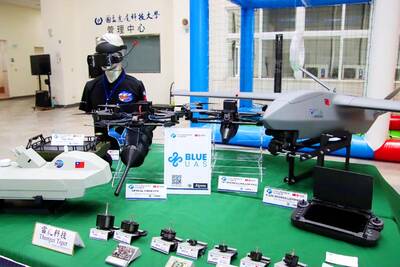
NON-RED SUPPLY: Boosting the nation’s drone industry is becoming increasingly urgent as China’s UAV dominance could become an issue in a crisis, an analyst said Taiwan’s drone exports to Europe grew 41.7-fold from 2024 to last year, with demand from Ukraine’s fight against Russian aggression the most likely driver of growth, a study showed. The Institute for Democracy, Society and Emerging Technology (DSET) in a statement on Wednesday said it found that many of Taiwan’s uncrewed aerial vehicle (UAV) sales were from Poland and the Czech Republic. These countries likely transferred the drones to Ukraine to aid it in its fight against the Russian invasion that started in 2022, it said. Despite the gains, Taiwan is not the dominant drone exporter to these markets, ranking second and fourth


 RSS
RSS