


Academics on Saturday offered different takes on President Tsai Ing-wen’s (蔡英文) Double Ten National Day address, with some praising her efforts to maintain cross-strait stability, while others remained skeptical on whether it was enough to placate Beijing.
Tsai, who said she was willing to have a “meaningful dialogue” with the leadership of Beijing, sent a message that showed she wanted to maintain peaceful Taiwan-China relations, so long as parity and dignity are assured, said Chao Chun-shan (趙春山), a professor emeritus at the Institute of China Studies at Tamkang University in Taipei.
Tsai also exercised restraint in not highlighting growing Taiwan-US relations in her speech, to avoid angering Beijing, he added.
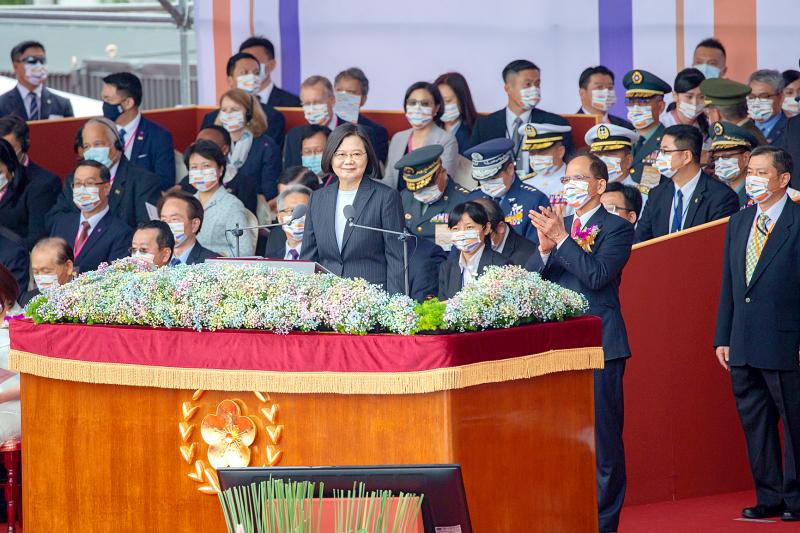
Photo: EPA-EFE
Tsai might want to create opportunities for peaceful dialogue with Beijing, evident in her echoing of China’s video message to the UN General Assembly that Beijing would never seek hegemony, expansion or a sphere of influence, Tamkang University Graduate Institute of China Studies associate professor Chang Wu-ueh (張五岳) said.
Tsai said in her speech that she is aware of China’s remarks and that “as countries in the region and around the world are now concerned about China’s expanding hegemony, we hope this is the beginning of genuine change.”
However, one Chinese academic disagreed, saying that Tsai had missed the point.
Liu Guosheng (劉國深), a cross-strait relations expert at Xiamen University, said that Tsai’s use of the words “hegemony” and “concerned” appeared to him as indirect rebukes of China.
Her Democratic Progressive Party (DPP) administration must recognize, with sincerity and courage, that “both sides of the Taiwan Strait belong to the same country,” so that it might understand Beijing’s position, he said.
Tamkang University strategic studies professor Alexander Huang (黃介正) said that Tsai did not show weakness or attempt to cozy up to China in her speech, but expressed her intention to hold healthy conversations with Beijing and maintain peaceful ties.
The two sides must accumulate goodwill and restore mutual trust, and one of the priorities at this stage is refraining from making meaningless and provocative comments toward each other, he said.
China’s Taiwan Affairs Office spokeswoman Zhu Fenglian (朱鳳蓮) said in a statement later on Saturday that Tsai’s address showed Taiwan’s continued hostility.
Only by returning to the so-called “1992 consensus” could there be mutual dialogue and improvement in ties, Zhu said.
The so-called “1992 consensus,” a term former Mainland Affairs Council chairman Su Chi (蘇起) in 2006 admitted making up in 2000, refers to a tacit understanding between the Chinese Nationalist Party (KMT) and the Chinese government that both sides of the Strait acknowledge there is “one China,” with each side having its own interpretation of what “China” means.

The manufacture of the remaining 28 M1A2T Abrams tanks Taiwan purchased from the US has recently been completed, and they are expected to be delivered within the next one to two months, a source said yesterday. The Ministry of National Defense is arranging cargo ships to transport the tanks to Taiwan as soon as possible, said the source, who is familiar with the matter. The estimated arrival time ranges from late this month to early next month, the source said. The 28 Abrams tanks make up the third and final batch of a total of 108 tanks, valued at about NT$40.5 billion
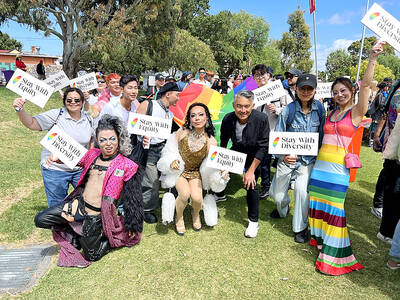
A group from the Taiwanese Designers in Australia association yesterday represented Taiwan at the Midsumma Pride March in Melbourne. The march, held in the St. Kilda suburb, is the city’s largest LGBTQIA+ parade and the flagship event of the annual Midsumma Festival. It attracted more than 45,000 spectators who supported the 400 groups and 10,000 marchers that participated this year, the association said. Taiwanese Designers said they organized a team to march for Taiwan this year, joining politicians, government agencies, professionals and community organizations in showing support for LGBTQIA+ people and diverse communities. As the first country in Asia to legalize same-sex
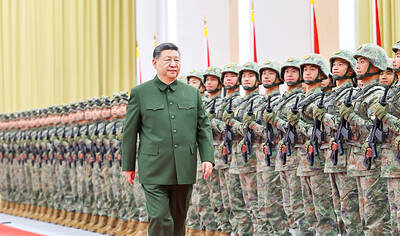
MOTIVES QUESTIONED The PLA considers Xi’s policies toward Taiwan to be driven by personal considerations rather than military assessment, the Epoch Times reports Chinese President Xi Jinping’s (習近平) latest purge of the Chinese People’s Liberation Army (PLA) leadership might have been prompted by the military’s opposition to plans of invading Taiwan, the Epoch Times said. The Chinese military opposes waging war against Taiwan by a large consensus, putting it at odds with Xi’s vision, the Falun Gong-affiliated daily said in a report on Thursday, citing anonymous sources with insight into the PLA’s inner workings. The opposition is not the opinion of a few generals, but a widely shared view among the PLA cadre, the Epoch Times cited them as saying. “Chinese forces know full well that
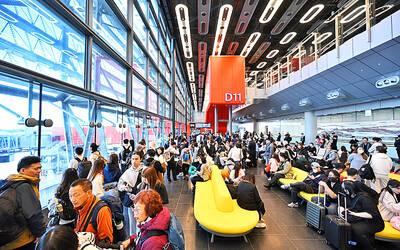
Travel agencies in Taiwan are working to secure alternative flights for travelers bound for New Zealand for the Lunar New Year holiday, as Air New Zealand workers are set to strike next week. The airline said that it has confirmed that the planned industrial action by its international wide-body cabin crew would go ahead on Thursday and Friday next week. While the Auckland-based carrier pledged to take reasonable measures to mitigate the impact of the workers’ strike, an Air New Zealand flight arriving at Taipei from Auckland on Thursday and another flight departing from Taipei for Auckland on Saturday would have to


 RSS
RSS