


Lawmakers yesterday asked the Ministry of Transportation and Communications to conduct a comprehensive review of the transportation allowances it paid to executives of state-run firms run by the ministry, after a report from the Legislative Yuan’s Budget Center showed that some of them received hefty allowances just to attend board meetings taking place at the building in which they work.
The center examined the salaries and allowances of board members from 15 state-run corporations run by the ministry and found that several executives, who also serve as board members representing the ministry, have allegedly received significant transportation allowances.
Taiwan High Speed Rail Corp chairman Chiang Yao-chung (江耀宗) last year received NT$176,000 in transportation allowances to attend board meetings, even though they were convened at the company’s headquarters in Taipei’s Nangang District (南港), the report said, adding that he also claimed NT$120,000 in transportation allowances in the first half of this year.
Taiwan International Ports Corp (TIPC) Taichung branch president Lu Chan-yu (盧展猷) also serves as the chairman of Taiwan International Windpower Training Corp, while TIPC executive vice president Wang Pai-feng (王派峰) also serves as the chairman of TIPC Marine Corp, the report said.
Both collected transportation allowances to attend board meetings for their second positions, with each claiming NT$51,000 from January to June, it said.
Minister of Transportation and Communications Lin Chia-lung (林佳龍) yesterday promised to deliver a report within two weeks on how the ministry plans to address the situation.
“Regardless of the customary practices in the past governing the payment of transportation allowances or attendance fees for board meetings, we will examine what the rules are and see if it is necessary to set up a system for it,” Lin said.
“Transportation allowances should be allocated to executives legally and reasonably. Senior executives should not claim a cent of allowance if they should not receive it in the first place,” he said, adding that allowances should be paid on a case-by-case basis.
Chiang, who also attended the meeting at the legislature’s Transportation Committee, was asked to explain the matter.
He said that all his predecessors had claimed transportation allowances to attend board meetings and other meetings, and the relevant information is disclosed in annual financial statements.
Should the ministry implement new regulations governing the payment of transportation allowances, the high-speed rail operator would comply with them, he said.
In other news, Lin told the lawmakers that he is confident that travelers on the Chiang Wei-shui Freeway (Freeway No. 5) would not experience hours-long traffic congestion during the four-day Mid-Autumn Festival holiday, which begins on Thursday.
The ministry’s plans to deal with likely traffic congestion during the long weekend came under scrutiny after it was criticized for its handling of traffic during the Dragon Boat Festival holiday in June, when travelers on the southbound lanes of the freeway had to endure an average driving speed of below 40kph for 32 consecutive hours.
“We have stipulated a plan to facilitate freeway traffic, but we have prepared ourselves for the worst-case scenario. We are confident we can control the traffic flow during the long weekend, but we need everyone’s help to do so, such as planning road trips based on updated traffic reports from the ministry’s Freeway 1968 and Highway to Happiness smartphone apps,” Lin said.
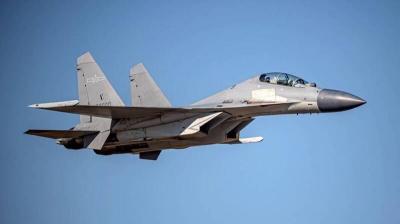
Eight Chinese naval vessels and 24 military aircraft were detected crossing the median line of the Taiwan Strait between 6am yesterday and 6am today, the Ministry of National Defense said this morning. The aircraft entered Taiwan’s northern, central, southwestern and eastern air defense identification zones, the ministry said. The armed forces responded with mission aircraft, naval vessels and shore-based missile systems to closely monitor the situation, it added. Eight naval vessels, one official ship and 36 aircraft sorties were spotted in total, the ministry said.
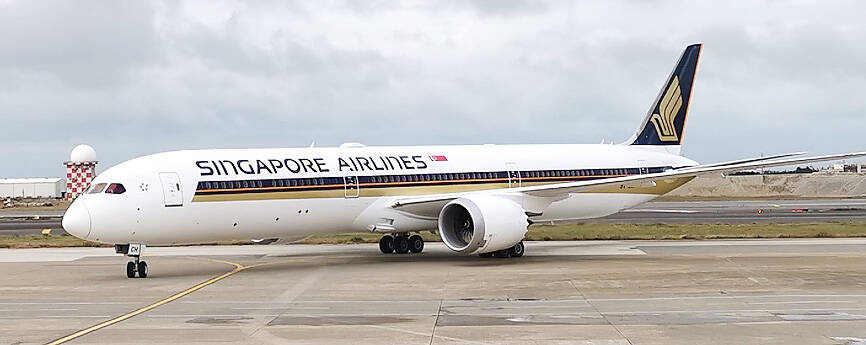
INCREASED CAPACITY: The flights on Mondays, Wednesdays, Fridays and Sundays would leave Singapore in the morning and Taipei in the afternoon Singapore Airlines is adding four supplementary flights to Taipei per week until May to meet increased tourist and business travel demand, the carrier said on Friday. The addition would raise the number of weekly flights it operates to Taipei to 18, Singapore Airlines Taiwan general manager Timothy Ouyang (歐陽漢源) said. The airline has recorded a steady rise in tourist and business travel to and from Taipei, and aims to provide more flexible travel arrangements for passengers, said Ouyang, who assumed the post in July last year. From now until Saturday next week, four additional flights would depart from Singapore on Monday, Wednesday, Friday
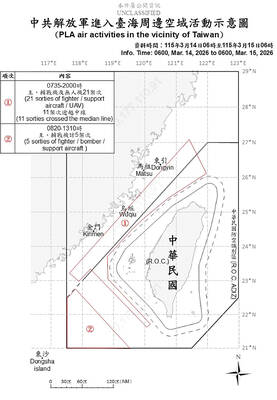
The Ministry of National Defense yesterday reported the return of large-scale Chinese air force activities after their unexplained absence for more than two weeks, which had prompted speculation regarding Beijing’s motives. China usually sends fighter jets, drones and other military aircraft around the nation on a daily basis. Interruptions to such routine are generally caused by bad weather. The Ministry of National Defense said it had detected 26 Chinese military aircraft in the Taiwan Strait over the previous 24 hours. It last reported that many aircraft on Feb. 25, when it spotted 30 aircraft, saying Beijing was carrying out another “joint combat
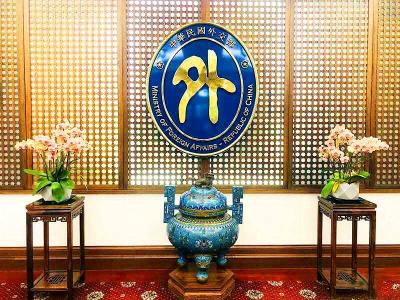
The Ministry of Foreign Affairs (MOFA) today said that if South Korea does not reply appropriately to its request to correct Taiwan’s name on its e-Arrival card system before March 31, it would take corresponding measures to alter how South Korea is labeled on the online Taiwan Arrival Card system. South Korea’s e-Arrival card system lists Taiwan as “China (Taiwan)” in the “point of departure” and “next destination” fields. The ministry said that it changed the nationality for South Koreans on Taiwan’s Alien Resident Certificates from “Korea” to “South Korea” on March 1, in a gesture of goodwill and based on the


 RSS
RSS