


The Transitional Justice Commission yesterday held a conference at National Taiwan University to discuss nine of the constitutional interpretations made by the Council of Grand Justices during the Martial Law era.
The roughly 300 interpretations made during the era were largely related to the establishment of laws and bodies used to consolidate the Chinese Nationalist Party’s (KMT) authority, commission Chairwoman Yang Tsui (楊翠) said.
The nine that were discussed were related to the establishment of the now-defunct National Assembly, the establishment of the military justice system and the issue of whether victims of political persecution could sue the government once martial law was lifted, she said.
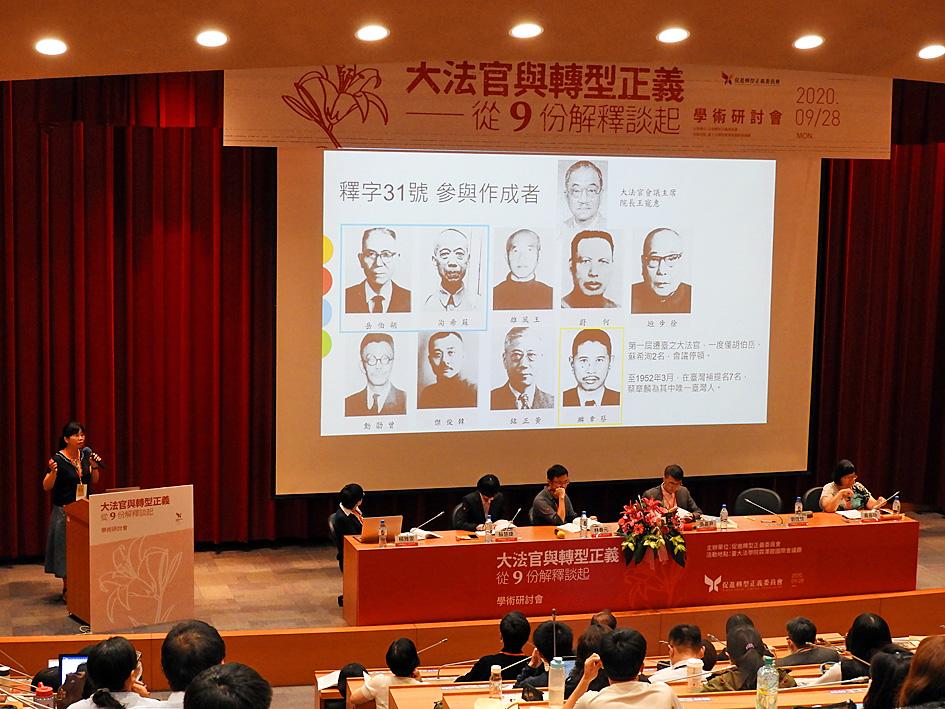
Photo: Chen Yu-fu, Taipei Times
Academics were invited to the conference to analyze the negative effects of the nine interpretations on constitutional democracy, Executive Yuan Human Rights Protection and Promotion Committee convener Lo Ping-cheng (羅秉成) said.
Whereas grand justices would rule independently in a functioning democracy, they served as puppets of the authoritarian government during the Martial Law era, he said.
The commission and the Judicial Yuan had deliberated on publishing details of the interpretations, and the latter agreed to first release nine of the interpretations with “some limitations,” such as keeping the names of the grand justices involved private, Lo said.
Interpretation No. 31, which concerned the establishment of the National Assembly, was completed in only five days, he said.
“As you can imagine, it would be impossible to thoroughly discuss the issue in that time frame. They probably had an answer before deliberating,” he said.
The KMT kept extending the terms of its legislators, thus “putting the ball in the grand justices’ court,” he said, adding that this gave the party’s political actions “the outward appearance of being legal.”
Deliberations on Interpretation No. 129, which touched upon the children of Chinese Communist Party members, were rare in that some grand justices opposed the KMT’s wishes, he said.
“One of the grand justices in opposition, Lin Chi-tung (林紀東), was lobbied to fall in line. Another grand justice told him directly: ‘This is an order from above,’” Lo said, adding that the KMT had party members sit in on the deliberations.
“Unfortunately, the name of the grand justice who lobbied Lin is one of those kept confidential by the Judicial Yuan. To this day the public still has no way of knowing who it was,” he said.
Historical facts and names should be public not to reprimand those involved with past injustices, but to let the public better understand how the past authoritarian government manipulated the judiciary, he said.
“Transitional democracy is being held captive. The Judicial Yuan should make the names and details of these constitutional interpretations public,” Democratic Progressive Party Legislator Fan Yun (范雲) said.
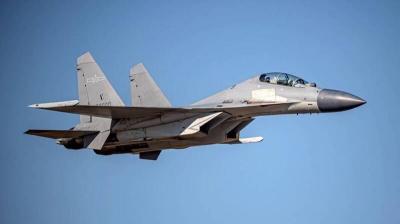
Eight Chinese naval vessels and 24 military aircraft were detected crossing the median line of the Taiwan Strait between 6am yesterday and 6am today, the Ministry of National Defense said this morning. The aircraft entered Taiwan’s northern, central, southwestern and eastern air defense identification zones, the ministry said. The armed forces responded with mission aircraft, naval vessels and shore-based missile systems to closely monitor the situation, it added. Eight naval vessels, one official ship and 36 aircraft sorties were spotted in total, the ministry said.
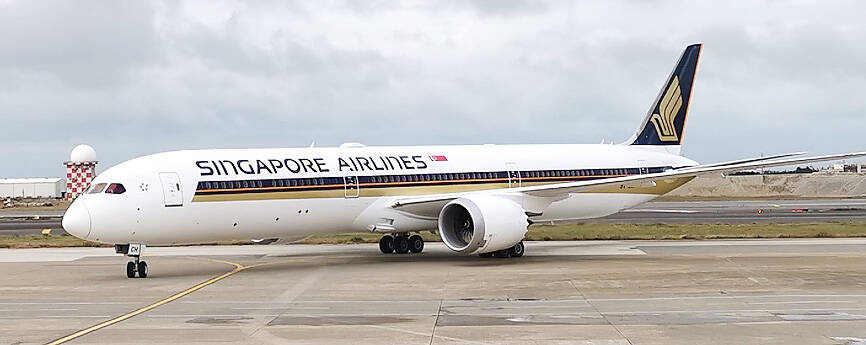
INCREASED CAPACITY: The flights on Mondays, Wednesdays, Fridays and Sundays would leave Singapore in the morning and Taipei in the afternoon Singapore Airlines is adding four supplementary flights to Taipei per week until May to meet increased tourist and business travel demand, the carrier said on Friday. The addition would raise the number of weekly flights it operates to Taipei to 18, Singapore Airlines Taiwan general manager Timothy Ouyang (歐陽漢源) said. The airline has recorded a steady rise in tourist and business travel to and from Taipei, and aims to provide more flexible travel arrangements for passengers, said Ouyang, who assumed the post in July last year. From now until Saturday next week, four additional flights would depart from Singapore on Monday, Wednesday, Friday
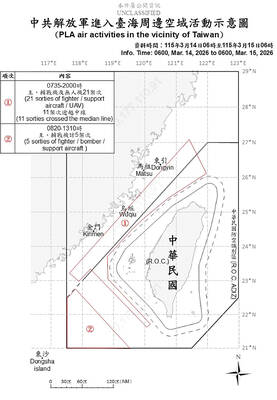
The Ministry of National Defense yesterday reported the return of large-scale Chinese air force activities after their unexplained absence for more than two weeks, which had prompted speculation regarding Beijing’s motives. China usually sends fighter jets, drones and other military aircraft around the nation on a daily basis. Interruptions to such routine are generally caused by bad weather. The Ministry of National Defense said it had detected 26 Chinese military aircraft in the Taiwan Strait over the previous 24 hours. It last reported that many aircraft on Feb. 25, when it spotted 30 aircraft, saying Beijing was carrying out another “joint combat
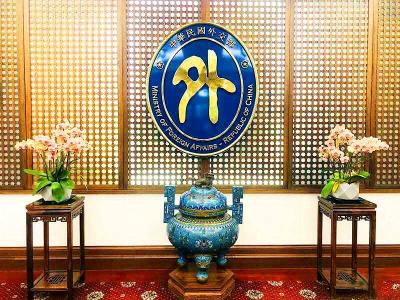
The Ministry of Foreign Affairs (MOFA) today said that if South Korea does not reply appropriately to its request to correct Taiwan’s name on its e-Arrival card system before March 31, it would take corresponding measures to alter how South Korea is labeled on the online Taiwan Arrival Card system. South Korea’s e-Arrival card system lists Taiwan as “China (Taiwan)” in the “point of departure” and “next destination” fields. The ministry said that it changed the nationality for South Koreans on Taiwan’s Alien Resident Certificates from “Korea” to “South Korea” on March 1, in a gesture of goodwill and based on the


 RSS
RSS