


An advertisement displayed in the corridor of the underground Taipei City Mall has caused contention online with social media users saying that it depicts Taiwanese bears as servants of Chinese pandas.
The advertisement — which imitates the style of an ancient Chinese painting, but replaces people with bears — shows a scene in imperial China, with Formosan black bears laboring, while pandas relax and enjoy beverages.
“The development of the tourism industry is important, but this type of targeted advertising is extremely disrespectful — and it makes people uncomfortable,” Democratic Progressive Party (DPP) Taipei City Councilor Chen E-jun (陳怡君) said.
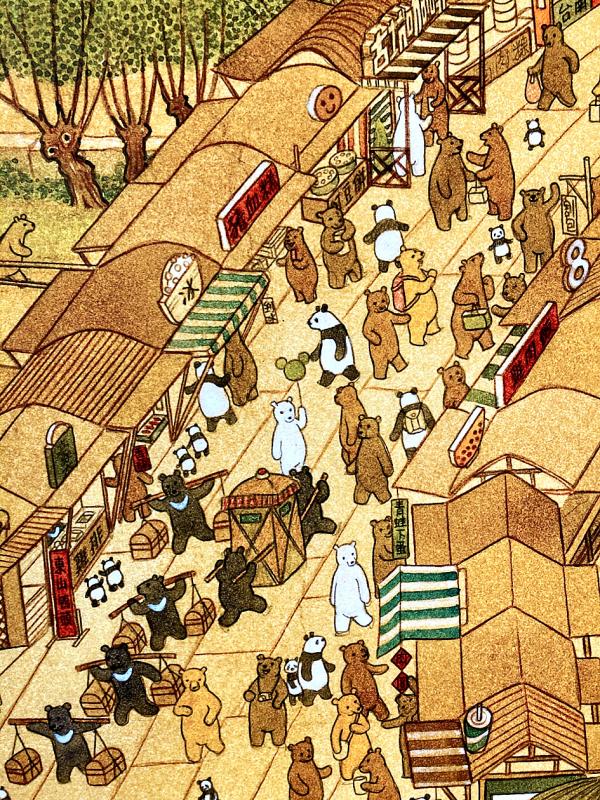
Photo courtesy of Taipei City Councilor Chen E-jun
The advertisement, under the purview of the Taiwan Railways Administration (TRA), intended to promote tourism, but it “denigrated the Formosan black bear,” which is Taiwan’s “national animal,” Chen added.
Given the Chinese military’s increased activity near Taiwan, the public is particularly sensitive about such depictions, she said.
Originally painted in 2014 by artist Chuang Hsin-tang (莊信棠), and titled Bears Along the River (熊熊上河圖), the painting is styled after Along the River During the Qingming Festival (清明上河圖), a work by Song Dynasty painter Zhang Zeduan (張擇端).
Chuang himself once said that the painting depicts the “current situation in Taiwan.”
The painting also shows foods that are typical in Taiwan, such as chicken cutlets, bubble tea, braised duck heads, glutinous rice cakes, Alishan tea and pig feet.
Asked for comment, the TRA said that the painting was a non-commercial advertisement placed for tourism purposes, and had been in place for two years.
Chuang in 2014 told the TRA that the painting showed common culture in Taiwan at the time, but given public concern, it has looked into replacing the advertisement, it said.

Considering that most countries issue more than five denominations of banknotes, the central bank has decided to redesign all five denominations, the bank said as it prepares for the first major overhaul of the banknotes in more than 24 years. Central bank Governor Yang Chin-lung (楊金龍) is expected to report to the Legislative Yuan today on the bank’s operations and the redesign’s progress. The bank in a report sent to the legislature ahead of today’s meeting said it had commissioned a survey on the public’s preferences. Survey results showed that NT$100 and NT$1,000 banknotes are the most commonly used, while NT$200 and NT$2,000

The Centers for Disease Control (CDC) yesterday reported the first case of a new COVID-19 subvariant — BA.3.2 — in a 10-year-old Singaporean girl who had a fever upon arrival in Taiwan and tested positive for the disease. The girl left Taiwan on March 20 and the case did not have a direct impact on the local community, it said. The WHO added the BA.3.2 strain to its list of Variants Under Monitoring in December last year, but this was the first imported case of the COVID-19 variant in Taiwan, CDC Deputy Director-General Lin Ming-cheng (林明誠) said. The girl arrived in Taiwan on

South Korea is planning to revise its controversial electronic arrival card, a step Taiwanese officials said prompted them to hold off on planned retaliatory measures, a South Korean media report said yesterday. A Yonhap News Agency report said that the South Korean Ministry of Foreign Affairs is planning to remove the “previous departure place” and “next destination” fields from its e-arrival card system. The plan, reached after interagency consultations, is under review and aims to simplify entry procedures and align the electronic form with the paper version, a South Korean ministry official said. The fields — which appeared only on the electronic form

The Ministry of Foreign Affairs (MOFA) is suspending retaliation measures against South Korea that were set to take effect tomorrow, after Seoul said it is updating its e-arrival system, MOFA said today. The measures were to be a new round of retaliation after Taiwan on March 1 changed South Korea's designation on government-issued alien resident certificates held by South Korean nationals to "South Korea” from the "Republic of Korea," the country’s official name. The move came after months of protests to Seoul over its listing of Taiwan as "China (Taiwan)" in dropdown menus on its new online immigration entry system. MOFA last week


 RSS
RSS