


The Taipei City Government yesterday said that a health department inspector last year had visited the site of a long-term care facility in Neihu District (內湖) after receiving a report questioning its status. A fire broke out at the facility on Tuesday afternoon, killing three people.
The Taipei Fire Department said that it received a report about a fire on the first floor of a four-story residential building on Kangning Road Sec. 1 at 2:38pm on Tuesday, firefighters arrived at 2:43pm and the fire was put out by 3:07pm.
The firefighters found three men in beds and rushed them to hospital for emergency treatment. Two of the men died on Tuesday and the third man died yesterday morning.
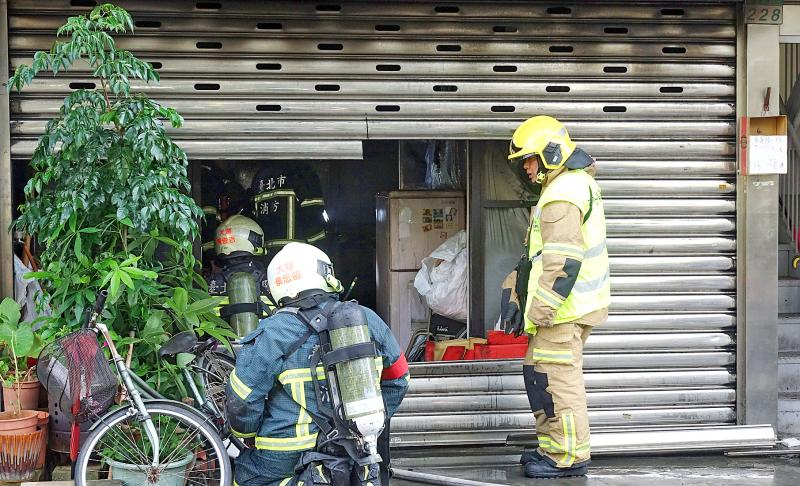
Photo: Chang Chia-ming, Taipei Times
The city’s departments of social welfare and health issued a joint news release late on Tuesday evening, saying that the long-term care facility was operated by a woman surnamed Ting (丁) and that it was not legally registered.
The three victims — aged 59, 69 and 70 — were physically disabled residents.
Ting, who was not in the house when the fire broke out, was taken by police for questioning on Tuesday evening.
Ting allegedly breached the Long-Term Care Services Act (長期照顧服務法) by operating an unregistered facility, as well as the Senior Citizens Welfare Act (老人福利法) for leaving elderly people who do not have the ability to care for themselves in an environment that is prone to danger or injuries.
Taipei Deputy Mayor Vivian Huang (黃珊珊) yesterday said that the warden of Ziyun Borough (紫雲), where the house is located, had called the city government’s 1999 hotline in August and September last year to ask if it was a legal facility.
A health department inspector, accompanied by the borough warden and police, went to the reported address on Sept. 17 last year.
The property was locked and when no one responded to their call and there did not appear to be any imminent danger, it was decided that police would continue to monitor the place for any suspected illegal behavior, Huang said.
The warden did not further report the facility as there were no complaints about the facility causing a disturbance to the community, and the health inspector did not mark the case for follow-up checks, she said.
“The person at fault is the one who broke the law,” Huang said, adding that although the inspection on the reported case was not effective, they should not be severely criticized.
The health department is trying to contact the investigator, who was a contracted personnel, to clarify why there was no follow-up on the case.
Additional reporting by CNA

LOUD AND PROUD Taiwan might have taken a drubbing against Australia and Japan, but you might not know it from the enthusiasm and numbers of the fans Taiwan might not be expected to win the World Baseball Classic (WBC) but their fans are making their presence felt in Tokyo, with tens of thousands decked out in the team’s blue, blowing horns and singing songs. Taiwanese fans have packed out the Tokyo Dome for all three of their games so far and even threatened to drown out home team supporters when their team played Japan on Friday. They blew trumpets, chanted for their favorite players and had their own cheerleading squad who dance on a stage during the game. The team struggled to match that exuberance on the field, with
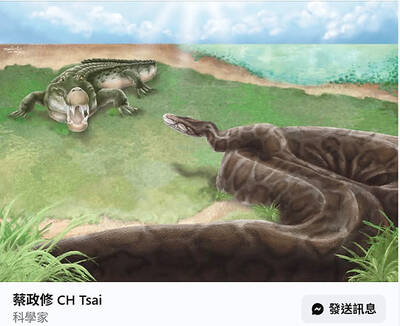
Taiwanese paleontologists have discovered fossil evidence that pythons up to 4m long inhabited Taiwan during the Pleistocene epoch, reporting their findings in the international scientific journal Historical Biology. National Taiwan University (NTU) Institute of Ecology and Evolutionary Biology associate professor Tsai Cheng-hsiu (蔡政修) led the team that discovered the largest snake fossil ever found in Taiwan. The single trunk vertebra was discovered in Tainan at the Chiting Formation, dated to between 400,000 and 800,000 years ago in the Middle Pleistocene, the paper said. The area also produced Taiwan’s first avian fossil, as well as crocodile, mammoth, saber-toothed cat and rhinoceros fossils, it said. Discoveries

Taiwanese paleontologists have discovered fossil evidence that pythons up to 4m long inhabited Taiwan during the Pleistocene epoch, reporting their findings in the international scientific journal Historical Biology. National Taiwan University (NTU) Institute of Ecology and Evolutionary Biology associate professor Tsai Cheng-hsiu (蔡政修) led the team that discovered the largest snake fossil ever found in Taiwan. A single trunk vertebra was discovered in Tainan at the Chiting Formation, dated to between 800,000 to 400,000 years ago in the Middle Pleistocene, the paper said. The area also produced Taiwan’s first avian fossil, as well as crocodile, mammoth, sabre-toothed cat and rhinoceros fossils, it said. Discoveries

Whether Japan would help defend Taiwan in case of a cross-strait conflict would depend on the US and the extent to which Japan would be allowed to act under the US-Japan Security Treaty, former Japanese minister of defense Satoshi Morimoto said. As China has not given up on the idea of invading Taiwan by force, to what extent Japan could support US military action would hinge on Washington’s intention and its negotiation with Tokyo, Morimoto said in an interview with the Liberty Times (sister paper of the Taipei Times) yesterday. There has to be sufficient mutual recognition of how Japan could provide


 RSS
RSS