


The continued detention of four legislators, who were yesterday indicted for bribery, requires approval from the Legislative Yuan, as the legislative session has begun, Legislative Yuan Secretary-General Lin Chih-chia (林志嘉) said yesterday.
Su Chen-ching (蘇震清) of the Democratic Progressive Party (DPP), Chen Chao-ming (陳超明) and Sufin Siluko (廖國棟) of the Chinese Nationalist Party (KMT), and independent Legislator Chao Cheng-yu (趙正宇) were detained last month while the legislature was in recess.
“If the Taipei District Court decides to extend the detention of the four sitting legislators, then the court must ask for permission through an official letter. Then Legislative Speaker You Si-kun (游錫堃) would convene cross-party negotiations to deliberate on the matter,” Lin said.
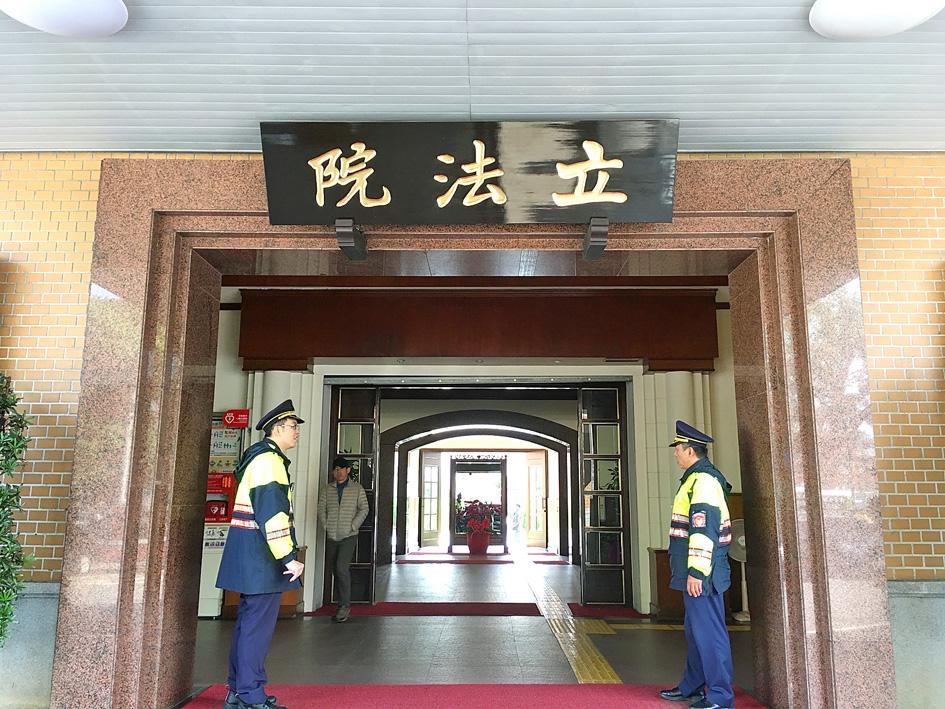
Photo: Lin Liang-sheng, Taipei Times
Lin cited the Additional Articles to the Constitution, which state that “no member of the Legislative Yuan may be arrested or detained without the permission of the Legislative Yuan, when that body is in session.”
Given that such a situation has not previously occurred, “the Judicial Yuan and prosecutors should discuss it. In theory, the judiciary should seek the legislature’s permission to extend the detention, so the legislative speaker would have to look into the matter,” DPP caucus whip Cheng Yun-peng (鄭運鵬) said.
Attorney Lin Chun-feng (林俊峰) said that the Constitution provides ways to resolve conflicts between government branches, but “this case concerns corruption and bribe-taking by legislators, and is not a political dispute.”
“If needed, it could go to the Council of Grand Justices for a constitutional interpretation,” Lin added.
In response to the indictment, the DPP’s anti-corruption committee said in a statement that Su’s party privileges had already been suspended for three years, and he could face further punishment depending the outcome of the case.
KMT caucus officials said that they would respect the judicial process.
“This case has dealt a serious blow to public trust and regard for legislators. It is time to amend the conduct rules to dismiss legislators from office when they are convicted in court. We must work to prevent Taiwan’s politics from being controlled by big business,” the Taiwan People’s Party said in a statement.
Former New Power Party (NPP) legislator Hsu Yung-ming (徐永明) was also indicted in the same case. He last month resigned from the party chairmanship and quit the party.
The NPP said in a statement that it was deeply sorry for the indictment of its former party chairman, as it has caused such a disturbance to the public.
“Aside from waiting for the final verdict in the lawsuit, we are to push for structural reform in the party with the most serious and cautious attitude possible,” it said.
Members of the NPP’s policymaking committee have already detailed reforms to its anti-corruption guidelines, it said, adding that it hopes the changes would help the party meet public expectations.
Additional reporting by Shelley Shan

Considering that most countries issue more than five denominations of banknotes, the central bank has decided to redesign all five denominations, the bank said as it prepares for the first major overhaul of the banknotes in more than 24 years. Central bank Governor Yang Chin-lung (楊金龍) is expected to report to the Legislative Yuan today on the bank’s operations and the redesign’s progress. The bank in a report sent to the legislature ahead of today’s meeting said it had commissioned a survey on the public’s preferences. Survey results showed that NT$100 and NT$1,000 banknotes are the most commonly used, while NT$200 and NT$2,000

The Centers for Disease Control (CDC) yesterday reported the first case of a new COVID-19 subvariant — BA.3.2 — in a 10-year-old Singaporean girl who had a fever upon arrival in Taiwan and tested positive for the disease. The girl left Taiwan on March 20 and the case did not have a direct impact on the local community, it said. The WHO added the BA.3.2 strain to its list of Variants Under Monitoring in December last year, but this was the first imported case of the COVID-19 variant in Taiwan, CDC Deputy Director-General Lin Ming-cheng (林明誠) said. The girl arrived in Taiwan on

South Korea is planning to revise its controversial electronic arrival card, a step Taiwanese officials said prompted them to hold off on planned retaliatory measures, a South Korean media report said yesterday. A Yonhap News Agency report said that the South Korean Ministry of Foreign Affairs is planning to remove the “previous departure place” and “next destination” fields from its e-arrival card system. The plan, reached after interagency consultations, is under review and aims to simplify entry procedures and align the electronic form with the paper version, a South Korean ministry official said. The fields — which appeared only on the electronic form

The Ministry of Foreign Affairs (MOFA) is suspending retaliation measures against South Korea that were set to take effect tomorrow, after Seoul said it is updating its e-arrival system, MOFA said today. The measures were to be a new round of retaliation after Taiwan on March 1 changed South Korea's designation on government-issued alien resident certificates held by South Korean nationals to "South Korea” from the "Republic of Korea," the country’s official name. The move came after months of protests to Seoul over its listing of Taiwan as "China (Taiwan)" in dropdown menus on its new online immigration entry system. MOFA last week


 RSS
RSS