


President Tsai Ing-wen’s (蔡英文) administration is just paying lip service to Hong Kong’s protesters, and it needs to enact legislation to provide them with “more substantial and due protection,” the Chinese Nationalist Party (KMT) said yesterday.
“Before the [Jan. 11 presidential election], the Tsai administration told everyone that it supports Hong Kong, but so far the Tsai administration’s support for Hong Kong appears to be just talk,” KMT Culture and Communications Committee director-general Alicia Wang (王育敏) told a news conference in Taipei.
With a new session at the Legislative Yuan set to open on Friday, “we hope that the Tsai administration will come up with specific measures to give Hong Kong friends more specific legal protection,” Wang said.
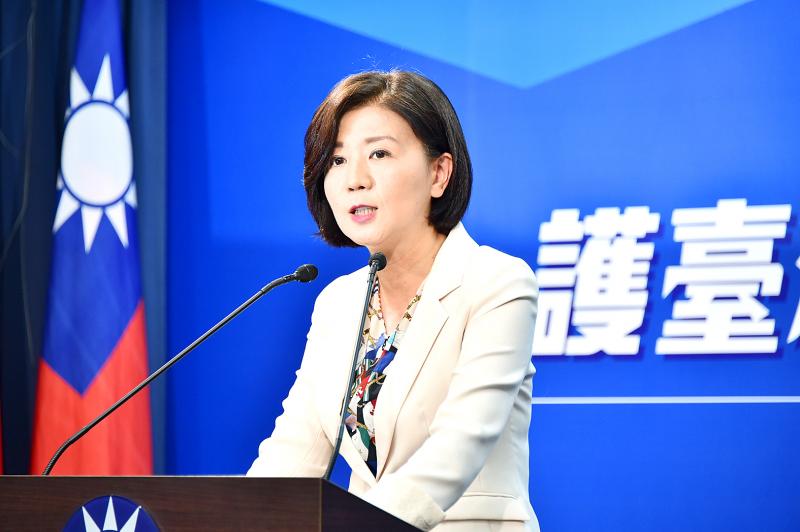
Photo: Tu Chien-jung, Taipei Times
The KMT is calling on Tsai and her Democratic Progressive Party (DPP) administration to “give them more substantial and due protection through legislation,” she said.
Since Taiwan does not have a refugee asylum law, there is no “principled law” to deal with cases where people have come to Taiwan under emergency circumstances to seek asylum for political reasons, KMT Legislator Chen I-hsin (陳以信) told the news conference.
Article 18 of the Act Governing Relations With Hong Kong and Macau (香港澳門關係條例) gives the government the ability to, under emergency situations, provide “necessary assistance” to residents of Hong Kong or Macau whose safety is threatened because of political reasons, Chen said.
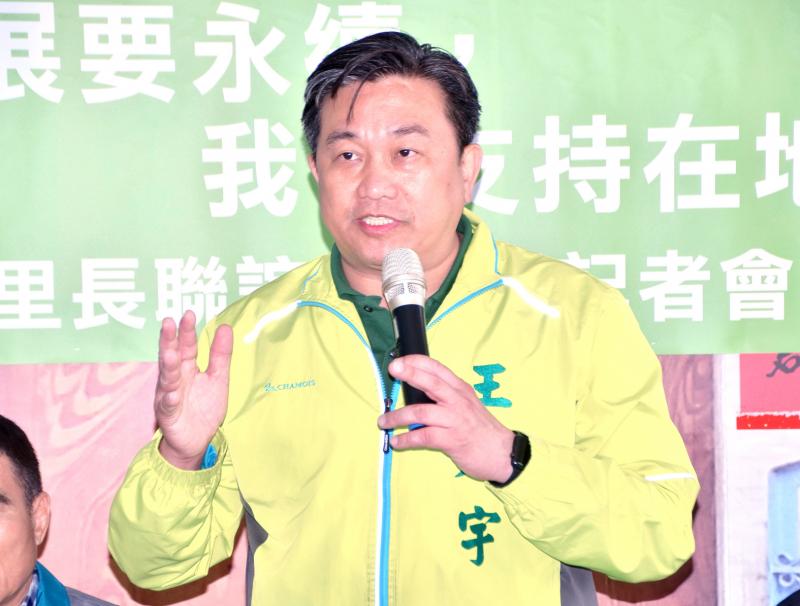
Photo: Wu Chun-feng, Taipei Times
However, it is not clear if the term “necessary assistance” means that Taiwan’s immigration laws could be circumvented, as Article 74 of the Immigration Act (入出國及移民法) stipulates that people who enter the nation without permission can be punished by up to three years in prison, he said.
A draft amendment to Article 18 of the Hong Kong and Macau act that he and other KMT lawmakers proposed in May would give the government a “legal basis” to deal with the issue, through “minimal amendments,” he said.
The Tsai administration’s Hong Kong Humanitarian Aid Project only applies to people who enter Taiwan legally, he said.
However, the people who are truly in need of humanitarian or emergency assistance are unable to travel legally, he added.
“Although on the surface the Tsai administration says it wants to support Hong Kong, in reality, it appears to be taking advantage of Hong Kong,” Chen said.
The DPP should prioritize the proposed amendments to the Hong Kong and Macau act in the upcoming session, he said.
Additional reporting by CNA

Taiwan has received more than US$70 million in royalties as of the end of last year from developing the F-16V jet as countries worldwide purchase or upgrade to this popular model, government and military officials said on Saturday. Taiwan funded the development of the F-16V jet and ended up the sole investor as other countries withdrew from the program. Now the F-16V is increasingly popular and countries must pay Taiwan a percentage in royalties when they purchase new F-16V aircraft or upgrade older F-16 models. The next five years are expected to be the peak for these royalties, with Taiwan potentially earning
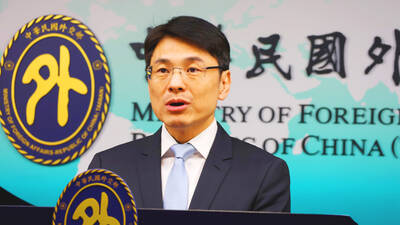
STAY IN YOUR LANE: As the US and Israel attack Iran, the ministry has warned China not to overstep by including Taiwanese citizens in its evacuation orders The Ministry of Foreign Affairs (MOFA) yesterday rebuked a statement by China’s embassy in Israel that it would evacuate Taiwanese holders of Chinese travel documents from Israel amid the latter’s escalating conflict with Iran. Tensions have risen across the Middle East in the wake of US and Israeli airstrikes on Iran beginning Saturday. China subsequently issued an evacuation notice for its citizens. In a news release, the Chinese embassy in Israel said holders of “Taiwan compatriot permits (台胞證)” issued to Taiwanese nationals by Chinese authorities for travel to China — could register for evacuation to Egypt. In Taipei, the ministry yesterday said Taiwan
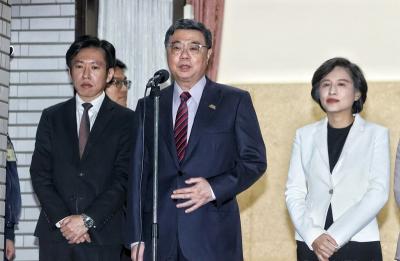
Taiwan is awaiting official notification from the US regarding the status of the Agreement on Reciprocal Trade (ART) after the US Supreme Court ruled US President Donald Trump's global tariffs unconstitutional. Speaking to reporters before a legislative hearing today, Premier Cho Jung-tai (卓榮泰) said that Taiwan's negotiation team remains focused on ensuring that the bilateral trade deal remains intact despite the legal challenge to Trump's tariff policy. "The US has pledged to notify its trade partners once the subsequent administrative and legal processes are finalized, and that certainly includes Taiwan," Cho said when asked about opposition parties’ doubts that the ART was
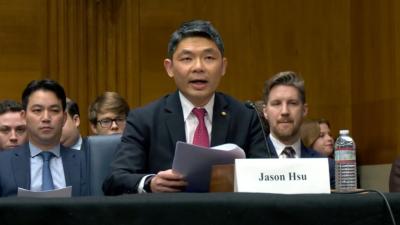
If China chose to invade Taiwan tomorrow, it would only have to sever three undersea fiber-optic cable clusters to cause a data blackout, Jason Hsu (許毓仁), a senior fellow at the Hudson Institute and former Chinese Nationalist Party (KMT) legislator, told a US security panel yesterday. In a Taiwan contingency, cable disruption would be one of the earliest preinvasion actions and the signal that escalation had begun, he said, adding that Taiwan’s current cable repair capabilities are insufficient. The US-China Economic and Security Review Commission (USCC) yesterday held a hearing on US-China Competition Under the Sea, with Hsu speaking on


 RSS
RSS