


An oceanographer has explained the reason for the formation of the “Milk Sea” (牛奶海) — an ocean area off the coast of Yilan County that has become a tourist hotspot because of its milk-colored water.
The Milk Sea near Turtle Island (Gueishan Island, 龜山島) is caused by the combination of seawater and a saltwater hot spring, Lin Yu-shih (林玉詩), an associate professor at National Sun Yat-sen University’s Department of Oceanography, said in an article posted on Facebook by the Oceanographic Society on Tuesday last week.
Researchers found that the Milk Sea contains particular bacteria that efficiently facilitate carbon fixation, a process in which the sulfur from hot spring water reacts with oxygen, forming a special hydrothermal ecosystem, Lin said.
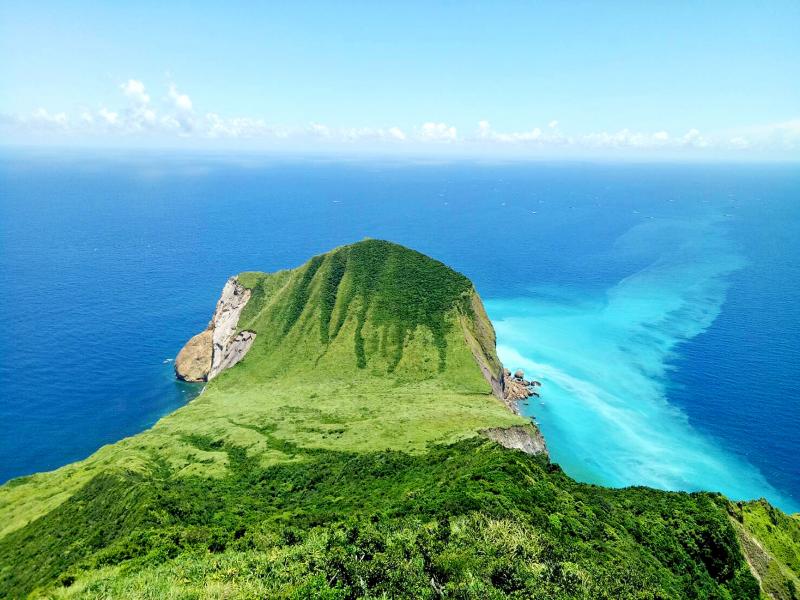
Photo: Chang Yi-chen, Taipei Times
Compared with seawater’s pH of 8, the Milk Sea only has a pH of 6, slightly more than buttermilk, she said, adding that hot spring water in the region can even have a pH as low as 1.5.
“Soaking in the [Milk Sea] for a prolonged period could have an effect similar to a chemical peel,” she added.
Although “sourer,” the Milk Sea has coral, because hot spring water is mixed with seawater as it gradually rises, she said, adding that water below the white-colored surface is actually no different from regular seawater.
The Milk Sea has complex waves and currents that befuddle even fishermen, and an instantaneous flow rate of up to 70cm, so after some time in the water, it is possible for people to inadvertently drift to the Japanese island of Ishigaki, she said.
Tidal vortexes in the area mean the milk-colored water circulates only within a certain range, occasionally creating some beautiful patterns, she said.
In 2000, a research team found a 2m hydrothermal vent on the seafloor of the area that discharged an extremely large quantity of geothermal water, but the vent has since been buried by falling rocks, she said.
Rock falls, landslides, as well as changing tides, currents and hydrothermal vents are factors contributing to the changing boundaries of the Milk Sea as observed every year, she said.
As Turtle Island is an active volcano, people need not worry that the Milk Sea will disappear if more hydrothermal vents in the area are buried by falling rocks, because new vents are being created by the continuous magmatic activity there, she said.
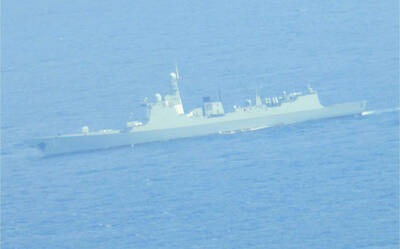
The military has spotted two Chinese warships operating in waters near Penghu County in the Taiwan Strait and sent its own naval and air forces to monitor the vessels, the Ministry of National Defense (MND) said. Beijing sends warships and warplanes into the waters and skies around Taiwan on an almost daily basis, drawing condemnation from Taipei. While the ministry offers daily updates on the locations of Chinese military aircraft, it only rarely gives details of where Chinese warships are operating, generally only when it detects aircraft carriers, as happened last week. A Chinese destroyer and a frigate entered waters to the southwest
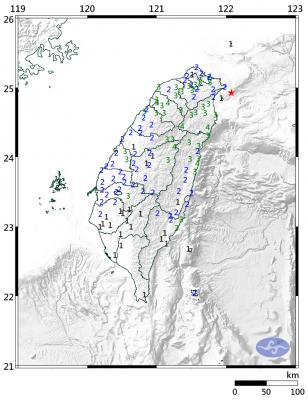
A magnitude 6.1 earthquake struck off the coast of Yilan County at 8:39pm tonight, the Central Weather Administration (CWA) said, with no immediate reports of damage or injuries. The epicenter was 38.7km east-northeast of Yilan County Hall at a focal depth of 98.3km, the CWA’s Seismological Center said. The quake’s maximum intensity, which gauges the actual physical effect of a seismic event, was a level 4 on Taiwan’s 7-tier intensity scale, the center said. That intensity level was recorded in Yilan County’s Nanao Township (南澳), Hsinchu County’s Guansi Township (關西), Nantou County’s Hehuanshan (合歡山) and Hualien County’s Yanliao (鹽寮). An intensity of 3 was

Japanese Prime Minister Sanae Takaichi’s comment last year on Tokyo’s potential reaction to a Taiwan-China conflict has forced Beijing to rewrite its invasion plans, a retired Japanese general said. Takaichi told the Diet on Nov. 7 last year that a Chinese naval blockade or military attack on Taiwan could constitute a “survival-threatening situation” for Japan, potentially allowing Tokyo to exercise its right to collective self-defense. Former Japan Ground Self-Defense Force general Kiyofumi Ogawa said in a recent speech that the remark has been interpreted as meaning Japan could intervene in the early stages of a Taiwan Strait conflict, undermining China’s previous assumptions
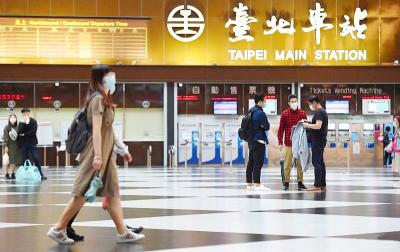
Taiwan Railways Corp (TRC) today announced that Shin Kong Mitsukoshi has been selected as the preferred bidder to operate the Taipei Railway Station shopping mall, replacing the current operator, Breeze Development Co Ltd. Among eight qualified firms that delivered presentations and were evaluated by a review committee, Shin Kong Mitsukoshi was ranked first, while Breeze was named the runner-up, the rail company said in a statement. Contract negotiations are to proceed in accordance with regulations, it said, adding that if negotiations with the top bidder fail, it could invite the second-ranked applicant to enter talks. Breeze in a statement today expressed doubts over


 RSS
RSS